
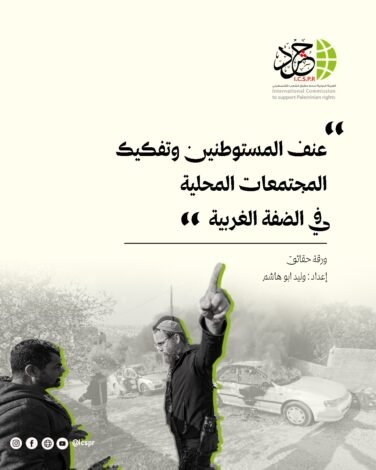
ICSPR: Settler Violence Is a Tool for Forcible Displacement and the Dismantling of Palestinian Communities in the West Bank

Date: 6 October 2026
Press Release
ICSPR: Settler Violence Is a Tool for Forcible Displacement and the Dismantling of Palestinian Communities in the West Bank
The International Commission to Support Palestinian Rights (ICSPR) has issued a fact sheet titled “Settler Violence and the Dismantling of Local Communities in the West Bank.” It examines patterns of attacks on Palestinians, their property, and their resources, and the consequences for the continued existence of Bedouin, pastoral, and agricultural communities. The paper warns that these attacks are becoming a tool for imposing forcible displacement and changing the geographic and demographic landscape. It calls for urgent protection on the ground and accountability for those responsible for carrying out, financing, and supporting the attacks.
Through the paper, the Commission affirms that settler violence cannot be treated as isolated individual incidents detached from the context of settlement expansion and control over land. Instead, its cumulative effects in destroying the foundations of life and forcing residents to leave their communities must be considered. It argues that targeting homes, grazing land, water sources, roads, and services creates a coercive environment that makes it increasingly difficult and dangerous for Palestinians to remain on their land.
The paper reviews cumulative data on attacks in the West Bank from October 2023 to September 2026, citing more than 62,000 attacks carried out by occupying forces and settlers combined, including more than 11,000 during the first half of 2026. It clarifies that these figures include attacks by both the military and settlers and are not limited to settler attacks alone.
According to the data presented in the paper, settler attacks, demolition orders, and the destruction of infrastructure have contributed to the dismantling and evacuation of more than 38 local and Bedouin communities and the displacement of more than 4,800 Palestinians. ICSPR stresses that the loss of these communities means more than the loss of shelter: it means uprooting communities from their land, livelihoods, and social relationships built over generations.
The paper examines various forms of attack, including shooting, night-time raids, beatings and intimidation, the burning of homes and vehicles, damage to agricultural facilities, theft of livestock and equipment, and the severing of water networks. It explains that the recurrence of these practices places residents in a constant state of fear and restricts their ability to work, travel, and access essential services.
The paper gives particular attention to pastoral settlement outposts as a means of controlling extensive areas beyond the boundaries of the structures established within them. It explains that building livestock enclosures and settlement sites on Palestinian grazing land, then preventing Palestinian herders from approaching them, deprives surrounding communities of essential resources and sharply increases the cost of obtaining fodder and water.
In this context, the paper reports the imposition of effective control over more than 600,000 dunums of agricultural and grazing land, denying Palestinians its use through the expansion of settlement outposts, armed force, and land closures under various designations. ICSPR argues that this deprivation links land seizure to the destruction of the local economy, pushing families to leave after losing their ability to sustain their livelihoods.
In the agricultural sector, the paper presents data on the uprooting, bulldozing, and burning of more than 85,000 olive and other fruit trees, as well as the demolition or partial or complete destruction of more than 2,100 homes, agricultural facilities, and livestock enclosures during the period covered. It also cites losses involving the death, theft, and killing of more than 8,500 livestock and farm animals. The Commission stresses that these attacks undermine income sources and food security and cannot be separated from the pressures facing communities seeking to remain on their land.
The paper explains that preventing herders and farmers from accessing their land turns their economic activities into a continuing burden, forcing some families to sell their livestock and abandon their sources of income. The destruction of water networks, energy sources, and equipment also increases communities’ dependence on external assistance and weakens their ability to sustain themselves independently.
ICSPR warns that forcible displacement breaks family and social ties and transforms productive, established households into displaced groups lacking property, income, and protection. It stresses that addressing these consequences requires protecting local communities as social and economic units, rather than merely providing temporary assistance to individuals after their displacement.
The paper also examines the effects of attacks and road closures on education and health. It highlights the dangers students and teachers face when travelling to school, the isolation of communities, and the obstruction of medical teams and ambulances. It argues that these conditions increase the vulnerability of children, pregnant women, and older people and deepen the harm caused by the loss of security and livelihoods.
On accountability, the paper presents human rights data indicating that more than 93% of investigations into settler attacks on Palestinians and their property are closed without indictments. ICSPR considers that the absence of accountability encourages repeated attacks and undermines victims’ confidence in obtaining redress, particularly when accompanied by financial and administrative support for settlement outposts or protection for attackers.
In its legal analysis, the Commission affirms that the classification of some outposts as unauthorised under Israeli procedures does not confer legality on other settlements under international law. It also argues that the forcible transfer of populations, the destruction of property, and organised attacks on civilians warrant investigation and accountability for war crimes and, where the relevant legal elements are met, crimes against humanity.
ICSPR stresses the responsibility of the occupying power to protect civilians, prevent attacks against them, investigate violations, and hold perpetrators accountable. In accordance with the analysis presented in the paper, it rejects treating settler violence as separate from the responsibility of authorities that finance, support, or provide protection for it.
The Commission calls for international measures that go beyond condemnation, including sanctions against those involved in organising and financing attacks and arming their perpetrators, through travel bans and asset freezes. It also calls for banning settlement products, ending investments that support settlement activities, and preventing the supply of weapons and equipment that could be used to attack civilians.
The paper recommends prioritising settler violence and forcible displacement within international criminal investigations and strengthening the documentation of incidents, the names of those responsible, and the outposts associated with attacks. This would enable evidence to be used in international and national accountability proceedings, including under universal jurisdiction.
Regarding protection on the ground, ICSPR calls for an international monitoring presence and civilian protection in communities most exposed to attacks and displacement, alongside the activation of community protection committees and early-warning mechanisms to support residents. It stresses that preventing displacement requires intervention before communities are dismantled, rather than limiting action to humanitarian assistance after residents have left.
The paper also proposes establishing a national emergency fund to support farmers and herders, provide fodder, water, and solar power, repair damaged homes and networks, and deliver legal and medical assistance. It calls for support in securing legal recognition and documentation of land ownership and protecting documents and records as part of safeguarding rights and confronting property seizures.
ICSPR affirms that protecting Palestinian local communities requires combining an end to attacks with an end to impunity and support for the conditions that enable residents to remain on their land. It stresses that continued displacement and the destruction of livelihoods threaten the social fabric and Palestinian presence, and that protecting civilians and their rights to land, housing, and work requires an urgent response linked to effective legal accountability.