
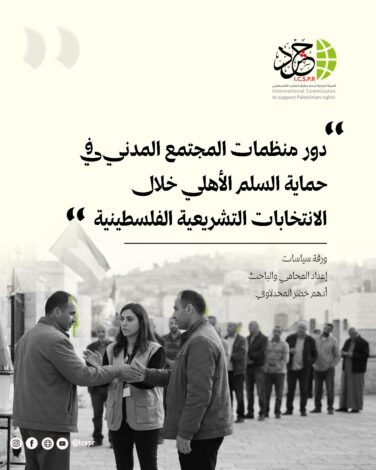
ICSPR Publishes a Policy Paper Entitled “The Role of Civil Society Organizations in Protecting Civil Peace ”

Date: 22 November 2026
Press Release
ICSPR Publishes a Policy Paper Entitled “The Role of Civil Society Organizations in Protecting Civil Peace”
The International Commission to Support Palestinian Rights (ICSPR) has published a policy paper entitled “The Role of Civil Society Organizations in Protecting Civil Peace During Palestinian Legislative Elections,” prepared by lawyer and researcher Adham Khader Al-Majdalawi. The paper calls for the adoption of a comprehensive national plan to prevent electoral disputes, strengthen independent oversight, safeguard freedom of choice and equal opportunities, and ensure that disagreements are addressed through the law and the competent institutions.
The Commission emphasizes that protecting civil peace is not a security or administrative objective separate from the democratic process. Rather, it is an obligation linked to safeguarding political and civil rights and enabling citizens and candidates to participate without fear, coercion, or discrimination. It further stresses that electoral integrity should not be measured solely by the proper conduct of voting and counting procedures, but also by the existence of an environment that protects pluralism and public freedoms, guarantees access to remedies and accountability, and respects the will of the people.
Occupation, Division, and the Consequences of War: Challenges to Equal Participation
The paper examines the legal, political, and social risks that may threaten civil peace throughout the various stages of the electoral process. These include Israeli restrictions on movement, assembly, and public activities; political and geographical division; declining public confidence in institutions; and the consequences of the war on the Gaza Strip, including destruction, displacement, loss of livelihoods, and disruption of essential services.
ICSPR explains that these circumstances affect the ability of voters, candidates, and observers to access different areas, communicate, and organize activities, making it more difficult to guarantee equal participation across all regions, particularly in the Gaza Strip and East Jerusalem.
The paper calls for incorporating these challenges into the planning of any future electoral process and avoiding the reduction of the causes of tension to local disputes alone. It emphasizes the need to distinguish between restrictions imposed by the occupation and national responsibilities related to protecting freedoms and managing political competition in accordance with the law. It also stresses that exceptional circumstances must not become a permanent justification for excluding any group or population from participation.
A National Coordination Framework and Early Warning System to Prevent the Escalation of Disputes
The paper proposes establishing a national coordination framework to protect civil peace during elections, bringing together civil society organizations, human rights institutions, the body responsible for administering elections, relevant legal and community stakeholders, and representatives of youth and women’s sectors, while respecting the mandate and independence of each entity.
The proposal includes developing a protocol defining responsibilities and mechanisms for communication, referral, and intervention; establishing local coordination committees; and holding regular meetings before, during, and after elections and the announcement of results. These measures would enable tensions to be monitored and addressed through an early and organized response.
The paper also calls for developing a professional early warning system based on verifiable information concerning threats, assaults, incitement, and disputes related to electoral competition. This would include establishing an incident registry and clear response levels, beginning with monitoring and preventive intervention and extending to urgent coordination with the competent authorities when an imminent threat arises, while safeguarding privacy, data confidentiality, and the safety of witnesses and whistleblowers.
Combating Incitement Must Not Justify Restrictions on Political Criticism
ICSPR warns against electoral competition turning into social or family polarization when accompanied by accusations of disloyalty, defamation, threats, and exclusion, or when media outlets and digital platforms are exploited to spread misinformation and incite violence.
The paper emphasizes the importance of distinguishing between legitimate political criticism, which is protected by freedom of opinion and expression, and threats, incitement to violence, and violations of the rights of others. It stresses that combating incitement or protecting public order must not become a pretext for silencing peaceful opposition or imposing disproportionate restrictions on expression, assembly, and political participation.
In this context, the paper proposes ongoing awareness-raising programmes and accessible educational materials on the rights of voters and candidates and procedures for submitting complaints and appeals. It also calls for engaging journalists, content creators, educational institutions, and community leaders in countering rumours and promoting a culture of pluralism and respect for differences.
Mediation Complements Accountability and Is Not a Substitute for the Judiciary
The paper recognizes the role of dialogue and community mediation in containing disputes between supporters of electoral lists and candidates and transforming personal or family confrontations into peaceful political discussions. However, it emphasizes that mediation must be voluntary and impartial and must not be used to pressure affected individuals or force them to waive their rights.
ICSPR calls for referring incidents involving crimes, serious threats, or violations requiring accountability to the competent authorities, rather than relying solely on customary settlements or treating temporary de-escalation as evidence that the underlying causes of disputes have been addressed.
The paper also proposes establishing legal contact points to receive reports, adopting standardized documentation forms and clear referral protocols, providing free legal consultations, following up on complaints, and informing complainants of the available procedures, while respecting confidentiality and the parties’ rights to respond and appeal in accordance with due process.
Civil Society Independence Is Essential for Effective Oversight
The paper explains that the effectiveness of civil society’s role requires protecting freedom of association, expression, and fieldwork; providing adequate resources and qualified personnel; and ensuring that organizations are not subjected to partisan or funding-related directives that undermine their professionalism.
It emphasizes that independence cannot be achieved merely by declaring neutrality. Rather, it must be demonstrated through verifiable practices, including financial and administrative transparency, disclosure of conflicts of interest, publication of working methodologies and criteria for selecting target areas and groups, and the equal application of oversight standards to all parties.
ICSPR calls for supporting small local organizations, particularly in areas affected by war or subject to movement restrictions, and training staff and observers in documentation, verification, conflict analysis, mediation, and nonviolent communication. It also recommends adopting plans to ensure operational continuity and protect data, personnel, and affected individuals.
Meaningful Participation of Women, Youth, Persons with Disabilities, and Displaced People
The paper stresses that protecting civil peace requires ensuring that political participation is not limited to groups with greater access to resources and public platforms. Instead, it must include women, youth, persons with disabilities, displaced people, and those affected by the war.
It proposes assessing the social, economic, and environmental barriers to their participation; organizing listening sessions to identify their priorities and concerns; providing safe and accessible venues, appropriate awareness materials, and reasonable accommodations; and monitoring threats, defamation, and social pressure targeting female candidates and activists.
The paper also emphasizes the importance of involving representatives of these groups in designing, implementing, and evaluating programmes, rather than settling for merely symbolic participation that has no real impact on their opportunities to influence and contribute to decision-making.
Measuring Success Through Impact, Not the Number of Activities and Statements
The paper highlights a potential gap between the declared roles of civil society organizations and the results that can actually be demonstrated. It stresses that organizing workshops, publishing reports, or holding dialogue sessions does not, in itself, prove a reduction in violence or improved protection of rights.
It calls for adopting indicators that measure improvements in citizens’ knowledge of their rights, increased use of complaint and appeal mechanisms, the speed of official responses, reductions in threats and incitement, and the extent to which recommendations are implemented and violations addressed. It also emphasizes the need to distinguish the impact of civil society interventions from the influence of other political, security, and social factors.
Drawing on previous Palestinian electoral experiences, the paper concludes that elections alone cannot guarantee democratic stability unless they are accompanied by respect for electoral results within legal frameworks, the continued functioning of representative institutions, the neutrality of competent authorities, and effective guarantees for dispute resolution and access to remedies.
The International Commission to Support Palestinian Rights (ICSPR) concludes by emphasizing the need to translate the proposed policies into an actionable national plan with specific objectives, clearly defined responsibilities, adequate resources, timelines, and independent review and evaluation mechanisms. Such a plan should begin before elections and continue throughout electoral campaigns, voting, the announcement of results, and the post-election period.
The Commission stresses that genuine success lies in creating an environment in which citizens and candidates can exercise their rights freely and safely, civil society organizations can fulfil their roles independently and professionally, and objections and disputes are addressed through legal and peaceful channels, without sacrificing justice or fundamental freedoms under any pretext.
To read the full policy paper, click here.