
Civil peace can no longer be treated as a marginal social issue or a security matter confined to controlling weapons and preventing crime and inter-family violence. Nor can it be reduced to a reconciliation agreement between political forces. Rather, it lies in society’s ability to manage its differences peacefully, protect its members from violence and arbitrary treatment, and ensure their access to justice

Date: 5 October 2026
Press Release
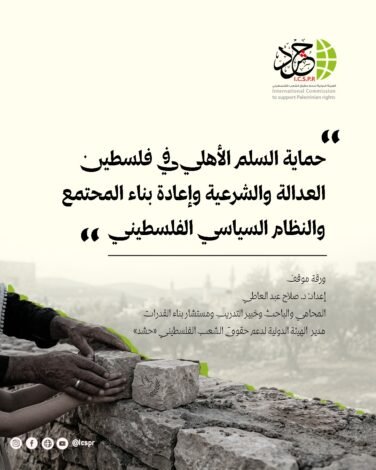
The International Commission to Support Palestinian Rights (ICSPR) has issued a position paper titled “Protecting Civil Peace in Palestine: Justice, Legitimacy, and Rebuilding Society and the Palestinian Political System,” prepared by Dr. Salah Abdel Ati, lawyer, researcher, and Director of the Commission. The paper presents a vision for addressing the challenges threatening social cohesion by linking the rule of law, the protection of rights and freedoms, justice for victims, institutional reform, and the renewal of political legitimacy.
In the paper, Dr. Salah Abdel Ati affirms that civil peace can no longer be treated as a marginal social issue or a security matter confined to controlling weapons and preventing crime and inter-family violence. Nor can it be reduced to a reconciliation agreement between political forces. He explains that its essence lies in society’s ability to manage differences peacefully, protect its members from violence and arbitrary treatment, ensure access to justice, and prevent force or family and partisan influence from replacing public institutions.
Abdel Ati stresses that the Palestinian civil peace crisis is fundamentally a crisis of legitimacy, trust, institutions, and the ability to manage differences. Addressing it therefore requires a national project that goes beyond security responses to rebuild the relationship between citizens and institutions, establish equal citizenship, and ensure that rights are protected by law rather than political or family affiliation.
Identifying Sources of Fragility
In his assessment of the Palestinian situation, Dr. Salah Abdel Ati argues that war, occupation, displacement, settlement expansion, and destruction have affected not only Palestinians’ lives, security, and property, but also the structures through which society functions, the trust linking citizens to institutions, and the relationships connecting individuals and communities.
The paper explains that the war in the Gaza Strip came on top of many years of blockade, division, poverty, and institutional erosion, deepening social and legal wounds. Meanwhile, settlement expansion, displacement, violence, and movement restrictions in the West Bank undermine social and economic stability and increase the fragility of the political environment.
Abdel Ati identifies four overlapping sources of this fragility: the occupation and its associated aggression, blockade, settlement expansion, and displacement; political and institutional division; the legacy of internal violations; and the destruction the war has inflicted on social structures, legal institutions, and public services. He stresses that these factors do not operate separately; they reinforce one another and therefore require an integrated response that overlooks none of them.
In analysing the consequences of political division, Dr. Salah argues that its effects have extended beyond disagreements between political forces to become an institutional and social reality affecting public employment, the justice system, freedoms, and networks of interests and loyalties. He notes that administratively reunifying institutions is insufficient unless accompanied by restoring trust in them, establishing consistent legal protection and public-service standards, and ending parallel legal and security systems.
He affirms that national unity does not simply mean bringing structures and agencies under a single administration. Rather, it requires rebuilding the political and social contract on the basis of equality, participation, and the protection of rights, so that citizens can feel protected by national institutions regardless of their affiliation.
In this context, Abdel Ati stresses that acknowledging internal violations does not mean equating them with the occupation’s crimes or diminishing its responsibility. It means recognising that Palestinian victims deserve justice regardless of who committed the violation. He also warns against using national unity as a pretext for remaining silent about grievances, or using accountability for internal violations as a tool to deepen division.
Justice and Renewing Legitimacy
In the paper, Dr. Salah Abdel Ati affirms that justice is not the opposite of civil peace, but a condition for its sustainability, and that reconciliation must not replace justice for victims or provide cover for impunity. He explains that an end to confrontations does not necessarily mean civil peace has been achieved if political detention, torture, exclusion, and discrimination persist, or grievances remain unaddressed.
Regarding the relationship between democracy and civil peace, Dr. Salah argues that political participation allows interests and disagreements to be managed through programmes, policies, and peaceful means. Closing channels of participation, by contrast, may move conflict from institutions to the streets and transform political competition into violence. He stresses that the goal is not a society without differences, but one in which people can exercise opposition without fear, resolve disputes without revenge, and secure their rights without resorting to weapons.
The paper examines four dimensions of legitimacy: representative legitimacy, based on expressing the popular will; legal legitimacy, grounded in compliance with the law, oversight, and accountability; performance-based legitimacy, related to institutions’ ability to provide protection, services, and justice; and rights-based and ethical legitimacy, founded on respect for dignity, freedoms, and equality.
Abdel Ati explains that an institution’s historical or legal standing does not relieve it of the responsibility to protect citizens and respect their rights. Elections alone cannot produce sustainable legitimacy in the absence of freedoms, equal opportunities, judicial independence, and respect for electoral results. He stresses that what is needed is a renewal of legitimacy, not merely a change in those occupying positions of power.
In addressing the legacy of violations, Dr. Salah Abdel Ati argues that Palestine needs an approach to transitional justice that takes account of the particular circumstances of a society living under occupation and suffering the consequences of prolonged division and a devastating war. He affirms that this approach must not be based on revenge against a political group or the use of the judiciary to settle scores. Nor should it involve a blanket amnesty that erases victims’ rights. Instead, it must rest on truth, acknowledgement, accountability, reparations, institutional reform, and guarantees of non-recurrence.
Through the paper, he calls for parallel pathways encompassing accountability for the occupation’s international crimes, addressing internal violations, advancing community reconciliation and reparations, and reforming laws and institutions. He notes that preserving testimonies and archives, listening to victims, and restoring their dignity can help transform memory from a source of revenge into a foundation for truth, learning, and preventing further violations.
Law and Transitional Governance
In examining the future of the Gaza Strip, Dr. Salah Abdel Ati argues that the transition from war to recovery is not a technical process limited to moving from destruction to reconstruction. It is a political and institutional process that must restore Palestinian national capacity, unify institutions, and renew legitimacy, rather than create alternative authorities or permanent arrangements detached from the popular will.
The paper affirms that any temporary civilian mechanism for administering Gaza’s affairs should focus on restoring services, organising recovery and reconstruction, protecting records and property, and supporting health, education, and social services. Its mandate must be clear and defined, its decisions subject to review, and its resources subject to oversight. It must also be founded on a temporary mandate, Palestinian ownership, participation, and accountability.
Abdel Ati warns against transitional arrangements becoming a means of separating Gaza from the West Bank, replacing national representation, or reshaping the political system without a popular mandate. He explains that their success should be measured by their contribution to building unified and legitimate Palestinian institutions, not by their continuation as permanent centres of power.
Regarding institutional reform, Dr. Salah argues that reunification should be a process of rebuilding trust, not merely transferring employees and organisational structures. He calls for political, legal, administrative, judicial, and security reform; separating public employment from political affiliation; protecting freedom of expression, association, assembly, and political activity; unifying legislation; and strengthening oversight and accountability.
The absence of security opens the door to crime and chaos, while security that is not subject to the law may itself become a source of fear and violations. Security institutions must therefore be grounded in professionalism, a unified lawful chain of command, civilian and judicial oversight, and individual accountability.
The paper stresses the need to prevent torture and arbitrary detention, guarantee fair trials, and prohibit the use of security agencies in political conflict. Abdel Ati affirms that the purpose of security is to protect citizens and society, not to protect those in power from society or to subjugate citizens.
In discussing the restoration of the justice system, Dr. Salah Abdel Ati argues that rebuilding the judiciary, prosecution service, and courts, and ensuring the enforcement of judgments, are fundamental to preventing violence. He explains that citizens’ inability to access courts or enforce judgments in their favour may lead them to seek alternatives based on weapons or family and political influence.
He calls for restoring records and case files; protecting judges, prosecutors, victims, and witnesses; providing legal assistance; expediting the resolution of cases while respecting due-process safeguards; ensuring judicial independence; and unifying the justice system within an independent national framework.
Abdel Ati warns against accumulated grievances turning into vigilantism or extrajudicial punishment. He stresses that all allegations, including allegations of collaboration with the occupation, must be subject to investigation, prosecution, and judicial proceedings not summary executions, torture, revenge, or collective punishment. He affirms that public anger does not justify crime and that the speed with which punishment is imposed does not make it justice.
Reconstruction and Social Cohesion
Regarding the role of families, clans, community leaders, and mediators, Dr. Salah Abdel Ati argues that these groups can help prevent revenge, mediate disputes, encourage tolerance, and protect social cohesion, particularly when institutions are weak. He stresses, however, that their role must support the law rather than replace it, and must not be used to conceal suspects, obstruct investigations or the enforcement of judgments, or grant immunity to perpetrators.
He explains that political factions must not become parallel legal or security authorities, and that family or political affiliation must not shield anyone from accountability. Protecting society requires institutional and community efforts to work together within a single legal framework that protects everyone.
In relation to reconstruction, Dr. Salah argues that the distribution of aid, compensation, employment opportunities, and housing is directly connected to civil peace. These processes redistribute resources, services, and opportunities and can either restore trust or generate new disputes.
The paper stresses the need for public and equitable criteria for allocating resources, transparent management, independent oversight, community participation, and effective complaints mechanisms. Abdel Ati warns against using aid and services to punish, exert pressure, or buy loyalty, and against discrimination on political, geographic, or family grounds.
He also calls for protecting property rights and land records and preventing the unlawful seizure or redistribution of property under the guise of reconstruction. He stresses that genuine recovery is not limited to rebuilding homes, roads, hospitals, and schools. It also entails rebuilding people’s lives, institutions, the rule of law, the economy, social relationships, and trust.
Through this paper, ICSPR presents a vision that links the protection of civil peace to justice for victims, renewed legitimacy, institutional reform, and the protection of freedoms. It rejects separating the restoration of security from the safeguarding of rights, reconciliation from accountability, or reconstruction from fairness in the distribution of resources.
Dr. Salah Abdel Ati affirms that sustainable civil peace requires society to be able to disagree without violence, address grievances without revenge, protect victims without discrimination, and restore trust in institutions. He stresses that the goal is to build a political and social system in which legitimacy is stronger than force, the law is stronger than weapons, and citizenship forms the basis of rights, protection, and participation.