
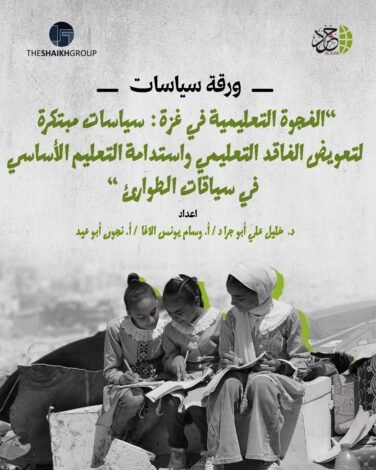
ICSPR Warns That a Generation’s Future in Gaza Is at Risk and Proposes an Integrated Policy to Restore Education and Address Learning Loss

Date: 5 October 2026
Press Release
ICSPR Warns That a Generation’s Future in Gaza Is at Risk and Proposes an Integrated Policy to Restore Education and Address Learning Loss
The International Commission to Support Palestinian Rights (ICSPR) has issued a policy paper on the learning gap in the Gaza Strip, calling for an integrated national policy to address learning loss among basic education students. The proposed policy combines accelerated learning and flexible education, safe learning spaces, psychosocial support, inclusive education, and adequate funding and effective coordination.
The paper warns that continued disruption to education threatens to entrench long-term gaps in reading, writing, and numeracy skills, increase school dropout rates, and deepen inequalities in learning opportunities. It stresses that rebuilding schools, while essential, cannot resolve the crisis on its own unless accompanied by programmes that restore learning opportunities and address the psychological and social consequences of war.
According to the data reviewed in the paper, approximately 658,000 children in the Gaza Strip have been deprived of formal education for more than two academic years. The paper focuses on basic education students, from Grade 1 to Grade 10, as this is the stage at which children develop the foundational skills needed to continue their education, and learning losses become harder to overcome the longer the disruption persists.
The paper explains that the learning gap results from several overlapping factors, most notably the destruction of schools, repeated displacement, the loss of safe learning environments, restrictions on the entry of educational supplies, electricity and communications outages, and the loss of teaching personnel, alongside the psychological and social pressures facing children and their families.
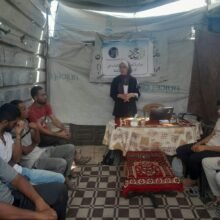
It notes that existing educational alternatives remain insufficient to meet the scale of need. The paper cites data showing that 405 temporary learning spaces serve approximately 226,400 learners, representing around 34% of the relevant age group. Some of these spaces consist of tents and open areas that are vulnerable to rain and lack suitable equipment, while electricity and internet outages limit the effectiveness of relying solely on online education.
ICSPR affirms that protecting children’s right to education requires an urgent response that does not wait for reconstruction to be completed and enables them to return to learning in safe, supportive environments. It argues that addressing learning loss must begin with an assessment of students’ actual skills and needs, rather than assuming that they can resume the curriculum from where their schooling stopped.
The paper proposes an integrated national policy built around five interconnected pillars: accelerated learning and flexible education; safe community learning spaces; psychosocial support; inclusive education; and governance, partnerships, and funding. These pillars aim to rebuild lost skills, improve the quality of education, and ensure access for the children most affected.
Under the accelerated learning pillar, the paper calls for catch-up programmes based on diagnostic assessments and focused on foundational reading, writing, and numeracy skills, alongside flexible educational arrangements suited to displacement and emergency conditions. It also proposes alternative teaching resources and low-cost technologies that reduce dependence on continuous internet access.
The paper stresses the need to expand safe learning spaces and rehabilitate available facilities while integrating psychosocial support into educational activities. It affirms that restoring children’s ability to learn requires attention to their sense of safety, motivation, and concentration, rather than simply delivering academic content.
It also calls for equal educational opportunities for displaced children, children with disabilities, and other particularly vulnerable groups, and for removing barriers to their enrolment and continued education. The paper highlights the importance of involving families and local communities in programme implementation and monitoring so that the response better reflects children’s needs.
The paper gives particular attention to teachers as the foundation of educational recovery. It recommends training them in education in emergencies, accelerated learning, and responding to students’ psychological and social needs. It also calls for incentives and psychological and professional support for teachers amid financial pressures, displacement, and difficult working conditions.
The paper recommends implementing the proposed programme through three interconnected phases: immediate response, early recovery, and reconstruction and sustainability, alongside stronger institutional coordination and improved monitoring and evaluation systems. It proposes total funding of US$50 million as a flexible, indicative budget estimate for implementing the interventions—not as funding that is already available or approved.
The paper sets out proposed targets for measuring programme progress, including reducing learning loss by 40% within 24 months, increasing the enrolment rate to 90% over the same period, training 3,000 teachers within 18 months, and reaching 250 schools within three years. It stresses that achieving these targets requires adequate funding, sustained coordination, and conditions that allow interventions to be implemented and their results monitored.
ICSPR affirms that educational recovery in the Gaza Strip goes beyond reopening schools: it is about protecting the future of an entire generation. Addressing learning loss must therefore be a priority in response and recovery plans. The Commission stresses the need to move from fragmented interventions to an integrated programme that guarantees Gaza’s children safe, inclusive, high-quality education and limits the war’s long-term effects on their lives and future opportunities.