
ICSPR Issues a Policy Paper on Advancing International Accountability for the Use of Prohibited Weapons in the Palestinian Context

Date: 2 September 2026
Press Release
ICSPR Issues a Policy Paper on Advancing International Accountability for the Use of Prohibited Weapons in the Palestinian Context
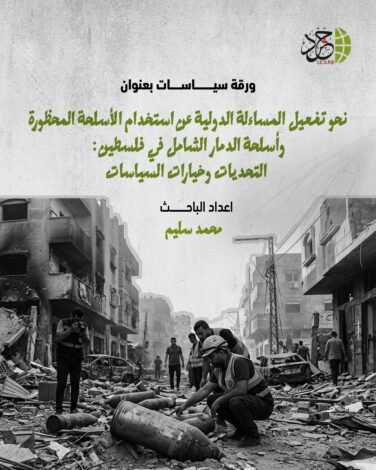
The International Commission to Support Palestinian Rights (ICSPR) has issued a policy paper titled: “Towards Advancing International Accountability for the Use of Prohibited Weapons,” prepared by researcher Mohammed Salim. The paper examines the international legal framework governing the prohibition of weapons and unlawful means and methods of warfare, as well as the challenges that hinder the documentation of violations and their transformation into legal files capable of investigation and accountability, particularly in the context of the ongoing Israeli aggression against the Gaza Strip.
The paper explains that the use of prohibited weapons, or prohibited means and methods of warfare, constitutes one of the gravest threats to civilian life and safety during armed conflicts due to the human, health, and environmental harm that may persist for many years. It affirms that international humanitarian law has established an integrated legal framework to prohibit or restrict the use of certain weapons, while international criminal law criminalises some of these acts and provides a basis for pursuing those responsible.
The paper notes that the particular significance of the Palestinian context lies in the scale of destruction and human and environmental losses caused by the Israeli aggression against the Gaza Strip, as well as the numerous human rights and international reports that have raised concerns and allegations regarding the use of weapons, munitions, and methods of warfare with dangerous destructive effects. It further notes that ongoing military operations, difficulties accessing targeted locations, the destruction of evidence, and limited capacity for independent investigations all obstruct the technical and legal verification of such violations.
The paper stresses that the core problem is not the absence of legal rules that prohibit or restrict the use of weapons, but rather the gap between those rules and the practical ability to investigate violations, collect and preserve evidence, identify those responsible, and transform documented incidents into files suitable for judicial prosecution. This gap is linked to weak enforcement mechanisms and international cooperation, as well as political and judicial constraints that limit the effectiveness of international justice.
The paper reviews the fundamental principles governing the use of force and weapons under international humanitarian law, foremost among them the principle of distinction between civilians and combatants, and between civilian objects and military objectives, as well as the prohibition on targeting civilians and civilian facilities. These principles also include the prohibition of indiscriminate attacks, the principle of proportionality, the duty to take all feasible precautions to avoid civilian harm and minimise damage, and the prohibition of means that cause superfluous injury or unnecessary suffering not justified by military necessity.
The paper refers to the principal international legal frameworks relevant to the matter, including the 1949 Geneva Conventions and their Additional Protocols, the 1993 Chemical Weapons Convention, the 1972 Biological and Toxin Weapons Convention, the 2017 Treaty on the Prohibition of Nuclear Weapons, the 1997 Anti-Personnel Mine Ban Convention, the 2008 Convention on Cluster Munitions, and the Rome Statute of the International Criminal Court.
The paper stresses the need to distinguish between a weapon prohibited in itself and a weapon that may be lawful as such but whose use becomes unlawful when directed against civilians, used indiscriminately, or employed in violation of the principles of proportionality and precaution. It also affirms that certain weapons or materials that raise legal concerns require an independent and technical investigation to determine their nature, the manner of their use, the surrounding circumstances, and their effects before a final legal characterisation can be reached.
The paper explains that the legal problem in the Gaza Strip is not confined to the scale of destruction and civilian casualties. It also extends to the nature of the weapons, munitions, and means used, the targets against which attacks were directed, and the extent to which such conduct complies with international humanitarian law. It notes that military operations in a highly densely populated environment containing residential neighbourhoods, displacement camps, hospitals, schools, and water facilities impose heightened legal obligations to protect civilians.
The paper states that the use of force in civilian areas has caused large numbers of deaths and injuries, widespread destruction of homes, infrastructure, health facilities, water networks, sanitation systems, and electricity networks, as well as the accumulation of vast quantities of rubble and the spread of unexploded ordnance that continues to endanger residents and people returning to their areas even after hostilities have ceased.
It further warns of the long-term health and environmental effects of weapons and munitions remnants, including the potential contamination of soil, water, and air, which may result in chronic damage to public health, the environment, and agricultural life. The paper also highlights permanent disabilities and long-term needs for treatment, rehabilitation, and psychosocial support, particularly among children.
The paper stresses that the existence of allegations or reports concerning the use of prohibited weapons or unlawful methods of warfare is not, by itself, sufficient to establish criminal responsibility. Transforming incidents into a legal file capable of investigation requires reliable evidence identifying the type, source, and characteristics of the weapon; the location and timing of its use; the nature of the intended target; the scale of damage caused; and the relationship between the harm and the military act.
It explains that this process faces major challenges in the Gaza Strip due to the continuation of military operations, the destruction of crime scenes, difficulties accessing many areas, the danger posed by unexploded ordnance, the loss of records, and the need for specialised expertise in analysing weapon remnants, medical and environmental impacts, and digital evidence.
The paper identifies key obstacles to advancing international accountability, including difficulty accessing targeted locations and collecting physical evidence; the inability in some cases to determine the type or source of a weapon or its supply chain; weak international cooperation in exchanging information, evidence, and technical expertise; limited mechanisms for implementing judicial and international decisions; politicisation and double standards; and weak protection for witnesses, victims, whistleblowers, and experts.
The paper presents four complementary options to strengthen international accountability: expanding independent international investigations; activating the mechanisms of the International Criminal Court and supporting them with evidence and information; encouraging states whose legislation allows it to exercise national or universal jurisdiction; and establishing an integrated international mechanism combining documentation, investigation, technical expertise, evidence preservation, and judicial cooperation.
The paper emphasises that these options are not competing but complementary. Independent investigations provide the evidentiary foundation; the International Criminal Court offers a pathway for individual criminal prosecution; national and universal jurisdiction expand the scope of accountability; and an integrated international mechanism provides the overarching framework that links documentation, investigation, and judicial referral.
The paper recommends establishing an integrated international mechanism to document and investigate the use of prohibited weapons and unlawful means and methods of warfare, and to link its findings to international and national judicial accountability mechanisms. This would bridge the gap between documenting violations and transforming them into evidence and legal files capable of investigation and prosecution.
It also calls for the establishment of a unified and secure database to document incidents and violations, including the type of weapon used or suspected to have been used, the location and date of the incident, the nature of the target, the number of victims, the nature of injuries, physical and digital evidence, testimonies, and medical and environmental reports. The paper stresses the importance of clearly distinguishing between verified facts and allegations that still require independent verification.
The paper further stresses the need to collect and analyse technical evidence through examining weapons and munitions remnants, conducting medical and forensic examinations, analysing soil and water samples where contamination or hazardous materials are suspected, and drawing on independent experts in weapons, forensic medicine, environmental science, and international law. Such efforts would help move from establishing that harm occurred to identifying its nature and source and its connection to a specific violation of international law.
The paper calls for the adoption of clear protocols for preserving evidence and guaranteeing its physical and digital integrity, documenting the source of each item of evidence, the date it was obtained, and its chain of custody. It also calls for protecting databases from loss or breach and maintaining secure backup copies to ensure that evidence can be used before competent judicial bodies in the future.
It highlights the importance of providing effective protection for witnesses, victims, whistleblowers, technical experts, medical professionals, human rights defenders, journalists, and sensitive information sources by ensuring confidentiality of identity, protecting personal data, assessing security risks, and establishing clear procedures for reporting threats.
The paper calls for expediting international investigations into violations and preventing prolonged procedures from weakening prospects for accountability. It also calls for investigations to address patterns in the use of weapons, rather than isolated incidents alone, in order to reveal potentially systematic policies or practices.
ICSPR affirms that advancing accountability for the use of prohibited weapons and unlawful means and methods of warfare requires urgent, systematic international action that begins from the moment a violation occurs and does not await the end of the aggression. This includes collecting, preserving, and analysing evidence and linking it to national and international judicial pathways, thereby strengthening prospects for justice for victims, prosecution of those responsible, and an end to impunity.