
ICSPR Issues a Paper on the Genocide of Palestinian Civilians in Gaza, the Consequences of the War, and Paths to Recovery

Date: 19 September 2026
Press Release
ICSPR Issues a Paper on the Genocide of Palestinian Civilians in Gaza, the Consequences of the War, and Paths to Recovery
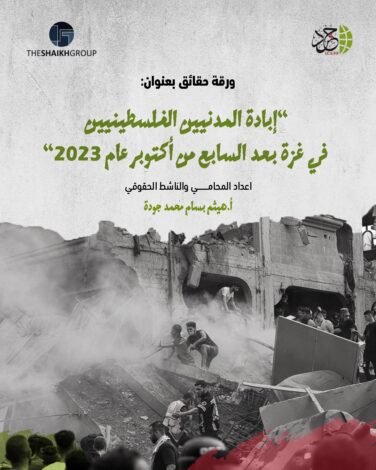
The International Commission to Support Palestinian Rights (ICSPR) has issued a paper on the genocide of Palestinian civilians in the Gaza Strip since 7 October 2023. The paper examines the scale of human losses and widespread destruction caused by the war, as well as its continuing humanitarian, social, economic, psychological, and political consequences. It also addresses the international legal framework governing the protection of civilians and pathways to recovery, reconstruction, and accountability.
The paper explains that the war on the Gaza Strip is among the most devastating conflicts of the modern era, having resulted in massive numbers of Palestinians killed, injured, and missing, as well as widespread destruction of homes, hospitals, schools, and civilian infrastructure. It notes that military attacks have struck residential areas and civilian facilities across the Strip, producing a comprehensive humanitarian catastrophe that has particularly affected children, women, and older persons.
The paper notes that the war has been accompanied by policies of siege, starvation, and obstruction of the entry of essential supplies, including food, medicine, fuel, and medical materials. These policies have compounded civilian suffering and turned the Gaza Strip into an area experiencing extensive collapse in health, humanitarian, and economic services.
According to the data reviewed in the paper, the number of Palestinian deaths in the Gaza Strip has exceeded 72,000, while the number of injured people has surpassed 172,000, in addition to thousands of people missing under the rubble. It further indicates that large numbers of the victims are children, women, and older persons, and that tens of thousands of families have lost relatives, deepening the war’s impact on Palestinian family and social structures.
The paper highlights that approximately 90% of the Gaza Strip’s population, or more than 1.9 million Palestinians, have been forcibly displaced. Many have experienced repeated displacement due to bombardment, evacuation orders, and the destruction of homes. The imposition of buffer zones, prohibited areas, and the so-called Yellow Line has also confined civilians to limited areas of the Strip, worsening overcrowding and undermining access to services, care, and humanitarian assistance.
The paper explains that widespread destruction has affected more than 80% of buildings in the Gaza Strip to varying degrees, while vast numbers of homes have been fully or partially destroyed. Electricity, water, sanitation, telecommunications, and major road networks have sustained severe damage, resulting in the collapse of essential services and exposing the population to growing health, environmental, and humanitarian risks.
It notes that the health sector has suffered widespread collapse due to attacks on hospitals, medical centres, ambulances, and health personnel. Only a limited number of hospitals remain partially operational under extremely difficult conditions. Shortages of medicines, medical supplies, and fuel have further undermined the ability of health facilities to treat injured people and patients and to respond to the spread of disease and epidemics.
The paper affirms that attacks on civilian infrastructure and obstruction of humanitarian assistance are inconsistent with the obligations of the occupying power under international humanitarian law, particularly the Fourth Geneva Convention, which requires the protection of civilians and prohibits attacks, violence, or collective punishment against them.
The paper reviews the legal framework for the crime of genocide, explaining that the 1948 Convention on the Prevention and Punishment of the Crime of Genocide criminalises acts committed with intent to destroy, in whole or in part, a national, ethnic, racial, or religious group. Such acts include killing, causing serious bodily or mental harm, and deliberately inflicting conditions of life calculated to bring about physical destruction.
The paper states that the large-scale killing of civilians, the widespread destruction of infrastructure, and the imposition of harsh living conditions through siege, displacement, and starvation raise serious issues of international legal responsibility and require investigation and accountability under international humanitarian law and international criminal law.
It also notes that the International Court of Justice, in the case concerning the application of the Genocide Convention in the Gaza Strip, issued provisional measures requiring steps to protect civilians and prevent acts prohibited by the Convention. The paper affirms that continuing violations and the deterioration of basic conditions of life in Gaza increase the need to implement international measures and take binding practical action to protect the population.
The paper highlights that the consequences of the war are not limited to human and material losses. They extend to the fragmentation of the social fabric, family separation, rising extreme poverty and malnutrition, and the spread of psychological distress, particularly among children and women. The destruction of schools and disruption of education have also threatened the future of an entire generation of children by depriving them of opportunities for education, development, and stability.
The paper explains that social recovery requires rebuilding family and community networks through psychosocial support programmes, the urgent reopening of schools, the provision of safe learning environments for children, programmes for the reunification of displaced families, and the strengthening of social solidarity and community initiatives.
It notes that the war has caused a near-total collapse of the local economy through the destruction of factories, workshops, markets, and economic facilities, the rise of unemployment to unprecedented levels, and the loss of livelihoods by tens of thousands of families. Most of the population has become almost entirely dependent on humanitarian aid amid widespread paralysis of productive sectors.
The paper affirms that economic recovery requires rebuilding productive infrastructure, supporting small and medium-sized enterprises, providing emergency employment opportunities, mobilising substantial international economic assistance, and gradually restoring markets and vital sectors. It also calls for cash-for-work programmes that employ young people in rubble removal and the rehabilitation of roads and public facilities, helping reduce unemployment and restore livelihoods.
The paper draws attention to the individual consequences of the war, including the loss of personal security and psychological stability, high levels of trauma and depression, permanent injuries and disabilities, and the loss of family providers or relatives. It stresses the necessity of providing mental-health services and physical rehabilitation for wounded and injured people and integrating persons with disabilities into recovery and community empowerment programmes.
The paper explains that the war has deepened the Palestinian internal political crisis and reshaped political priorities amid growing debate over the governance and future of the Gaza Strip. It has also intensified regional and international tensions and returned the Palestinian cause to the centre of global debate on war crimes, genocide, and pathways to international accountability.
The paper affirms that political recovery requires activating international legal mechanisms to hold those responsible for crimes accountable, strengthening Palestinian political unity, restructuring governing institutions on genuinely democratic foundations, and expanding international diplomatic action in support of Palestinian rights. This includes submitting documented legal files to competent international courts and mechanisms.
The paper warns against the continuation of Israeli violations of the ceasefire, including bombardment and gunfire against civilians, obstruction and reduction of humanitarian assistance, restrictions on the movement of patients and injured persons through crossings, and the continued military control of wide areas of the Gaza Strip. It stresses that any ceasefire must be binding and accompanied by an effective international monitoring mechanism that protects civilians and prevents repeated violations or circumvention of humanitarian agreements.
The paper recommends an immediate and permanent end to the military assault on the Gaza Strip and the safe and regular opening of crossings to guarantee the unrestricted entry of humanitarian assistance, particularly food, medicine, fuel, shelter materials, and medical supplies. It also calls for ensuring the protection of medical and humanitarian personnel in accordance with international humanitarian law.
It calls on the international community, particularly the United Nations, to fulfil its legal and moral responsibility to protect civilians, activate international accountability mechanisms, support investigations into serious violations, ensure that perpetrators do not evade punishment, and provide the necessary funding for humanitarian relief and reconstruction.
The paper urges international legal and human rights bodies to continue legal proceedings and the professional documentation of violations, support programmes to reconstruct and rehabilitate infrastructure and essential services, and ensure the continuity of psychosocial support for people affected by the war.
ICSPR affirms that the protection of Palestinian civilians in the Gaza Strip, ensuring their access to basic needs, ending violations against them, and holding those responsible accountable are legal and moral obligations upon the international community. It stresses that a just and sustainable peace cannot be achieved without ending the occupation, lifting the siege, and guaranteeing the Palestinian people’s right to self-determination.
ICSPR affirms that this paper is issued in partnership with The Shaikh Group (TSG) as part of efforts to document crimes and violations committed against Palestinian civilians in the Gaza Strip, strengthen international accountability, and promote an effective humanitarian and legal response that guarantees civilian protection, reconstruction, and justice for victims.