
ICSPR: Palestinian Elections Are Not Merely About Renewing Seats—They Are a Test of Political Platforms and Voters’ Right to Choose a Different Future
 wasem aa
Send an email
wasem aa
Send an email
Date: 9 October 2026
Press Release
ICSPR: Palestinian Elections Are Not Merely About Renewing Seats—They Are a Test of Political Platforms and Voters’ Right to Choose a Different Future
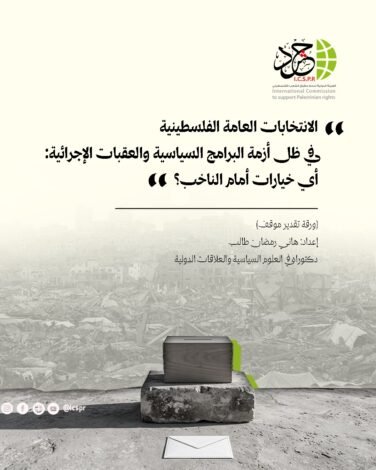
The International Commission to Support Palestinian Rights (ICSPR) has issued an assessment paper titled “Palestinian General Elections Amid a Crisis of Political Platforms and Procedural Obstacles: What Choices Do Voters Have?” The paper examines the political and rights-related challenges facing the electoral process and assesses whether the platforms on offer can respond to the transformations brought about by war, division, and the declining effectiveness of national institutions.
The paper affirms that the value of elections extends beyond determining the winning political forces or redistributing political representation. It also depends on the nature of the mandate granted by voters and their ability to choose between clear platforms offering practical answers on ending division, rebuilding the political system, managing recovery and reconstruction, and protecting national rights and public freedoms.
ICSPR explains that elections, if the conditions for a free and inclusive process are established, can provide an opportunity to renew legitimacy and correct the political course. However, they may reproduce existing crises if competition remains confined to slogans and loyalties, without a serious review of past experience or the presentation of viable alternatives.
The Crisis of Political Platforms and the Need for Review
The paper argues that the electoral crisis cannot be separated from the crisis of political platforms. It notes that some political forces have continued to operate according to priorities and strategies shaped in earlier periods, despite profound changes in Palestinian realities, the balance of power, and the regional and international environment.
It stresses that the problem does not lie in the diversity of platforms or differing political orientations in themselves, nor does it imply that all political forces bear equal responsibility for the crisis. Rather, it lies in the absence of a shared national strategy capable of reconciling the goals of national liberation with the requirements of governance, institution-building, and the protection of society.
The paper warns that continuing to use the same tools and assumptions without evaluating outcomes transforms failure from an experience that can be corrected into a prolonged impasse. It explains that strategic review does not mean automatically abandoning previous choices, but assessing their objectives, methods, and limitations, and determining what should continue and what requires modification or replacement.
In this context, the paper addresses the need for an open political examination of the reasons for continuing division, the limits of negotiation and resistance strategies, the relationship between governance and national liberation, the relationship between the Palestinian Authority and the Palestine Liberation Organization, and how to respond to regional and international changes. It considers presenting these reviews to the public an essential responsibility of political forces seeking renewed voter confidence.
War Poses New Questions for Electoral Competitors
The paper notes that the events of October 2023 and the subsequent war starkly exposed the limitations of previous approaches and intensified the need for a unified national response suited to the new reality.
It affirms that electoral platforms must move beyond announcing broad objectives to explaining practical means of achieving them and presenting clear proposals for protecting rights, rebuilding institutions, addressing the consequences of war, and restoring national unity.
Through the paper, ICSPR explains that voters should not be asked to grant an open-ended mandate based solely on a political force’s historical standing or organisational record. Instead, they should have the opportunity to assess each platform’s ability to explain ongoing changes, learn from experience, and offer a political course that is both implementable and subject to accountability.
The paper poses central questions to competing electoral lists and political forces: How can division be ended? How should reconstruction be managed? What place should resistance, negotiations, and diplomatic action have within a shared national vision? And how can representative institutions be rebuilt to restore their national role?
Four Possible Patterns of Voter Choice
The paper identifies four principal possibilities for electoral behaviour, presenting them as analytical scenarios rather than definitive predictions of election results.
The first is voting according to traditional factional affiliation, with organisational history, political identity, and family and social relationships continuing to influence choices. The paper notes that these ties may help mobilise voters, but they do not remove the need to offer platforms that address current needs.
The second is punitive voting, in which voters use their ballots to hold accountable the political forces they consider responsible for division, political failure, or mismanagement of public affairs. The paper explains that this behaviour may express rejection of previous political choices, even when voters are not fully convinced by the alternative they support.
It warns that punishing past performance is not, on its own, sufficient to produce a better political course unless accompanied by a clear and convincing alternative with a different platform and the capacity to implement it.
The third is platform-based voting, in which integrity, competence, governance, reform, and the ability to address national and livelihood concerns become key criteria for choice. The paper argues that this pattern challenges political forces to move from relying on their political history to persuading citizens of the merits of their policies.
The fourth is seeking an alternative through independent lists or new figures and political forces that transcend traditional alignments. The paper stresses that a sustainable alternative cannot emerge simply by registering an electoral list or bringing independent personalities together. It requires organisational development, a social base, a clear political identity, and the ability to translate its platform into effective policies and institutions.
Procedural and Rights-Related Obstacles
The paper examines obstacles associated with holding elections under occupation, including the possibility of disruption in the Gaza Strip or prevention in Jerusalem, alongside internal Palestinian barriers with political and rights-related dimensions.
It affirms that voters’ ability to choose depends not only on the diversity of candidates and lists, but also on an environment that permits meaningful participation, competition, and the presentation of alternatives. It notes that the emergence of new political forces requires the protection of public freedoms, a legal framework regulating political party activity, financial independence, and a social base that transcends existing geographic and political divisions.
ICSPR argues that addressing electoral obstacles must proceed alongside addressing the crisis of political platforms, so that a focus on procedures does not replace political debate, and debate over platforms is not used to disregard the conditions necessary for free and inclusive participation.
Elections That Open a Path to Change
The paper concludes that elections can move beyond renewing the legitimacy of existing political forces and become an opportunity to redirect the Palestinian political course, provided they are accompanied by serious political reviews and clear platforms on unity, reform, governance, reconstruction, and the protection of national rights.
It stresses that platforms confined to general slogans may push voters towards traditional loyalties or protest against past performance, rather than a comparison of implementable policies.
ICSPR affirms that the most important question is not simply who wins, but which platform receives a popular mandate and how that mandate will be translated into institutions and policies that meet citizens’ needs. Drawing on the paper’s analysis, it calls for electoral competition to become an opportunity for review, accountability, and the presentation of alternatives—not merely a reproduction of the disagreements and political choices that have failed to address accumulated crises.