
ICSPR Issues a Policy Paper Calling for an Integrated National Programme for Economic Recovery and Employment in the Gaza Strip

Date: 20 September 2026
Press Release
ICSPR Issues a Policy Paper Calling for an Integrated National Programme for Economic Recovery and Employment in the Gaza Strip
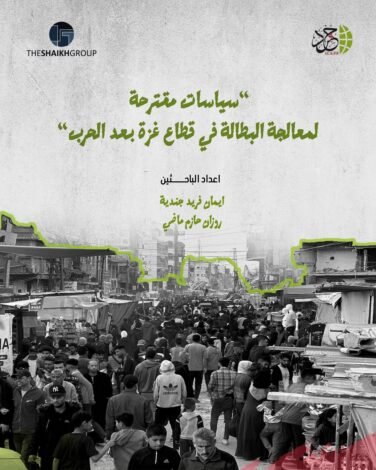
The International Commission to Support Palestinian Rights (ICSPR) has issued a policy paper on addressing unemployment in the Gaza Strip after the war. The paper calls for the adoption of an integrated national programme for economic recovery and employment that combines an urgent response for affected families, the revival of productive sectors, support for small and medium-sized enterprises, the development of vocational training, and investment promotion, in order to create sustainable employment opportunities and strengthen the local economy’s capacity to recover.
The paper explains that unemployment has become one of the most serious economic and social crises facing the Gaza Strip in the post-war period, as a result of the widespread destruction of infrastructure, economic, productive, service, and commercial facilities; the cessation of operations by thousands of enterprises; and the loss of income by large numbers of workers.
The paper notes that the unemployment rate in the Gaza Strip exceeded 80% in 2025, while youth unemployment reached around 90% and women’s unemployment was approximately 95%. The poverty rate exceeded 90%, food insecurity reached around 96%, more than 80% of economic establishments were damaged or destroyed, and gross domestic product contracted by approximately 35%.
The paper affirms that these indicators reflect the transformation of unemployment from a temporary economic problem into a structural crisis affecting all aspects of life in the Gaza Strip. It has led to increased poverty and economic vulnerability, declining income and local consumption, greater dependence on humanitarian assistance, worsening food insecurity, and growing psychological and social problems, particularly among youth, recent graduates, and women.
The paper explains that the worsening of unemployment is linked to a range of accumulated factors, including the widespread destruction of factories, economic establishments, and markets; the disruption of key productive sectors, particularly industry, agriculture, and services; the suspension of investment and reconstruction projects; restrictions on the movement of people and goods; and the limited capacity of the private sector to absorb the workforce.
It notes that the mismatch between some education and training outputs and labour-market needs, together with the growing reliance on humanitarian assistance instead of productive activity, has further aggravated unemployment and weakened the capacity of the local economy to recover and generate new employment opportunities.
The paper highlights that the war has caused profound changes in the structure of Gaza’s economy and labour market. Productive and service sectors have sustained widespread destruction, thousands of businesses have ceased operations fully or partially, and economic activity has declined to unprecedented levels amid continuing restrictions on movement and trade and delays in reconstruction efforts.
It affirms that the unemployment crisis threatens social stability and civil peace, driving higher rates of poverty, exclusion, and aid dependency, widening food insecurity, and increasing the likelihood of migration and the search for employment opportunities outside the Gaza Strip. It also weakens families’ ability to meet their basic needs and delays economic and social recovery.
The paper compares three policy alternatives for addressing unemployment: temporary and emergency employment programmes; support for small and medium-sized enterprises; and an integrated national programme for recovery and employment. It explains that temporary employment programmes can provide rapid income and immediate work opportunities for affected families, but their impact remains limited and short-term and depends on external funding.
The paper further notes that supporting small and medium-sized enterprises can help create sustainable jobs, stimulate economic activity, and strengthen entrepreneurship. However, it requires sufficient funding and a stable investment and legal environment and is not enough if implemented in isolation amid the scale of destruction and restrictions imposed on the local economy.
The paper concludes that an integrated national programme for economic recovery and employment represents the most effective and sustainable option, as it combines urgent interventions and temporary employment programmes with support for small and medium-sized enterprises, reconstruction, vocational and technical training, investment promotion, and the development of the digital economy and remote work.
The paper recommends that the Palestinian Government lead the programme through the Ministry of Labour, in coordination with the Ministries of National Economy, Social Development, and Planning, and in partnership with the private sector, civil society institutions, and supporting international actors. This would ensure complementarity of roles, unified efforts, and the allocation of resources according to genuine recovery priorities.
It calls for a diversified mix of funding sources, including reconstruction allocations, international grants and assistance, private-sector contributions, and corporate social-responsibility programmes, in addition to the creation of a national fund to support employment, finance small and medium-sized enterprises, and promote entrepreneurial initiatives.
The paper stresses the need to implement temporary employment programmes linked to reconstruction projects, rubble removal, and the rehabilitation of roads and public facilities. This would provide rapid employment opportunities for young people and unemployed workers while simultaneously supporting infrastructure rehabilitation and the restoration of essential services.
It also recommends supporting and financing small and medium-sized enterprises and entrepreneurial projects, developing vocational and technical training programmes linked to labour-market needs, stimulating investment in labour-intensive productive sectors, and supporting the digital economy and remote work to generate new employment opportunities, especially for young people, women, and recent graduates.
The paper affirms the importance of establishing a joint national committee comprising governmental bodies, the private sector, international institutions, and civil society organisations. The committee would be responsible for planning, supervision, and follow-up on implementation, holding periodic meetings to exchange data, prevent duplication of interventions, and ensure that resources reach the groups and sectors most affected.
The paper proposes setting clear performance indicators to measure success, including the gradual reduction of unemployment, an increase in the number of newly created jobs, a rise in the number of small and medium-sized enterprises that have been reopened or established, an increase in the proportion of vocational-training graduates who enter the labour market, stronger contributions by productive sectors to economic activity, and reduced household dependence on humanitarian aid.
The paper calls on the Palestinian Government to prepare and adopt a comprehensive national employment policy as part of recovery and reconstruction plans, establish the legal and administrative environment necessary to encourage investment and entrepreneurship, and develop a national system to monitor and periodically assess employment programmes and their impact.
It also calls on donor bodies to provide sustainable funding for employment programmes and economic recovery, rather than relying solely on short-term projects. It recommends allocating part of the funding to support small and medium-sized enterprises and to build the capacities of young people and women through vocational training and professional qualification programmes.
The paper recommends that the private sector expand investment in labour-intensive productive sectors, strengthen partnerships with educational institutions and training centres to prepare qualified personnel in line with labour-market needs, and support entrepreneurial initiatives and start-up projects while providing practical training opportunities for graduates.
It calls on international institutions to strengthen technical and financial support for economic recovery and reconstruction programmes, coordinate with governmental bodies and the private sector to ensure complementarity and avoid duplication, support digital-economy and remote-work projects, and develop monitoring and evaluation systems to ensure the sustainability of employment-programme outcomes.
ICSPR affirms that addressing unemployment in the Gaza Strip is a fundamental entry point for restoring the human and economic dignity of the population. The success of recovery and reconstruction depends on moving from emergency relief towards a productive economy that creates sustainable employment opportunities, promotes social stability, and reduces poverty, migration, and dependence on assistance.
ICSPR affirms that this paper is issued in partnership with The Shaikh Group (TSG) as part of efforts to develop practical policies for economic recovery and employment in the Gaza Strip and to support Palestinians’ rights to work, development, and a dignified life.