
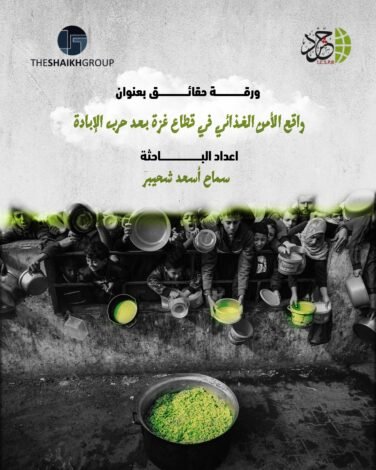
ICSPR issues a fact sheet titled: “The State of Food Security in the Gaza Strip After the War of Genocide”

Date: 28 June 2026
Press Release
In partnership with The Shaikh Group and as part of the Youth Civil Society Activists Diploma Program
ICSPR issues a fact sheet titled: “The State of Food Security in the Gaza Strip After the War of Genocide”
The International Commission to Support Palestinian People’s Rights (ICSPR), in partnership with The Shaikh Group and as part of the Youth Civil Society Activists Diploma Program, has issued a fact sheet prepared by researcher Samah Asaad Shmeir titled: “The State of Food Security in the Gaza Strip After the War of Genocide,” examining the reality of the severe food crisis in the Gaza Strip and the impact of the systematic starvation policy and restrictions on the entry of humanitarian aid and food supplies on the civilian population, amid the widespread destruction of agricultural land, water infrastructure, and basic means of livelihood.
The paper explains that the Gaza Strip is passing through a critical stage of food insecurity as a result of the war and the systematic crime of starvation used as a tool of warfare, noting that despite the declaration of a ceasefire on 10 October 2025, the continued restrictions on the entry of aid and food supplies, along with the destruction of agricultural land and water facilities, have led to a worsening food crisis and rising rates of malnutrition, especially among children and women.
The fact sheet reviews the concept of food security as defined by the United Nations Food and Agriculture Organization (FAO), namely the availability of safe and adequate food for all members of society on a continuous basis, and stresses that the reality in the Gaza Strip has become dangerously far removed from this minimum threshold of humanitarian protection. It also explains that the aim of the paper is to present the state of food security in the Strip and highlight the impact of starvation policies and restrictions on the entry of humanitarian assistance on civilians.
According to the figures cited in the paper, it was agreed after the ceasefire entered into force that 600 trucks would enter the Gaza Strip daily, yet the actual daily average does not exceed 200 trucks, including aid, commercial goods, and other supplies. The United Nations and government reports also estimate that between 86% and 94% of agricultural land in the Strip has been damaged or destroyed, while between 80% and 90% of water sources have been destroyed, according to reports by municipalities and the Palestinian Water Authority.
The paper indicates that medical and UN reports for 2026 confirm that more than 71,000 children are facing the risk of severe malnutrition, while more than 40% of pregnant and breastfeeding women are suffering from malnutrition. It also records that the poverty rate in the Strip has effectively exceeded 90% and that nearly the entire population of the Gaza Strip now lives in poverty and depends almost entirely on humanitarian assistance.
The fact sheet notes that Médecins Sans Frontières documented, in four health facilities it manages or supports between late 2024 and early 2026, a clear rise in premature births and deaths among babies born to mothers who suffered malnutrition during pregnancy, along with high rates of miscarriage and a sharp increase in children with malnutrition failing to adhere to treatment plans. It also explains that Gaza’s markets are experiencing severe price volatility due to the blockade and the scarcity of essential goods, as data from the Palestinian Central Bureau of Statistics showed that the consumer price index in the Strip rose by 5.01% year-on-year, with exceptional monthly surges of 12.42% in March and 37.92% in February.
On the legal side, the paper stresses that the systematic starvation crime committed by the Israeli occupation violates relevant international laws and conventions, including the Universal Declaration of Human Rights, the International Covenant on Economic, Social and Cultural Rights, and the rules of international humanitarian law, the Geneva Conventions, and the two Additional Protocols, all of which prohibit starving civilians as a method of warfare and prohibit targeting objects indispensable for their survival, such as food, agricultural areas, and drinking water facilities.
The paper also notes that UN Security Council Resolution 2417 of 2018 condemned the use of starvation of civilians and the denial of humanitarian access as a method of warfare, called on parties to conflict to protect civilians and civilian objects, and demanded the safe and unhindered delivery of humanitarian assistance, while also referring to the possibility of imposing UN sanctions on individuals or entities that deliberately obstruct the delivery of aid to those in need. It adds that the International Court of Justice, in the genocide case brought by South Africa, issued binding orders that classified the deliberate starvation of Palestinians in Gaza as a genocide risk and obliged Israel to open crossings and ensure the unhindered flow of sufficient food.
The fact sheet further points out that Article 8 of the Rome Statute of the International Criminal Court considers the intentional starvation of civilians, whether through depriving them of materials indispensable for their survival or by obstructing relief supplies, to be a war crime requiring prosecution and accountability. In this context, it notes that the International Criminal Court issued formal arrest warrants against Israeli Prime Minister Benjamin Netanyahu and former Defense Minister Yoav Gallant on charges of committing war crimes and crimes against humanity, including the use of starvation as a method of warfare.
The paper warns that the continuation of systematic starvation policies will have grave health and demographic consequences, including the deterioration of general health indicators, rising rates of malnutrition among children and pregnant and breastfeeding women, increased risks of stunting and delayed growth, higher rates of fetal and newborn deaths, and the spread of diseases associated with malnutrition and weakened immunity, in addition to mounting demographic imbalances resulting from worsening health and living conditions.
It also explains that these policies have deeply dangerous structural economic effects, including the collapse of purchasing power, the destruction of local agricultural and livestock production capacity, disruption of production and supply chains, rising poverty and unemployment rates, and the transformation of society into one that depends almost entirely on humanitarian aid, thereby undermining prospects for economic recovery and weakening the foundations of long-term sustainability and food security.
On the social level, the paper notes that the continuation of starvation is likely to weaken social cohesion, deepen community vulnerability, increase profiteering, exploitation, and economic crimes linked to scarcity of resources, and widen poverty gaps, while also increasing social tensions and disputes caused by competition over limited resources and services.
In light of these findings, the researcher presents a number of recommendations, most notably the activation of international accountability mechanisms to compel the Israeli occupation to comply with international humanitarian law and guarantee the opening of crossings and the regular, unhindered entry of humanitarian and relief assistance, including food supplies and basic necessities. The paper also recommends calling on the international community to provide the necessary funding for programs aimed at rehabilitating the agricultural sector and supporting livelihoods through economic empowerment and employment projects that strengthen food security and reduce dependence on aid.
The paper further calls on the United Nations to ensure support for and sustainability of World Food Programme operations in the Gaza Strip, including the operation of community bakeries, soup kitchens, and emergency food assistance projects, while also urging the international community to expand technical and financial support programs directed toward rehabilitating water infrastructure, including repairing water networks and local wells to ensure access to safe and sustainable water supplies.
ICSPR affirms that this fact sheet comes within the framework of efforts aimed at shedding light on the catastrophic consequences of the systematic starvation policy in the Gaza Strip and pushing for effective international action that ensures food reaches the civilian population, supports relief and early recovery efforts, and rehabilitates agricultural and water infrastructure in ways that strengthen food security and limit the worsening humanitarian crisis in the Strip.
It should be noted that this paper does not necessarily reflect the views of ICSPR or The Shaikh Group.