
(ICSPR) Publishes a Position Paper on 3,689 Israeli Violations of the Ceasefire Protocol and the Continuing Humanitarian Catastrophe in Gaza

Date: 15 August 2026
Press Release
ICSPR Publishes a Position Paper on Israeli Violations and Breaches of the Ceasefire Protocol, Documenting 3,689 Violations and the Continuing Humanitarian Catastrophe in Gaza
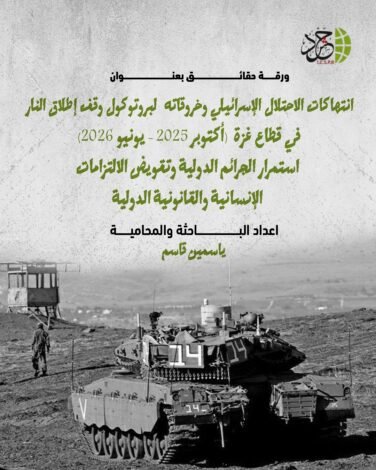
The International Commission to Support Palestinian Rights (ICSPR) has published a position paper prepared by researcher Yasmin Qassem, entitled: “Israeli Occupation Violations and Breaches of the Ceasefire Protocol.” The paper documents 3,689 Israeli violations since the ceasefire protocol entered into force in October 2025 until the end of June 2026. These violations resulted in the killing of more than 1,127 Palestinians and the injury of at least 3,643 others, while civilians accounted for approximately 99% of all casualties.
The paper explains that, despite the ceasefire protocol, the Israeli occupation continued to commit grave and systematic violations against the civilian population, including air and artillery bombardment, assassination operations, ground incursions, the issuance of evacuation orders, the targeting of civilian objects, restrictions on the entry of humanitarian assistance, and obstruction of recovery and reconstruction efforts.
It notes that the average number of Israeli violations reached approximately 13 violations per day, while the average number of those killed exceeded four per day and the average number of injuries reached approximately 25 per day. The paper also documented approximately 142 cases of arrest and abduction carried out by the occupation forces or affiliated armed militias during the same period.
The paper reports that approximately 265 children were killed since the ceasefire protocol entered into force, an average of one child killed every day. Approximately 191 women and at least 30 elderly persons were also killed. In addition, more than 11 journalists, three medical personnel, at least 77 police officers, five fishermen, and three humanitarian and relief workers were killed.
ICSPR documented the injury of more than 600 children, approximately 380 women, and around 100 elderly persons as a result of direct attacks on residential neighbourhoods and displacement shelters. Nearly 800 bodies were recovered from beneath the rubble of targeted homes, out of approximately 9,000 missing persons whose fate remains unknown amid continued obstruction of the entry of equipment and supplies required for rubble removal.
The paper stresses that Israeli violations have not been limited to targeting individuals, but have also affected tents, shelters, vehicles, and civilian institutions. Israeli forces committed massacres targeting more than 57 tents housing displaced persons, shelled at least 33 civilian and police vehicles, and targeted more than 13 police stations or posts.
It adds that the occupation issued more than 43 evacuation orders targeting residential blocks and homes in various areas of the Gaza Strip. Twelve bombardments and attacks were recorded following the issuance of evacuation orders during May alone, confirming the continued use of evacuation orders as a tool of forced displacement within a recurring pattern of violations.
The paper also documented approximately 600 artillery attacks targeting civilians in various parts of the Gaza Strip and at least 560 incidents of gunfire from the positions of occupation forces, military vehicles, and military cranes towards displaced persons’ tents and civilian gatherings. In addition, more than 373 assassination operations resulted from the bombardment of vehicles, homes, and tents and from attacks carried out by drones.
According to the paper, the number of air-bombardment crimes exceeded 749, targeting homes, residential facilities, civilian vehicles, tents, and gatherings of civilians. More than 366 crimes involving the demolition and destruction of facilities, the levelling of land, and the destruction of residential blocks were also committed. Israeli forces destroyed or demolished more than 2,600 buildings since the ceasefire protocol entered into force, while approximately 95% of the homes located behind what is known as the Yellow Line were demolished or destroyed.
The paper examines Israel’s military expansion, the imposition of field control, and the reshaping of Gaza’s geographical reality. It notes the construction of an earth barrier approximately 17 kilometres long along the Yellow Line, in addition to the construction of an earth barrier in Beit Lahia approximately five kilometres long.
It also documents approximately 80 ground incursions accompanied by changes in the positions and deployment of occupation forces inside the Gaza Strip, the expansion of the Yellow Line at least ten times within six months, and the establishment of approximately 23 military-crane positions equipped with machine guns east of the Strip.
The paper states that the occupation has controlled approximately 55% of the northern Gaza Strip and imposed effective control over more than 64% of the Strip’s total area. The area available to the population has been reduced to approximately 133 square kilometres, out of a total area of 365 square kilometres. Areas subjected to complete destruction cover approximately 233 square kilometres, equivalent to around 64% of the total area of the Gaza Strip.
Israeli violations in the vicinity of the Yellow Line resulted in the killing of more than 224 Palestinians, including 18 women and 43 children, as a result of direct attacks on civilians, according to the paper.
On the humanitarian situation, the paper explains that the occupation forces forced approximately 2.3 million Palestinians to crowd into a border strip no larger than 100 square kilometres, with an estimated population density of 23,000 people per square kilometre, amid the absence of safe and suitable areas capable of accommodating the population.
Approximately one million displaced Palestinians continue to live in catastrophic humanitarian conditions, while displaced persons account for around 80% of the population of the Gaza Strip. Displaced people are spread across more than 1,600 displacement sites, including approximately 116 UNRWA shelters hosting around 76,000 displaced persons.
Approximately 38,500 displaced persons have been forced to sleep in the open, while more than 350,000 families urgently require shelter. Approximately 132,000 tents have deteriorated and become unfit for use. Diseases, epidemics, and rodents have spread in more than 80% of shelters, and more than two million cases of infectious diseases and watery diarrhoea have been recorded as a result of deteriorating health and environmental conditions.
The paper also documents more than 71,338 cases of hepatitis A among displaced persons, more than 10,000 cases of skin diseases, and over 18,000 cases of chickenpox, external parasites, and impetigo.
It reports the collapse of approximately 50 damaged buildings on civilians since the ceasefire entered into force, resulting in the killing of approximately 30 people who had taken refuge in those buildings. The severe humanitarian conditions also resulted in the deaths of approximately 11 displaced persons from the cold, including ten children and one woman.
Regarding humanitarian assistance, the paper confirms that only 58,664 trucks were allowed to enter the Gaza Strip out of 165,000 trucks that should have been permitted to enter, representing a compliance rate of no more than 35%. Since the ceasefire, no more than 30 fuel trucks and approximately 13 cooking-gas trucks have entered, exacerbating the energy crisis and affecting the ability of residents and humanitarian institutions to meet basic needs.
ICSPR documented approximately 405 cases of closure and obstruction of humanitarian aid access through crossings in northern and southern Gaza. The Israeli occupation also allowed no more than 8,878 travellers to leave through the Rafah crossing, out of 24,000 travellers who should have been enabled to travel.
More than 609,751 students remain deprived of their right to education. Recovery and reconstruction needs in the Gaza Strip are estimated at more than USD 73 billion, while the value of direct damage to buildings and infrastructure is estimated at approximately USD 30 billion.
Against the backdrop of deteriorating living conditions, the paper explains that approximately 95% of Gaza’s population depends on humanitarian assistance to meet basic needs. Around 77% of the population faces high levels of acute food insecurity, while the proportion of people living below the poverty line has risen to more than 93%.
Approximately 70% of families are unable to obtain the minimum amount of water required for their needs, while around 82% of families are unable to secure food or access clean water. More than 60 million tonnes of rubble generated by the destruction of buildings and infrastructure have accumulated across the Gaza Strip, in addition to more than 700,000 tonnes of solid waste scattered throughout residential areas and around displacement camps.
The paper warns of worsening malnutrition, noting that approximately 37,000 pregnant and breastfeeding women suffer from acute malnutrition and that around 800,000 displaced children face increasing risks of malnutrition and diseases linked to deteriorating humanitarian conditions. More than 71% of children aged between six and 23 months also suffer from severe food poverty.
With regard to the health sector, the paper confirms that approximately 50% of health services have ceased operating. Only 16 hospitals out of 38 remain operational after more than 1,800 health facilities were partially or completely destroyed or damaged.
More than 87% of medical supplies and laboratory testing materials have been depleted, while the number of functioning medical devices does not exceed 24% of the total devices in hospitals and medical centres across the Strip. More than 20,863 patients and injured persons need to travel outside the Gaza Strip to receive treatment, including 5,342 children.
The paper notes that approximately 11,000 diabetic patients suffer from shortages of insulin, including 2,500 children. Around 14,000 cancer patients face the risk of losing access to treatment, including more than 3,000 patients in urgent need of chemotherapy. The deaths of approximately 1,500 cancer patients have also been documented.
Researcher Yasmin Qassem affirmed that the occupation’s continued commission of these violations, despite the entry into force of the ceasefire protocol, confirms its breach of its legal obligations as the occupying power, particularly its obligations under the Fourth Geneva Convention of 1949, the Hague Regulations of 1907, Additional Protocol I of 1977, customary international law, and international human-rights instruments.
The paper explains that the targeting of civilians and civilian objects, obstruction of humanitarian assistance, targeting of the health sector and medical personnel, forced displacement, and the undermining of public order constitute grave violations that may amount to war crimes and crimes against humanity. In view of their widespread and systematic nature, they may also fall within the acts constituting the crime of genocide.
The International Commission to Support Palestinian Rights (ICSPR) calls on mediators, the international community, and the United Nations—particularly the Security Council—to assume their legal and moral responsibilities in protecting the civilian population in the Gaza Strip, compelling the occupation to respect the rules of international humanitarian law, ensuring an immediate and genuine ceasefire, and taking effective measures to end impunity.
It also calls on States Parties to the Geneva Conventions and the Rome Statute to support international investigation and accountability procedures concerning grave violations, war crimes, and crimes against humanity committed against Palestinians, and to ensure that those responsible are held accountable.
ICSPR calls for the occupation to be compelled to fulfil its obligations regarding recovery and reconstruction, support the rehabilitation of hospitals, schools, water and sewage networks, and essential infrastructure, and ensure that the entry of construction materials and necessary equipment is not obstructed.
It further calls for the establishment of an independent and impartial international mechanism to monitor implementation of the ceasefire agreement, monitor and document violations and breaches, and ensure clear procedures for holding accountable all parties that violate their obligations, particularly the Israeli occupation as the occupying power.
The Commission also calls for the full and sustainable opening of all crossings and the guaranteed, urgent, and adequate flow of humanitarian assistance, medical supplies, fuel, and relief materials without restrictions or obstacles. It stresses the need to strengthen measures to protect displaced persons and shelters and provide them with shelter and basic services.
The Commission affirms the need to take decisive measures to prevent the continuation of policies of forced displacement and demographic change in the Gaza Strip and to ensure respect for the right of civilians to remain in and return to their residential areas, in accordance with international law.