
On International Youth Day, ICSRP Publishes a Position Paper Entitled “The Repercussions of Forced Displacement and Death on the Reality of Palestinian Youth

Date: 13 August 2026
Press Release
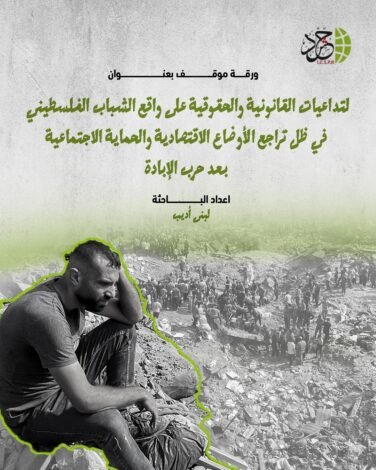
On International Youth Day, ICSRP Publishes a Position Paper Entitled: “The Repercussions of Forced Displacement and Death on the Reality of Palestinian Youth Amid the Deterioration of Economic Conditions and Social Protection Following the Genocidal War”
The International Commission to Support Palestinian Rights (ICSRP), on the occasion of International Youth Day, has published a new position paper prepared by Attorney Lubna deeb, entitled: “The Repercussions of Forced Displacement and Death on the Reality of Palestinian Youth Amid the Deterioration of Economic Conditions and Social Protection Following the Genocidal War.”
The paper examines the situation of Palestinian youth in the Gaza Strip amid the catastrophic consequences of the genocidal war, including killing, forced displacement, the widespread destruction of the foundations of life, the collapse of economic and social conditions, and the severe deterioration of protection systems. These circumstances have directly affected the present and future of Palestinian youth.
The paper explains that Palestinian youth have paid a heavy price as a result of the continued aggression. The effects of the war have not been limited to direct human losses but have extended to the loss of family members, the destruction of homes and sources of income, the fragmentation of the social environment, the decline of educational and employment opportunities, and the intensification of fear, anxiety, and the loss of safety and stability.
The paper affirms that repeated forced displacement has destabilised the social and psychological well-being of young people, deprived them of regular access to basic services, and weakened their ability to continue their education or seek employment opportunities. Displacement has also shifted young people away from paths of development, advancement, and community participation towards forced efforts focused on securing daily necessities and coping with conditions of survival.
The paper highlights the economic repercussions of the war, noting that the destruction of economic establishments and sources of income, rising unemployment and poverty rates, and the decline in employment opportunities have deepened the vulnerability of Palestinian youth. These factors have weakened their ability to achieve economic independence, support their families, or plan for their future.
The paper also addresses the impact of the collapse of social protection on young people, amid the loss of breadwinners in thousands of families, the growing number of female-headed households, and the increasing responsibilities placed on girls and young women. This has compelled broad segments of young people and women to assume additional family and economic burdens, often at the expense of education, employment, mental health, and social integration.
The paper further examines the psychological and social impact of the war on youth, including trauma resulting from killing, displacement, the loss of family members, and the destruction of homes. It also highlights the growing sense of a blocked future and the loss of the ability to resume a normal course of life. The paper warns that the continuation of these conditions threatens to transform psychological and social suffering into a long-term crisis that will affect young people’s ability to participate in recovery and reconstruction.
The paper points out that Palestinian youth should not be treated merely as recipients of assistance, but rather as essential partners in humanitarian response, recovery, and reconstruction. It stresses the need to involve them in designing and implementing programmes and policies targeting them and to utilise their capacities and skills in confronting the effects of the war and rebuilding society.
The paper also emphasises the importance of adopting a comprehensive response that is not limited to the provision of emergency assistance, but includes social protection, psychological support, education, vocational training, employment opportunities, and economic empowerment. This would enable young people to rebuild their lives, strengthen their independence, and participate in shaping their future.
ICSRP calls for Palestinian youth issues to be given priority in national and international plans, and for a safe environment to be provided for them, with their rights to life, education, employment, and a dignified existence protected. Particular attention must be given to girls and young women, young people with disabilities, and those affected by displacement and the loss of family members.
The Commission affirms that addressing the situation of Palestinian youth requires ending the aggression, bringing forced displacement to an end, lifting restrictions on the delivery of humanitarian assistance, rebuilding infrastructure and educational, economic, and social institutions, and holding accountable those responsible for the crimes and violations committed against Palestinian civilians.
The paper concludes that the continuation of displacement, killing, and the deterioration of economic conditions and social protection threatens not only the lives of Palestinian youth but also the future of Palestinian society as a whole. Accordingly, protecting and empowering young people and rebuilding their educational, professional, and social opportunities constitute a national and international responsibility and an essential pathway towards recovery, reconstruction, and the construction of a future based on justice, dignity, and rights.