
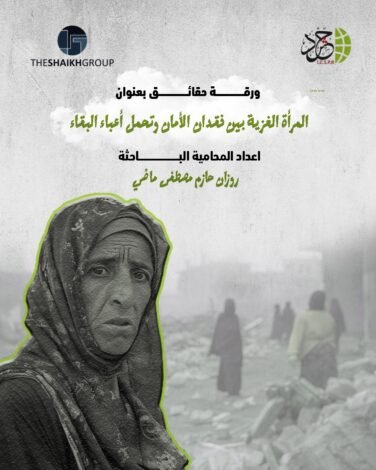
ICSPR issues a fact sheet titled “Gazan Women Between Loss of Safety and the Burden of Survival”

Date: 30 June 2026
Press Release
In partnership with The Shaikh Group and as part of the Youth Civil Society Activists Diploma Program
ICSPR issues a fact sheet titled: “Gazan Women Between Loss of Safety and the Burden of Survival”
The International Commission to Support Palestinian People’s Rights (ICSPR), in partnership with The Shaikh Group and as part of the Youth Civil Society Activists Diploma Program, has issued a fact sheet prepared by lawyer and researcher Rozan Hazem Mostafa Madi titled: “Gazan Women Between Loss of Safety and the Burden of Survival,” examining the reality of Palestinian women in the Gaza Strip during the war and the escalating humanitarian, economic, psychological, and social challenges imposed upon them, while also highlighting the central role women continue to play in community resilience and in carrying the burdens of survival.
The paper explains that Palestinian women in the Gaza Strip are living through one of the most complex and severe humanitarian crises of the modern era, amid the ongoing war and its catastrophic effects on all aspects of humanitarian, social, and economic life, with these conditions directly affecting women as one of the groups most harmed during armed conflict due to the loss of safety, repeated displacement, loss of breadwinners, and the burden of multiplied responsibilities within the family and society.
The fact sheet notes that women in Gaza face overlapping psychological, economic, social, and health-related challenges at a time when the humanitarian system and basic services are experiencing acute collapse, which has deepened women’s suffering and undermined their ability to access the minimum requirements of a dignified life. It further stresses that the paper aims to shed light on the reality of Gazan women during the war, highlight the most pressing challenges they face, and focus on the humanitarian, economic, and psychological dimensions of the crisis, alongside the role of women in community steadfastness and in bearing the burdens of survival.
The paper points out that women make up approximately 49% of the total Palestinian population, according to data from the Palestinian Central Bureau of Statistics, while the number of women in the Gaza Strip exceeds 1.06 million, reflecting the central place of Palestinian women within society. It explains that the war has led to fundamental changes in the social and economic roles of women, as increasing numbers of them have become heads of households after losing husbands or income sources, in addition to assuming caregiving and support responsibilities under extremely difficult humanitarian conditions.
According to the indicators and statistics cited in the paper, the percentage of households headed by women rose from around 12% before the war to nearly 18% afterward, while the number of new widows resulting from the war exceeded 22,000. The paper also notes that women’s participation in the labor market stands at around 17%, while unemployment among women has exceeded 90% in some estimates, alongside the displacement of hundreds of thousands of women and girls and a marked increase in the number of women who have lost their breadwinners.
The fact sheet explains that the psychological and social dimensions of the crisis constitute one of the most dangerous aspects of women’s suffering in the Gaza Strip, as women endure enormous psychological pressures due to continuous bombardment, loss of family members, and repeated displacement, resulting in high levels of anxiety, fear, and psychological trauma. Women also face challenges linked to the loss of safety and stability, especially inside overcrowded displacement centers lacking privacy and humane living conditions, while the psychological burden grows even heavier for women responsible for caring for children and the elderly in the absence of adequate psychosocial support.
On the social level, the paper explains that the war has caused profound changes within the Palestinian family, forcing many women to assume new roles as primary providers for their households while continuing to shoulder domestic and caregiving responsibilities. It also notes a rise in the number of widows and women who have lost their breadwinners, which has increased the scale of social and economic burdens placed on women amid weakening protection and support networks and growing complexity in everyday life under war and displacement.
Economically, the paper stresses that the war has caused a sharp deterioration in conditions inside the Gaza Strip, which has directly affected women, especially with the destruction of income sources and soaring unemployment. The paper outlines several major economic challenges, including loss of work opportunities and income, rising poverty among women, increased dependence of families on women as a primary source of support, limited opportunities for economic empowerment, and the decline of small projects and women-led productive activities, in addition to growing difficulty in securing basic family needs amid rising prices and shrinking humanitarian aid.
On the humanitarian and health front, the paper highlights that women in displacement centers are living in extremely harsh conditions due to severe overcrowding, lack of privacy, and the absence of the basic elements of dignified life. Women and girls also face major difficulties in accessing clean water, hygiene materials, and medical care, particularly reproductive health services, at a time when the health system is suffering from broad collapse as a result of the ongoing war.
The fact sheet adds that the most prominent health challenges facing women include shortages of medicines and essential health services, difficulty for pregnant women in reaching health care, malnutrition among women and children, high levels of stress and psychological trauma, and weak protection and health care services directed toward women. It emphasizes that the seriousness of these conditions is compounded by the continuing collapse of large parts of the health system and the absence of preventive and therapeutic services necessary to protect women and safeguard their dignity and health rights.
In the legal framework, the paper reviews women’s rights under international humanitarian law, noting that this body of law guarantees protection for civilians during armed conflicts and that women are among the groups entitled to special protection in times of war. It also stresses that the Convention on the Elimination of All Forms of Discrimination against Women requires the protection of women and the guarantee of their basic rights, including the right to life, health, and protection from violence and discrimination, while placing legal responsibility on the occupying authorities toward civilians in the occupied territory, including ensuring women’s access to basic humanitarian needs and preventing them from being targeted or subjected to collective suffering.
The paper also highlights the central role played by Gazan women in preserving the cohesion of the family and society despite the harsh humanitarian conditions. It explains that women have managed family affairs during emergencies and displacement, cared for children, the elderly, and the sick, participated in community and relief initiatives, supported children psychologically and educationally despite the harsh conditions, strengthened community solidarity inside displacement centers, and contributed to securing basic needs for families.
The fact sheet concludes that Gazan women are living through exceptional conditions during the war, facing loss of safety and growing economic, social, and psychological burdens, in addition to the challenges of displacement, poverty, and the collapse of basic services. Despite these conditions, women continue to form an essential pillar of Palestinian society’s resilience and the continuity of daily life through assuming responsibilities of support, care, and community assistance, which underlines the urgent need for humanitarian and rights-based interventions that protect women and strengthen their economic and psychological resilience.
In light of this, the paper presents a number of recommendations, most notably enhancing international protection for women in the Gaza Strip, ensuring respect for the rules of international humanitarian law, supporting psychosocial support programs for women and girls, providing comprehensive health services especially in reproductive health, supporting women heads of households and widows economically, creating economic empowerment programs and employment opportunities for women, improving conditions for women inside displacement centers, strengthening gender-responsive humanitarian action, supporting women’s and community initiatives, and documenting violations committed against women while ensuring accountability for those responsible.
ICSPR affirms that this fact sheet comes within the framework of its efforts to shed light on the reality of Palestinian women in the Gaza Strip and the violations and compounded suffering they face during the war, while working to enhance legal and humanitarian awareness of women’s issues and push for more just and effective responses that take into account their needs and basic rights.
It should be noted that this fact sheet does not necessarily reflect the views of ICSPR or The Shaikh Group.