
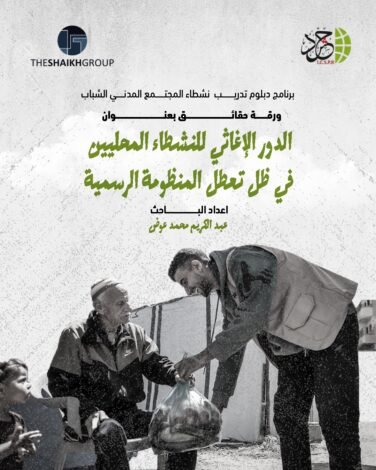
ICSPR issues a fact sheet titled: “The Relief Role of Local Activists Amid the Breakdown of the Official System” as part of the Youth Civil Society Activists Diploma Program

Date: 14 June 2026
Press Release
In partnership with The Shaikh Group (TSG) and as part of the Youth Civil Society Activists Diploma Program
ICSPR issues a fact sheet titled: “The Relief Role of Local Activists Amid the Breakdown of the Official System”
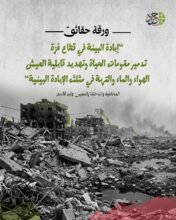
The International Commission to Support Palestinian People’s Rights (ICSPR), in partnership with The Shaikh Group (TSG), and as part of the Youth Civil Society Activists Diploma Program, has issued a fact sheet prepared by researcher Abdel Karim Mohammad Awad titled: “The Relief Role of Local Activists Amid the Breakdown of the Official System,” examining the growing importance of local initiatives and field activists in filling the humanitarian gap caused by the collapse of the official system and the declining capacity of humanitarian organizations to respond inside the Gaza Strip.
The paper explains that major crises and catastrophic turning points often lead to bureaucratic or field paralysis in official relief systems, leaving affected communities in direct confrontation with the risk of annihilation and making local individual initiatives a humanitarian bridge to fill the gap left by aid organizations in critical moments. It stresses that studying the relief role of local activists is of utmost importance because they represent the first line of defense and the backbone of rapid response, with the ability to break siege conditions, create solutions out of suffering, and transform spontaneous social solidarity into a real lifeline.
The fact sheet indicates that the targeting of headquarters and the banning of the work of the United Nations Relief and Works Agency for Palestine Refugees (UNRWA) led to the paralysis of the formal relief lifeline on which more than 80% of the population in the Gaza Strip had depended, while more than 35% of UN aid convoys were directly targeted or blocked, creating an urgent need for local distribution networks and activists. It also notes that local activists and youth initiatives are running more than 250 community kitchens and improvised food points that rely on self-help efforts and local donations to provide daily meals to displaced people.
The paper highlights that local activists and volunteer paramedics have established more than 80 field medical points inside displacement centers and overcrowded camps to compensate for the collapse of the official health system and the shutdown of hospitals. It adds that they have used alternative means of transport, including bicycles, motorcycles, and rudimentary carts, to deliver aid and medicine to around 150,000 besieged residents in dangerous isolation zones. It further notes that activists and educators launched more than 400 educational and teaching initiatives in displacement tents in an effort to save the academic year and protect children from illiteracy after the destruction of schools.
The fact sheet also points out that activist groups on platforms such as WhatsApp and Telegram manage monitoring and relief networks that collect urgent needs data for hundreds of thousands of families and help fill part of the official statistical gap. According to field estimates cited in the paper, local initiatives direct around 98% of their resources straight to beneficiaries, while nearly 70% of the actual day-to-day relief work on the ground at the height of the siege depends directly on the efforts of local activists.
In describing the nature of activists’ roles, the paper states that they provided emergency services to displaced people during repeated movement and displacement, including water, quick meals, and transportation, and helped secure shelter spaces, provide medicines and medical supplies, and document humanitarian cases through video to obtain support and, in some cases, medical evacuation for patients. It also refers to their role in building educational initiatives, supplying community kitchens in devastated areas, and providing drinkable water carts in the most underserved locations.
At the same time, the fact sheet addresses a number of criticisms and challenges associated with some local initiatives, including the absence of databases and institutional linkages that would ensure fair distribution, weak oversight over funds and aid received by some individuals, and the existence of fake initiatives or misleading documentation materials that have contributed to declining trust between some donors and grassroots actors in recent months.
The paper explains that the war of genocide has had deep effects on the relief work of local activists at the social, economic, political, and individual levels, including the fragmentation of the social fabric, the drying up of cash liquidity, soaring prices, destruction of local markets, the absence of institutional coordination, and the use of aid as a tool of political and military pressure and collective punishment. It also notes that activists themselves suffer from psychological and physical exhaustion and total burnout, since they are members of the affected community and seek survival for their own families while continuing relief work under threat of death.
On the legal side, the fact sheet emphasizes that international humanitarian law provides clear protection for civilians and humanitarian workers, citing Article 55 of the Fourth Geneva Convention, which obliges the occupying power to ensure food and medical supplies for the population, while also guaranteeing protection for relief personnel to facilitate their missions. It argues that the systematic targeting of food and water distribution facilities, the obstruction of relief, and the use of starvation as a weapon of war constitute grave violations that may amount to war crimes, crimes against humanity, and genocide under the Rome Statute.
The paper concludes with several recommendations, most notably calling on international organizations to exert effective pressure on donors and UN agencies to channel no less than 25% of aid and direct funding to local networks and initiatives that have flexible access, alongside providing legal and protective cover for activists on the ground, training them in digital security, developing their skills in financial governance, crisis management, and psychological first aid, and creating joint horizontal coordination platforms among youth initiatives to ensure fair distribution and prevent duplication or waste.
ICSPR affirms that this fact sheet comes within the framework of efforts aimed at highlighting the vital role played by local activists in protecting Palestinian society and strengthening its resilience amid war and the breakdown of the official system, while pushing for the protection and empowerment needed for these popular efforts that have become one of the pillars of human survival in the Gaza Strip.
It should be noted that this fact sheet does not necessarily reflect the views of ICSPR or The Shaikh Group (TSG).