
ICSPR Warns of the Targeting of Humanitarian Response and Infrastructure in the Gaza Strip and the Use of Relief as a Tool of Control

Date: 14 August 2026
Press Release
ICSPR Warns of the Targeting of Humanitarian Response and Infrastructure in the Gaza Strip and the Use of Relief as a Tool of Control
The International Commission to Support Palestinian Rights (ICSPR) sent an urgent briefing memorandum to a number of relevant UN and international bodies on the occasion of World Humanitarian Day. The memorandum addresses the systematic collapse of the protection and relief system in the Gaza Strip as a result of the continued targeting of infrastructure, humanitarian workers, and civil-society organisations, as well as the imposition of restrictions aimed at stripping humanitarian action of its impartiality and independence and transforming it into a system of political and security control.
The Commission addressed its memorandum to the Secretary-General of the United Nations, the UN Special Coordinator for the Middle East Peace Process, the President of the Human Rights Council, the United Nations High Commissioner for Human Rights, the Prosecutor of the International Criminal Court, the Special Rapporteurs on the situation of human rights in the occupied Palestinian territory and on violence against women and girls, the President of the International Committee of the Red Cross, and the Director-General of the World Health Organization.
ICSPR called on these bodies to take urgent action to protect civilians and humanitarian workers and ensure the unrestricted delivery of humanitarian assistance and essential supplies to the Gaza Strip.
The Commission affirmed that this year’s World Humanitarian Day coincides with an exceptional and unprecedented reality for relief work in the Gaza Strip. The humanitarian response has gone beyond the limits of conventional administrative and logistical work and reached a level of existential sacrifice.
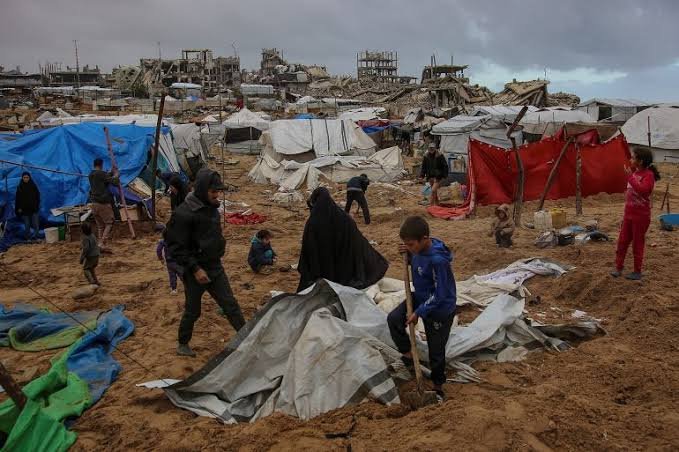
Local and national organisations and volunteer teams have been forced to devise rudimentary solutions to provide the minimum necessities of life by distributing water and securing food inside displacement camps, amid the absence of fuel and modern logistical equipment and the interruption of electricity and communications.
The Commission noted that humanitarian and field workers in Gaza are not teams arriving from safe areas. Rather, they are displaced persons who have lost their homes and family members and live in the same tents as the people benefiting from their services. Nevertheless, they continue to perform their daily duties under severe risks, continuous psychological pressure, and ongoing loss of life, without personal protective equipment or safe supply routes, and amid a constant sense of direct threat while carrying out their humanitarian work.
ICSPR explained that the scale of destruction in the Gaza Strip has exceeded the operational limits of an emergency response and has become the comprehensive destruction of the means of sustaining life. More than 73,000 Palestinians have been killed and more than 174,000 injured, most of them children and women. These human losses have occurred alongside the systematic targeting of civilian infrastructure, essential services, and the foundations of civilian life.
Based on reports by the Euro-Mediterranean Human Rights Monitor and testimonies from the Private Transport Association, the Commission stated that the Israeli occupation deliberately paralyses relief operations by destroying trucks and warehouses, targeting drivers, and preventing the entry of spare parts.
It noted that 75% of the truck fleet in the Gaza Strip has been destroyed, leaving only 25% of the original 1,200 trucks. More than 20 relief-truck drivers have also been killed and 15 others arrested, some of whom remain detained, since the ceasefire entered into force in October 2025.
The Commission also referred to documentation by the United Nations Office for the Coordination of Humanitarian Affairs showing that 186 humanitarian workers were killed in Gaza during the past year alone. This represents more than half of the total number of humanitarian workers killed worldwide, which stands at 350, making the Gaza Strip the most dangerous area in the world for humanitarian personnel.
ICSPR affirmed that it has documented the killing of more than 500 humanitarian and relief workers, including 203 UNRWA employees, in addition to the killing of 1,411 medical personnel, 113 civil-defence paramedics, and 260 journalists.
The Commission explained that approximately 90% of civilian infrastructure in the Gaza Strip has been destroyed, with initial losses exceeding USD 70 billion. This includes the complete destruction of 268,000 housing units, the severe destruction of 148,000 housing units, rendering them uninhabitable, and the destruction of 90% of rehabilitation and service centres.
In addition, 725 water wells and 700,000 linear metres of sewage networks have been targeted and destroyed. This has reduced the daily per-capita water supply to less than three litres and deprived 90% of the population of access to clean water. Approximately 130,000 litres of untreated wastewater also leak into the environment and the sea every day, further aggravating the health and environmental catastrophe in the Strip.
ICSPR noted that coordination procedures and checkpoints have been turned into tools for obstructing and banning aid convoys and relief-truck drivers. This has occurred alongside shortages of fuel shipments and equipment, the besieging and undermining of UNRWA and national civil-society organisations, and the erosion of their ability to operate and their sources of funding.
The Commission affirmed that these facts cannot be treated as temporary operational difficulties. Rather, they constitute explicit and grave violations of international humanitarian law and international human-rights law.
It explained that the occupation’s practices violate the obligations set out in the Fourth Geneva Convention of 1949, particularly Articles 27, 55, and 59, which require the occupying power to ensure the provision of supplies and medical necessities to the population, facilitate the passage of relief operations, and protect those carrying them out.
The Commission further affirmed that targeting civilian objects, humanitarian convoys, and relief-truck drivers, despite their clearly visible markings and the prior coordination of their routes, constitutes a direct violation of the principles of distinction, proportionality, and precaution established under international humanitarian law.
ICSPR stressed that these acts, taken together, may constitute war crimes and crimes against humanity, including the use of starvation as a weapon of war. They may also fall within the acts prohibited under the Convention on the Prevention and Punishment of the Crime of Genocide.
The Commission called on the international community, the United Nations, and relevant international bodies to fulfil their legal and moral responsibilities to protect civilians and humanitarian workers. It affirmed that providing relief to those in need and saving civilian lives is not a political favour, but a legal and moral obligation and an inherent right guaranteed by international instruments.
ICSPR called for the occupation to be compelled to open all crossings, allow humanitarian and medical assistance, shelter materials, and fuel to enter without restrictions or conditions, and provide full protection for truck drivers, convoys, and humanitarian, UN, and local personnel.
It also called for an urgent, transparent, and independent international investigation under UN supervision into all attacks targeting relief workers and medical, UN, and civil-society facilities, and for those responsible to be held accountable.
The Commission stressed the need to protect the independence of humanitarian action and reject any security or political arrangements intended to subject aid distribution to mechanisms of control. It called for adherence to the principles of humanity, neutrality, and independence, as well as the lifting of financial and banking restrictions imposed on national civil-society organisations.
ICSPR called for direct and urgent funding for Palestinian civil-society organisations and UNRWA to ensure the continuation of protection and care services and the documentation of violations. It also called for the initiation of proceedings before the International Criminal Court and the activation of the principle of universal jurisdiction to prosecute those responsible for targeting humanitarian personnel and the essential infrastructure necessary for life.
The International Commission to Support Palestinian Rights concluded its memorandum by affirming that protecting humanitarian action in the Gaza Strip is not merely a procedural or logistical matter. It is an international legal obligation linked to the protection of civilians, the preservation of their dignity, and the guarantee of their rights to life, food, water, healthcare, and shelter.
The Commission further stressed that the continued targeting of relief operations and infrastructure and the transformation of aid into a tool of control threaten the lives of millions of Palestinians and require urgent and effective international intervention, as well as genuine accountability for those responsible for these crimes.