
ICSPR: The Gaza Port Massacre Exposes the Falsehood of the Truce — 6 Palestinians Killed and 14 Injured in Preliminary Toll, Reflecting the Practical Translation of Official Incitement to Genocide and the Rejection of the Second Phase amid the Continued Deprivation of the Conditions Necessary for Life

Date: 18 August 2026
Press Release
ICSPR: The Gaza Port Massacre Exposes the Falsehood of the Truce — 6 Palestinians Killed and 14 Injured in Preliminary Toll, Reflecting the Practical Translation of Official Incitement to Genocide and the Rejection of the Second Phase amid the Continued Deprivation of the Conditions Necessary for Life
The International Commission to Support Palestinian Rights (ICSPR) strongly condemns the new Israeli crime targeting Palestinian civilians this evening in the vicinity of the fishermen’s port west of Gaza City and along Gaza’s seashore, including the “Ala Helwa Walmurra” Café. According to the preliminary toll announced by the Palestinian Ministry of Health in the Gaza Strip, the attack resulted in 6 Palestinians killed and 14 others injured.
ICSPR stresses that targeting a public café frequented by civilians, resulting in this number of deaths and injuries, constitutes an act of state terrorism and a grave crime requiring international investigation and accountability. Any Israeli military claims do not absolve the occupying power of its obligations under international humanitarian law, particularly the principles of distinction, proportionality, military necessity, and the obligation to take all feasible precautions to protect civilians.
ICSPR affirms that the Gaza Port massacre cannot be treated as an isolated war crime. Rather, it comes within the broader context of the continued genocide, killings, targeting, and assassinations despite the announcement of a ceasefire. This demonstrates that the truce has so far failed to provide effective protection for civilians and that the occupying power is treating it as a mechanism for managing the genocidal war and reorganizing its tools, rather than as a commitment leading to an end to killings, withdrawal, and the termination of the occupation.
ICSPR strongly condemns the inflammatory statements made by Israeli National Security Minister Itamar Ben-Gvir, in which he called for the killing of dozens of Palestinians in the Gaza Strip on a daily basis, alongside his calls for renewed settlement and the displacement of Palestinians. ICSPR stresses that such statements, issued by a senior government official, constitute highly dangerous official incitement to killing, genocide, and forced displacement, rather than merely extremist rhetoric, and therefore require investigation and accountability under international law. ICSPR welcomes international positions rejecting these statements, including those expressed by Egypt and the United Kingdom, but stresses that the gravity of the current phase requires moving beyond condemnation toward concrete and deterrent legal and political measures.
ICSPR stresses that the Israeli government’s refusal to implement the obligations of the second phase of the ceasefire and its refusal to withdraw from the Gaza Strip constitute a repudiation of its obligations under the agreement and UN Security Council Resolution 2803, as well as an attempt to unilaterally reshape the agreed arrangements. ICSPR warns that the continued occupation’s control over parts of the Strip, the expansion of deployment areas, checkpoints, and buffer zones, and preventing residents from returning threaten to transform temporary arrangements into a permanent geographic and political reality that entrenches the occupation rather than bringing it to an end.
ICSPR condemns the continued operations of assassination, targeting, and unlawful killings and stresses that the declaration of a ceasefire does not grant the Israeli occupation an open license to use excessive lethal force. Security or military claims do not negate the obligations imposed by international humanitarian law, particularly the principles of distinction, proportionality, necessity, and precaution. ICSPR further emphasizes that any intentional unlawful killing must be subject to investigation and accountability and that the concept of “precision targeting” must not become a cover for killing and impunity.
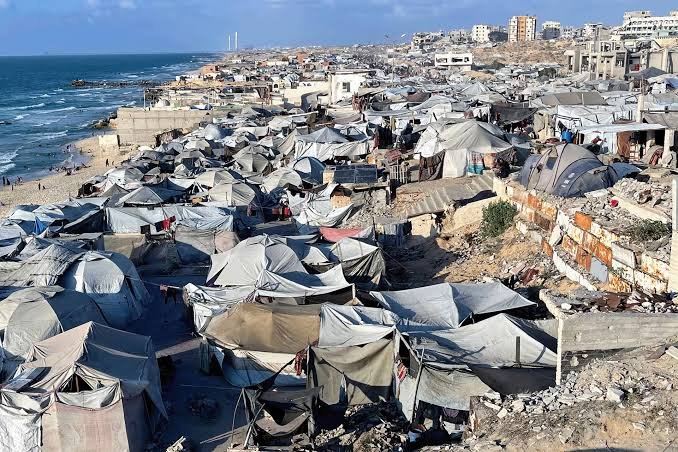
ICSPR warns that the continuation of killings, bombardment, and restrictions on the entry of essential supplies is accompanied by the deliberate or dangerously inadequate provision of the basic necessities of life in the Gaza Strip. This is occurring amid severe shortages of fuel, lubricants, and spare parts required to operate water wells, pumping stations, sewage systems, and municipal machinery. As a result, most water wells have ceased operating or are at risk of shutting down, while sewage services, waste collection, and road clearance face the threat of collapse, raising the risk of sewage overflows and the spread of diseases and epidemics, particularly in densely populated displacement areas.
ICSPR affirms that water, food, medicine, fuel, electricity, and sanitation are not bargaining chips or instruments of political pressure. Denying civilians access to the basic necessities of life or obstructing their delivery can have catastrophic consequences for the rights to life, health, and human dignity. ICSPR calls for the urgent and sustained entry of fuel, water, food, medicines, medical supplies, and spare parts, while ensuring the protection of health facilities, municipalities, and medical, humanitarian, and technical personnel and enabling them to continue their work.
ICSPR stresses that the continuation of these policies amid the collapse of the healthcare system compounds the risks faced by patients, wounded persons, children, women, and older persons, leaving thousands of medical cases vulnerable to death or serious complications due to shortages of medicines, medical supplies, and fuel and the inability to access treatment. ICSPR warns that the collapse of water and sanitation services on top of the existing health crisis could trigger a new wave of diseases and epidemics that could be prevented if the necessary political and humanitarian will were available.
ICSPR calls on the international community, the United Nations, the Security Council, States Parties to the Geneva Conventions, and States Parties to the Convention on the Prevention and Punishment of the Crime of Genocide to move from condemnation and appeals to effective enforcement. This must include taking collective and effective measures to halt killings and assassinations, provide international protection for civilians, ensure implementation of the second phase of the ceasefire, secure the withdrawal of Israeli occupation forces from the Gaza Strip, open the crossings, guarantee the full flow of humanitarian assistance, fuel, medicine, food, and water, and prevent displacement, settlement, and any alteration of the geographic and demographic reality of the Strip.
ICSPR calls on the United States, the mediators, and the parties sponsoring the ceasefire agreement to assume their political and legal responsibilities and use their influence to compel the Israeli government to fulfill its obligations under the agreement. Recovery and reconstruction in Gaza must be treated as Palestinian rights, not as instruments for reshaping the Strip or coercing its population. The occupying power must not be permitted to continue policies aimed at politically and geographically restructuring Gaza.
ICSPR stresses that any arrangements for recovery and reconstruction must guarantee the return of displaced persons to their areas, preserve the unity of the Gaza Strip, the West Bank, and Jerusalem, and respect the unity of the Palestinian political and legal system. Such arrangements must be based on the participation of Palestinian institutions, the United Nations and its agencies, including UNRWA, civil society organizations, and local actors, and must be linked to a political process that ends the occupation and guarantees the Palestinian people’s right to self-determination.
ICSPR emphasizes that the Gaza Port massacre, official incitement to kill Palestinians, the refusal to implement the second phase of the ceasefire, continued assassinations, the deprivation of the necessities of life, and the humanitarian and health collapse are not isolated crimes or developments. Rather, they are interconnected elements of a criminal policy aimed at keeping Palestinians subjected to killing, siege, and control, imposing the outcomes of the war by force, and transforming temporary realities into a permanent colonial reality.
ICSPR stresses that what is required today is not more statements of condemnation and appeals, but the effective enforcement of Israel’s obligations to halt killings, incitement, and assassinations; implement the second phase of the ceasefire; withdraw from the Gaza Strip; open the crossings; ensure the entry of sufficient humanitarian aid, temporary shelters, fuel, food, water, and medicine; protect civilians, health facilities, and essential services; prevent displacement and settlement; and pave the way for the reconstruction of Gaza, ultimately leading to an end to the occupation and the realization of the Palestinian people’s right to self-determination.
End
International Commission to Support Palestinian Rights (ICSPR)