
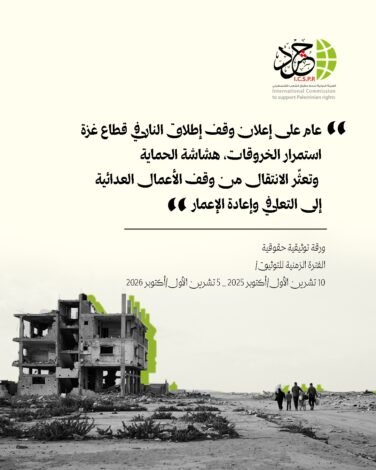
ICSPR A Year into Gaza’s Ceasefire, Continued Casualties and Stalled Reconstruction Reveal a Dangerous Gap Between the Agreement and Civilian Protection

Date: 7 October 2026
Press Release
ICSPR: A Year into Gaza’s Ceasefire, Continued Casualties and Stalled Reconstruction Reveal a Dangerous Gap Between the Agreement and Civilian Protection
The International Commission to Support Palestinian Rights (ICSPR) has issued a human rights documentation report titled “A Year Since the Announcement of the Ceasefire in the Gaza Strip: Continuing Violations, Fragile Protection, and the Stalled Transition from the Cessation of Hostilities to Recovery and Reconstruction.” Covering the period from 10 October 2025 to 5 October 2026, the report assesses the agreement’s impact on civilian protection, the restoration of essential services, safe return, and recovery.
The Commission affirms that the decline in large-scale military operations has not translated into sustained protection for the population or an end to the humanitarian crisis. Continuing violations, restrictions, and shortages of services have left large sections of the Palestinian population in a prolonged state of emergency. It stresses that the success of a ceasefire cannot be measured solely by a reduction in fighting, but must also be assessed by an end to violations, secure humanitarian access, the restoration of the basic conditions for life, and accountability.
Continuing Violations and Casualties
According to the cumulative figures presented in the report, 1,460 Palestinians were killed and 5,116 others injured between the ceasefire’s entry into force on 10 October 2025 and 5 October 2026. ICSPR considers that these continuing human losses reveal the fragility of protection arrangements and demonstrate that civilians remained exposed to death and injury during a period that should have enabled the restoration of security and civilian life.
The report records the killing of more than 300 children and approximately 246 women and girls during the ceasefire period. It also addresses casualties among journalists, medical personnel, humanitarian workers, fishermen, and police officers. The Commission stresses that these incidents require independent investigations to establish the circumstances of each case, determine responsibility, and uphold the rights of victims and their families.
The report examines several patterns of violations, including shooting, bombardment, and attacks on vehicles, homes, and tents, alongside risks arising from the military presence and restrictions on access to various areas, particularly those near deployment lines.
ICSPR explains that the direct consequences extend beyond casualties to obstructing families’ return to their communities and property and weakening their ability to travel, work, and obtain services. It argues that persistent fear and uncertainty prevent a transition from merely reducing hostilities to achieving the stability necessary for recovery.
Displacement, Shelter, and Safe Return
The report identifies the shelter crisis as one of the clearest manifestations of continuing hardship. The shelter assessments it reviews indicate that approximately 94% of the Gaza Strip’s population—around 1.98 million people—need shelter assistance and non-food items, while approximately 65% of households live in tents or temporary shelters.
The Commission affirms that the return of large numbers of residents to their communities does not necessarily mean a return to normal life, given widespread destruction and shortages of safe housing, water, electricity, health care, and education. Rubble, war remnants, and unexploded ordnance also obstruct a stable and dignified return.
The report warns against treating return simply as geographic movement without ensuring safety, housing, and services. ICSPR stresses that protecting displaced people’s rights requires enabling them to make voluntary and informed decisions, securing living conditions that preserve their dignity, and avoiding placing the burden on families to adapt to an environment lacking the basic necessities of life.
The report also affirms that the needs of children, women, patients, persons with disabilities, and displaced families must remain central to humanitarian responses and recovery plans. Their rights must not be marginalised in favour of political or security arrangements that fail to provide tangible protection.
Health, Water, and Food Security
In the health sector, the report presents data indicating that only 19 of 36 hospitals were partially functioning in September 2026, with no hospital operating at full capacity. It links this continuing fragility to shortages of medicines, supplies, equipment, and fuel, as well as difficulties in providing specialised treatment within the Gaza Strip.
ICSPR affirms that the continuing need for medical evacuation among thousands of patients and injured people reflects the gap between health needs and available capacity. It calls for facilitating access to treatment outside Gaza while rehabilitating health facilities and supplying the materials needed to operate them, so that service disruptions do not become an additional cause of death or worsening disabilities.
Regarding water, the report states that the average quantity reaching residents between October 2025 and February 2026 was approximately 21.2 litres per person per day, with sharp disparities across the Gaza Strip and a large proportion of households relying on water tankers. It explains that relief arrangements have not resulted in the sustainable restoration of water and sanitation networks.
The Commission stresses that providing water is inseparable from repairing networks, operating pumping and treatment stations, and allowing the entry of fuel and spare parts. Continued reliance on emergency solutions leaves residents vulnerable to service interruptions and health risks.
On food security, the report records a relative improvement compared with the most severe phases of the war, owing to increased aid flows and improved access to food during some periods. However, it emphasises that this improvement remained fragile and insufficient. It reviews an analysis indicating that more than 1.2 million people, representing approximately 59% of the population covered by the analysis, faced crisis or worse levels of food insecurity between mid-April and the end of June 2026.
ICSPR considers regular aid deliveries and the restoration of livelihoods to be complementary requirements for addressing the crisis. Improved supplies during a particular period do not ensure stable food security while households continue to lack income, services, and the ability to meet their basic needs.
Implementation, Recovery, and Accountability Gaps
The report identifies four principal gaps: a protection gap associated with continuing casualties and violations; a humanitarian implementation gap arising from persistent restrictions and unmet basic needs; a recovery gap resulting from the slow rehabilitation of housing, services, and infrastructure; and an accountability gap linked to the absence of an effective and transparent mechanism for investigating incidents, establishing responsibility, and holding perpetrators accountable.
The Commission explains that the commitments examined in the report extend beyond halting military operations to allowing aid entry and facilitating its distribution, opening crossings and ensuring freedom of movement, facilitating medical evacuation, guaranteeing return and preventing forcible displacement, rehabilitating facilities, and initiating recovery and reconstruction.
It affirms that difficulties in implementing these commitments have kept residents dependent on emergency assistance rather than enabling them to rebuild their lives. It also notes that reconstruction means more than constructing buildings: it requires restoring health, education, water, energy, roads, and public-service systems.
ICSPR stresses that international support for the agreement does not, by itself, guarantee implementation. What is needed is to translate announced commitments into measurable results that residents experience in their security, health, housing, and ability to travel, learn, and work.
Calls for Protection and Reconstruction
ICSPR calls for effective, measurable mechanisms to monitor ceasefire implementation, stronger independent oversight of violations and humanitarian access, and investigations that establish responsibility. It urges an approach that goes beyond political management of the agreement and provides clear tools for protecting civilians.
The Commission also calls for humanitarian aid to reach the population without unjustified obstacles and for regular deliveries of food, medicines, fuel, shelter and repair materials, and equipment needed to remove rubble and rehabilitate facilities. It stresses the need to facilitate movement through crossings and medical evacuations and to protect humanitarian and essential-service workers.
It calls for accelerated recovery and reconstruction under Palestinian leadership, with participation, respect for residents’ fundamental rights, and safe, voluntary, and dignified return. It stresses that political or security arrangements must not replace the fulfilment of legal and humanitarian obligations or perpetuate displacement and marginalise the rights of those affected.
ICSPR affirms that the approaching first anniversary of the ceasefire requires a serious assessment of what has been achieved on the ground. Continuing violations and immense humanitarian needs demand a shift from promises to implementation. It concludes that the purpose of a ceasefire is not merely to reduce the intensity of war, but to protect people, restore civilian life, enable recovery, and ensure justice and an end to impunity.