
(ICSPR) Publishes a Report on the Situation of Palestinian Women Prisoners in Israeli Occupation Prisons and the Violations Committed Against Them

Date: 16 August 2026
Press Release
International Commission (ICSPR) Publishes a Report on the Situation of Palestinian Women Prisoners in Israeli Occupation Prisons and the Violations Committed Against Them
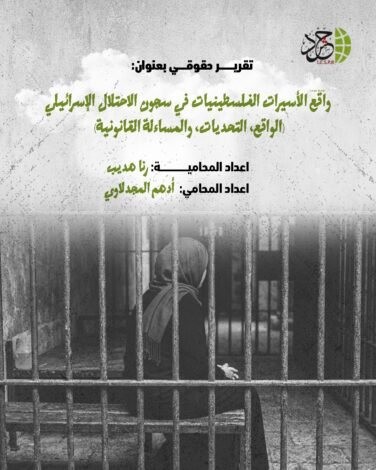
The International Commission to Support Palestinian Rights (ICSPR) has published a new human-rights report on the situation of Palestinian women prisoners in Israeli occupation prisons. Prepared by Attorney Rana Hudeib and Attorney Adham Al-Majdalawi, the report examines the dangerous changes in the policies of arrest, detention, torture, and cruel treatment imposed on Palestinian women, with particular focus on violations related to pregnancy, childbirth, and motherhood, as well as the impact of these practices on women prisoners, their children, and their families.
The report affirms that the issue of Palestinian women prisoners represents one of the most significant human-rights and humanitarian files reflecting the systematic repression and abuse practised by the occupation authorities against the Palestinian people. It notes that Palestinian women have not been exempt from policies of arrest and torture; rather, they have been targeted in ways that violate their human dignity, privacy, and fundamental rights.
The report covers the period from before 7 October 2023 through 2026, with particular focus on the changes affecting women prisoners after the pivotal events that followed 7 October, including the widespread escalation of arrest campaigns, the tightening of security and punitive measures inside prisons, and the increase in torture, medical neglect, and ill-treatment.
Geographically, the report focuses on the Israeli detention, interrogation, and prison facilities where Palestinian women are held, particularly Damon Prison, the primary detention facility for women prisoners, as well as Hasharon and Ofer prisons and other interrogation and detention centres. It also addresses the Israeli civilian hospitals to which women prisoners are transferred during childbirth or in critical medical cases.
The report explains that approximately 9,600 Palestinian prisoners and detainees are held in occupation prisons, amid an unprecedented escalation in daily arrest campaigns that have involved more than 11,500 arrests since 7 October 2023. The current number of women prisoners, detainees, and convicted women ranges between 84 and 99, a fluctuating figure due to the continuation of arrest campaigns and successive releases.
Approximately 25 women prisoners are being held under administrative detention without formal charges or trial. The report considers the use of administrative detention a tool of psychological and physical punishment and a means of depriving Palestinian women of fair-trial guarantees.
The report also documented at least 28 mothers held as prisoners, including pregnant women, in addition to two girls under the age of 18. The prisoners also include university students, journalists, human-rights defenders, activists, and academics, reflecting the broad scope of targeting affecting different groups of Palestinian women.
The report addresses cases of women prisoners from the Gaza Strip who are being held in isolation from the outside world amid a policy of enforced disappearance and field detention. The occupation authorities have refused to disclose their names or exact numbers and have denied the International Committee of the Red Cross permission to visit them or monitor their conditions.
ICSPR affirms that, even before October 2023, Palestinian women prisoners were held in harsh detention conditions that violated the minimum international standards for the treatment of prisoners and deprived them of the basic elements of their social, health, and humanitarian rights. However, these conditions deteriorated dramatically after 7 October, with the escalation of punitive measures, the tightening of detention conditions, and the increase in torture and medical neglect.
The report states that the Israeli Prison Service has adopted a range of practices violating women prisoners’ fundamental rights, including systematic medical neglect, malnutrition, overcrowding, confiscation of personal belongings, electricity cuts, deprivation of medical treatment and medication, and the denial of personal hygiene supplies.
It notes that women prisoners are subjected from the moment of arrest to violent night-time raids on their homes, the terrorisation of family members, beatings, pushing, verbal abuse, the binding of hands, blindfolding, and forced and degrading body searches, including partial nudity in some cases.
Some detainees are also forced to sit or stand in degrading positions for long periods during transfer. Their personal belongings are confiscated or damaged, including clothing, blankets, personal items, books, notebooks, letters, family photographs, and money held in “canteen” accounts.
The report explains that these practices have effects beyond material deprivation. They aim to humiliate women prisoners, break their psychological will, sever their links with their families, and deprive them of the basic means that help them cope with detention and preserve their human dignity.
The report examines the harsh living conditions inside occupation prisons, noting that most women prisoners are held in overcrowded rooms and sections, particularly in Damon Prison. The facilities exceed their limited capacity and lack sufficient beds and appropriate blankets, while suffering from poor ventilation, high humidity, and difficult conditions for maintaining privacy and general hygiene.
Overcrowding has also reduced opportunities for movement and access to the prison yard, increased the likelihood of infectious diseases spreading, and caused profound psychological effects as women prisoners are forced to live in confined spaces for long periods under constant psychological pressure and tension.
Regarding nutrition, the report states that the Prison Service has reduced the quantities of food provided to women prisoners and supplied limited, poor-quality meals lacking the necessary variety and nutritional value. The meals also lack proteins, vitamins, vegetables, and fruit, including the specific nutritional needs of sick, pregnant, and breastfeeding prisoners.
Some food is reportedly spoiled or unfit for consumption, while women prisoners are prevented from purchasing food from the “canteen” or compensating for shortages in the meals provided. This has resulted in weight loss, persistent hunger, exhaustion, weakened immunity, and dizziness, particularly among prisoners suffering from chronic illnesses.
The report also documents the confiscation of women prisoners’ personal belongings during arrest or repeated searches inside the prison sections. These belongings include clothing, blankets, hygiene products, personal items, books, notebooks, letters, family photographs, and basic electrical devices permitted inside the prisons.
Testimonies from released women prisoners confirm that confiscation campaigns are often accompanied by the destruction of room contents and personal belongings. They leave deep psychological and emotional effects, particularly when letters and family photographs are confiscated, as these items constitute an important means of maintaining emotional contact with family members.
According to the report, these policies directly affect the living conditions of women prisoners, who are forced to live without adequate clothing and basic necessities and face difficulty replacing them because of restrictions on bringing in or purchasing supplies.
The report also addresses the policy of cutting electricity. It explains that the Prison Service deliberately cuts electricity for long periods or repeatedly, while reducing water supplies, restricting access to facilities, and preventing women prisoners from entering the prison yard.
These measures deprive women prisoners of lighting and ventilation, disable ventilation systems during periods of high temperatures, and increase their suffering inside the rooms, particularly for sick and elderly prisoners. They also cause sleep disturbances and increase feelings of isolation and anxiety.
Regarding the denial of treatment and medication, the report states that the Israeli Prison Service follows a dangerous policy involving delays in treatment, reductions in medication supplies, or the complete denial of medication. In some cases, it provides painkillers instead of medical examinations or specialised treatment.
This policy also includes refusing or delaying the transfer of women prisoners to hospitals for surgery or diagnostic examinations, failing to provide timely care, and depriving pregnant women prisoners of specialised healthcare, pregnancy monitoring, and periodic gynaecological examinations.
The report notes the deteriorating condition of prison clinics due to shortages of medication, medical supplies, and healthcare personnel, as well as the denial of psychological care to women prisoners despite the severe psychological pressure caused by traumatic arrest and harsh detention conditions.
These practices contribute to the worsening of chronic illnesses, weakened immunity, increased pain, and a heightened risk of health complications that may later become difficult to treat, turning medical neglect into a systematic punitive policy.
Women prisoners are also deprived of personal hygiene supplies, including soap, shampoo, toothpaste, toothbrushes, and sanitary pads. Water necessary for bathing and cleaning is reduced or denied, and the times at which it may be used are restricted.
The occupation authorities fail to provide women prisoners with sufficient quantities of women’s hygiene products and prevent the entry of clean clothes and blankets or delay their replacement, amid limited access to regular cleaning materials, poor ventilation, and the spread of humidity and insects in some cells.
This has increased the risk of skin diseases, infections, and communicable illnesses, in addition to deteriorating women prisoners’ physical and psychological health and creating feelings of humiliation and loss of human dignity.
Pregnant Women Prisoners and Mothers Behind Bars
The report devotes a special section to the conditions of pregnant women prisoners, mothers, and childbirth behind bars. It affirms that women prisoners face compounded suffering as a result of starvation policies and harsh and inhumane detention conditions, threatening the lives of the women, their unborn children, and their infants.
The report explains that pregnant women prisoners are subjected to harsh practices beginning at the moment of labour and transfer. When signs of labour appear, they are not transported humanely; instead, their hands and feet are shackled with metal chains before they are removed from their cells.
The prisoner is then transported for long hours in a poorly ventilated metal military vehicle known as the “bosta,” which intensifies the pain of labour because of the vehicle’s vibrations and the lack of comfortable seating.
Inside the operating room, the prisoner is forced to remain shackled to the delivery bed throughout labour. The restraints are not removed until the final minutes before the baby is delivered. After childbirth, the restraints are reapplied to the prisoner’s hands and feet within a period of only five to ten minutes to allow doctors to complete the delivery procedure.
Childbirth takes place under strict security supervision, while the husband, mother, or any other family member is prohibited from attending to provide psychological support to the prisoner during this sensitive stage.
After childbirth, the mother and her newborn are returned to prison within a few days, and sometimes within only 48 hours, without consideration for the body’s need for rest and postpartum recovery.
The infant is also held with the mother inside the cell in an environment unsuitable for breastfeeding and lacking sunlight, ventilation, and basic infant supplies, such as sterilising materials, suitable food for the breastfeeding mother, and nappies.
After spending a limited period with the mother inside the prison, the Prison Service forces the mother to hand the child over to the family outside the prison, causing severe psychological trauma to both mother and child.
The report affirms that childbirth by women prisoners inside occupation prisons is not an isolated or exceptional occurrence but a systematic and longstanding practice dating back to the early years of the occupation. Human-rights organisations documented the first case of a woman prisoner giving birth inside prison in 1972, when prisoner Umaima Zaki Shamout gave birth. Dozens of similar cases followed, including those of prisoners Majda Al-Salmi, Manal Al-Agha, Mirفت Taha, Samar Subaih, and Fatima Al-Zaq.
These cases demonstrate the continuation of the policy of holding children with their mothers under harsh detention conditions, where women prisoners are shackled by their hands and feet and deprived of healthcare, food, and the basic necessities required by both mother and child.
The report affirms that these practices constitute a flagrant violation of the rights of women prisoners and children and contradict the provisions of international humanitarian law and international human-rights law, particularly the rules concerning the protection of pregnant women, mothers, and children; the prohibition of torture and cruel and degrading treatment; and the right to health and human dignity.
ICSPR concludes that the violations suffered by Palestinian women prisoners do not constitute isolated practices or individual excesses. Rather, they form part of a systematic policy aimed at subjugating women prisoners, breaking their will, depriving them of their fundamental rights, and using arrest, torture, medical neglect, solitary confinement, and deprivation of family contact as tools of pressure and collective punishment.
The Commission calls on the international community, the United Nations, the International Committee of the Red Cross, and international human-rights and women’s organisations to assume their legal and humanitarian responsibilities towards Palestinian women prisoners, ensure that they receive immediate and regular visits, disclose the conditions of detainees from the Gaza Strip, and end the policies of enforced disappearance and administrative detention.
It also calls for the immediate release of women prisoners, children, pregnant prisoners, and sick prisoners; the provision of necessary medical and psychological care; the transfer of sick and pregnant prisoners to civilian hospitals without restrictions or delay; and the provision of pregnancy and childbirth care in accordance with medical and humanitarian standards.
ICSPR calls for an end to torture, ill-treatment, degrading searches, and solitary confinement; the improvement of detention conditions; the provision of sufficient food, clean water, hygiene supplies, clothing, and blankets; and the guarantee of communication with families, lawyers, and human-rights organisations.
The Commission stresses the need for an independent international investigation into the crimes and violations committed against Palestinian women prisoners, accountability for those responsible, and guarantees that perpetrators of torture, medical neglect, and gender-based violence will not enjoy impunity.
It further stresses that protecting Palestinian women prisoners is not merely a matter of political solidarity but an obligation under international law. The continuation of these violations in the absence of accountability encourages the occupation to continue its repressive policies and threatens the lives, dignity, and fundamental rights of Palestinian women.