
ICSPR: Protecting Palestinians in Europe Must Not Be Held Hostage to Political Polarisation—Combating Discrimination Begins with Ensuring Justice and Freedom of Expression
 wasem aa
Send an email
wasem aa
Send an email
Date: 12 October 2026
Press Release
ICSPR: Protecting Palestinians in Europe Must Not Be Held Hostage to Political Polarisation—Combating Discrimination Begins with Ensuring Justice and Freedom of Expression
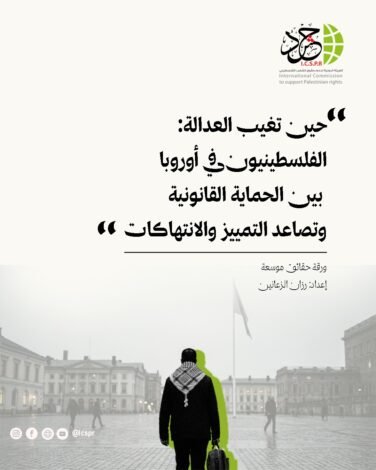
The International Commission to Support Palestinian Rights (ICSPR) has issued an extensive fact sheet titled “When Justice Is Absent: Palestinians in Europe Between Legal Protection and Rising Discrimination and Violations.” The paper examines the challenges facing some Palestinians in European countries and the gap between legal safeguards and actual practices. It calls for equal protection of rights and freedoms, improved access to justice, and action against racism and hate speech.
Through the paper, the Commission affirms that the protection of Palestinians’ rights must not be affected by political polarisation surrounding the Palestinian issue. Commitment to human rights is measured not merely by the existence of legislation, but by its fair and effective application to everyone, regardless of their national origin, legal status, or peaceful political views.
The paper explains that many Palestinians have sought safety, protection, and stability in Europe after experiencing displacement, war, and the loss of the basic conditions necessary for life. Some, however, face challenges relating to freedom of expression and peaceful assembly, discrimination, asylum procedures, statelessness, and difficulties in obtaining legal assistance and effective remedies.
ICSPR stresses that Palestinian communities in Europe are not a homogeneous group. They include European citizens of Palestinian origin, residents, refugees, asylum seekers, and stateless persons. These differing circumstances affect the level of protection and access to services, requiring responses that address each group’s needs.
The paper also clarifies that these challenges do not mean that all Palestinians face the same level of discrimination or that European countries pursue a uniform policy towards them. Rather, they highlight the need for regular, accurate monitoring of practices and the assessment of each case against human rights standards.
The paper notes that these challenges became more pronounced following the outbreak of the war in the Gaza Strip in October 2023, amid increasing political and social polarisation. Restrictions emerged on some demonstrations and events supporting Palestinian rights, alongside professional, media, and academic pressures experienced by some individuals because of their views.
The paper examines measures that included banning gatherings or imposing conditions on them, restricting the use of certain Palestinian symbols and slogans, and taking action against activists, students, and academics. ICSPR stresses the need to review these restrictions to ensure that they have a clear legal basis, are necessary and proportionate, and are not applied in a discriminatory manner.
The Commission affirms that peaceful expressions of support for Palestinian rights must receive the same protection afforded to other lawful political views. Palestinian identity or expressions of solidarity must not become grounds for exclusion or restrictions.
At the same time, the paper distinguishes between restrictions that may be based on legitimate legal and security considerations and those that are disproportionate or selective. It emphasises the importance of allowing challenges and review, rather than assuming in advance that every measure is either lawful or unlawful.
The paper explores the overlap between discrimination based on Palestinian origin, restrictions arising from political positions, and racism against Arabs and Muslims in some European contexts. It argues that this overlap can heighten individuals’ vulnerability, particularly when combined with insecure residence status or linguistic and social difficulties.
The paper reviews data indicating that approximately 47% of Muslims surveyed in a European study reported experiencing forms of discrimination. It stresses, however, that this figure is not a direct measure of discrimination against Palestinians, but an indicator of the broader environment that may affect them when their Palestinian identity intersects with an Arab or Muslim identity.
ICSPR calls for clear mechanisms to monitor discrimination linked to Palestinian identity or peaceful support for Palestinian rights, while respecting privacy and protecting the data of those affected. It urges against merely placing their experiences within broad categories that may fail to capture the specific nature of the challenges they face.
Regarding international protection, the paper examines difficulties faced by some Palestinian refugees and asylum seekers, including delays in processing applications, complications in family reunification, limited access to specialised legal assistance, and concerns about administrative detention or return in some individual cases.
The Commission stresses the need for fair and effective asylum procedures and individual assessments of protection claims, taking account of the humanitarian and political circumstances surrounding Palestinian cases and respecting the principle of non-refoulement.
The paper also addresses the burden of statelessness and the difficulties it may create in obtaining secure residence status or travel documents, accessing employment and education, travelling, reuniting with family members, and registering civil-status events. It warns against leaving individuals in prolonged legal uncertainty without clear pathways to regularise their status or obtain protection.
ICSPR calls for procedures that ensure stateless persons receive the necessary documentation and legal protection and prevent them from remaining in a legal vacuum or unjustified detention, alongside stronger legal advice and support services.
The paper explains that Palestinian refugee women may face compounded risks arising from the intersection of gender, national origin, legal status, and experiences of displacement. These include difficulties in accessing justice, exposure to violence, and limited access to specialised psychosocial support.
The Commission stresses the need for additional safeguards for pregnant women and survivors of violence, consideration of their needs during asylum procedures and interactions with authorities, and access to care, legal assistance, and protection services.
In this context, the paper discusses published reports concerning a pregnant Palestinian refugee in the Netherlands. It emphasises the need to await the outcomes of judicial and human rights investigations before reaching definitive conclusions about the facts and responsibility. It considers that such cases highlight the importance of independent and transparent investigations, without prejudging their findings, and of protecting the most vulnerable women.
The paper also examines concerns surrounding reviews of funding for some Palestinian and civil society organisations, the suspension of certain forms of support, and the imposition of additional oversight requirements. It considers the potential effects on these organisations’ ability to continue humanitarian, human rights, and documentation activities.
ICSPR affirms that financial oversight and efforts to combat terrorist financing must not become tools for restricting legitimate civil society work. It calls for any restrictive measures to be based on transparent and objective criteria, to be necessary and proportionate, and to be open to challenge, with safeguards for affected organisations.
The Commission argues that protecting civic space requires balancing legitimate oversight requirements with the continued operation of human rights and humanitarian activities. Organisations must not be subjected to blanket suspicion because of their Palestinian identity or the issues they advocate for.
ICSPR calls on European governments to ensure equal enjoyment of freedom of expression and peaceful assembly, review restrictions imposed on events related to the Palestinian issue, and conduct independent and transparent investigations into allegations of violence and ill-treatment by authorities.
It also calls for stronger legal protection for women, children, refugees, asylum seekers, and stateless persons; access to legal assistance, complaint mechanisms, and effective remedies; and safeguards to ensure that measures addressing terrorism or incitement do not restrict legitimate human rights and civil society activity.
The paper recommends including Palestinians’ circumstances within mechanisms monitoring discrimination, racism, and hate speech, developing tools to track restrictions on their civil and political rights, and strengthening accountability to ensure the effective implementation of international and European obligations.
It further calls for greater cooperation between Palestinian and European organisations to document cases, produce periodic reports comparing legislation with actual practices, and support those affected, while systematically distinguishing between lawful restrictions and discriminatory or disproportionate practices.
ICSPR concludes that ensuring equal rights for Palestinians in Europe is a test of the credibility of the human rights system and its ability to apply its principles without selectivity or political polarisation. It stresses that dignity, equality, and justice are not rights that change according to a person’s identity or peaceful political views. Genuine protection begins when legal safeguards become a reality that affected individuals can access and benefit from.