

ICSPR Holds Dialogue on Multitrack Diplomacy and the Role of Divesting U.S. Municipal Funds from Israel Bonds in Confronting the Occupation

October 30, 2026
Press Release
ICSPR Holds Dialogue on Multitrack Diplomacy and the Role of Divesting U.S. Municipal Funds from Israel Bonds in Confronting the Occupation
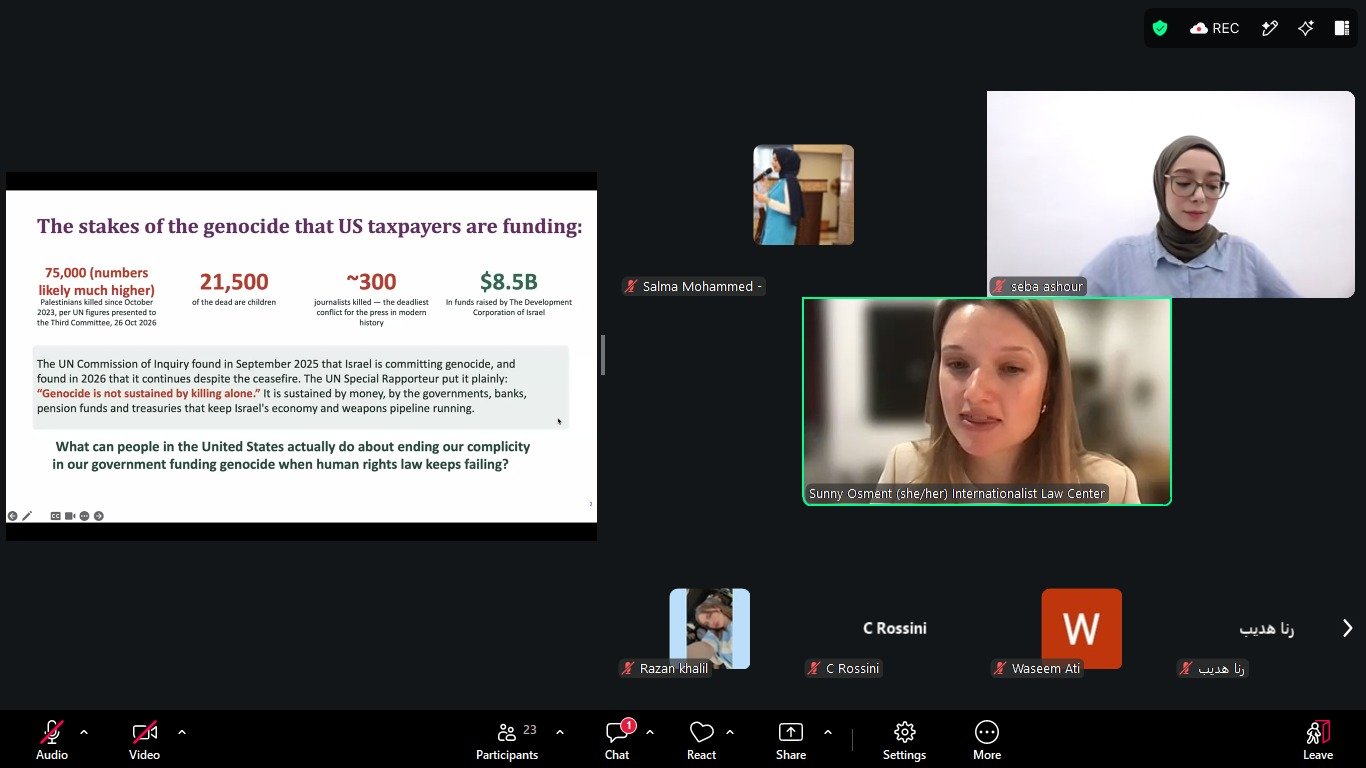
The International Commission to Support Palestinian Rights (ICSPR) held an international dialogue on Thursday, October 29, 2026, to examine how multitrack diplomacy and legal and financial mechanisms can be used to confront the Israeli occupation. The discussion focused in particular on investments by U.S. local governments and municipalities in Israel Bonds. The guest speaker was attorney Sani Osment, a litigation attorney at the Center for International Law in the United States. Saba Ashour and Salma Mohammed facilitated the two-hour session.
The meeting examined ways to develop human-rights and civic action in light of the obstacles facing international accountability efforts and lawsuits concerning U.S. policies toward Gaza. Participants discussed the importance of neither limiting their response to condemning violations nor relying on a single legal avenue. Instead, they considered how field documentation, litigation, grassroots organizing, and scrutiny of public institutions’ decisions to invest taxpayers’ money in Israeli-issued bonds could work together.
During the meeting, Osment presented an approach that would direct part of the legal and grassroots effort toward points of economic influence that can be examined and challenged. She explained that investment decisions made by U.S. counties and municipalities open a legal discussion about the management of public funds, returns, liquidity, and the protection of taxpayers’ money, alongside the political and human-rights questions raised by those investments.
The discussion outlined three complementary tracks. The first is official diplomacy, conducted by states and diplomats through international institutions and encompassing treaties, summits, Security Council decisions, and sanctions. The second is led by experts, academics, and non-governmental organizations through informal dialogue, policy development, and approaches to conflict resolution. The third relies on civil society, youth activists, local communities, and legal networks through public campaigns, litigation, direct economic action, and calls to review public investments.
Participants emphasized that these tracks do not cancel one another out. Official diplomacy remains an important forum for demanding the protection of rights; experts and human-rights organizations can develop arguments and legal case files; and grassroots action gives local communities a means of influencing decisions that affect public funds. The session focused particularly on what the grassroots track can achieve when broad demands are translated into specific measures before local councils and the bodies responsible for investment decisions.
Osment addressed the limits of relying exclusively on international human-rights law and litigation in U.S. courts. She pointed to the impact of the United States’ use of its veto in the Security Council on certain international enforcement efforts. She also noted that measures or rulings issued by the International Court of Justice do not, by themselves, resolve the difficulties of implementation in the absence of political support and effective enforcement mechanisms.
She also discussed the obstacles facing lawsuits that challenge U.S. military assistance or arms transfers. She cited Defense for Children International–Palestine v. Biden as an example of the debate over federal courts’ authority to review decisions involving foreign policy and the executive branch, including arguments based on the “political question doctrine” and sovereign immunity. As described in the meeting report, she explained that a court’s recognition of the gravity of the facts presented in a case does not necessarily mean it will consider itself empowered to grant the judgment or remedy sought by the plaintiffs.
Participants stressed that these obstacles do not mean abandoning litigation or documentation. Rather, they call for a broader range of tools. International and domestic legal avenues can continue while advocates also examine financial and administrative decisions governed by different legal standards and seek to hold the responsible bodies accountable at the local level.
Against this background, Osment presented a proposal for action concerning municipal investments in Israeli bonds, known as Israel Bonds. The session discussed the nature of these bonds as debt instruments issued by Israel, whether they can be traded before maturity, and how their returns compare with other options available to public institutions.
Her argument centered on the duty of county and municipal treasury officials to manage taxpayers’ money according to financial and legal standards, including preservation of capital, liquidity, and an appropriate return. According to the presentation, the question is not only where an institution stands on Israeli policies, but also whether the investment decision itself meets the requirements of sound public-fund management.
Osment compared investments in Israel Bonds with other instruments, including U.S. Treasury securities, certificates of deposit, and money market funds. The comparison focused on an investor’s ability to access or dispose of its funds before maturity, as well as the returns and risks associated with each instrument. It was presented as a basis for requesting and examining investment data, rather than relying solely on general political objections that do not address the financial details of a decision.
The speaker drew on South Africa’s experience under apartheid to illustrate the importance of economic pressure alongside political and moral positions. She referred to the role of financial institutions and lending decisions in exerting pressure on the system at that time, suggesting that assessments of financial risk and investor behavior can become influential when linked to sustained, organized action.
The meeting also examined Palm Beach County, Florida, as a case study in local action concerning the investment of public funds in Israel Bonds. According to the session report, grassroots and legal efforts drew on a review of investment officials’ duties and raised questions about returns, liquidity, and whether the bonds were suitable under public-fund management policies.
Osment stated that pressure from taxpayers and legal action concerning fiduciary duty contributed to a reduction in the maximum permitted investment in Israel Bonds from 25% to 15%. The report also stated that this policy change was associated with the withdrawal of more than $250 million in public funds. These figures were presented during the meeting as part of the speaker’s case study.
The session highlighted a practical lesson from the case: action can begin with a request for access to public-investment records, followed by a comparison of those records with the standards governing the responsible authority’s management of funds. This can lead to scrutiny of the decision before local councils or through available legal channels. In this way, financial transparency, audits of investment portfolios, and taxpayer participation become tools of civic action rather than issues separate from human-rights advocacy.
Regarding the role of Palestinian organizations, the discussion addressed the need to connect documentation of destruction and violations in Gaza with the work of legal and research teams outside Palestine. The recommendations emphasized collecting and organizing field data and making it available to specialized researchers, so they can develop more precise case files and examine potential links between events on the ground and relevant investment decisions or entities.
The recommendations also addressed building alliances with local taxpayers in the United States, union members, and human-rights and legal organizations. According to the proposal discussed, these groups could review state, county, and municipal investment portfolios; identify public treasuries with significant holdings of Israel Bonds; and request publicly available audit data on the scale of those investments, their returns, and associated liquidity risks.
The meeting further stressed that public communications aimed at local communities should be clear and specific. Rather than stopping at a call for divestment, campaigns should explain how public bodies make decisions about tax revenue, what alternative investments are available, and how those decisions may affect priorities for local services. Making this connection clear was seen as a way to broaden public discussion and engage people who may hold different political views but agree that institutions should be accountable for their management of public funds.
In an intervention during the meeting, Dr. Salah emphasized the distinction between individual consumer boycotts and institutional divestment. He explained that individual boycotts help raise awareness and encourage community participation, while institutional divestment campaigns address decisions involving larger sums and direct financial flows. The two were discussed as tools with different scales and mechanisms of impact, rather than as automatic substitutes for one another.
The meeting concluded by emphasizing the importance of continued coordination among those documenting events in Gaza, legal experts, and local campaigns focused on public investments. Participants agreed that developing effective accountability tools requires sustained work: accurate documentation, legal arguments that can be examined, access to investment data, and organized civic action capable of monitoring decisions and holding those responsible for them accountable.