
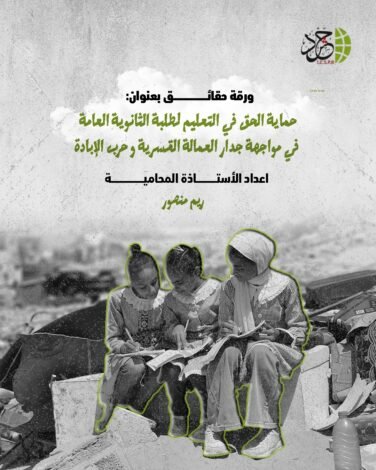
ICSPR Issues a Fact Sheet Titled: “Protecting the Right to Education for Secondary School Students in the Face of the Barrier of Forced Labour and the Genocide”

Date: 24 July 2026
Press Release
ICSPR Issues a Fact Sheet Titled: “Protecting the Right to Education for Secondary School Students in the Face of the Barrier of Forced Labour and the Genocide”
The International Commission to Support Palestinian People’s Rights (ICSPR) has issued a fact sheet prepared by lawyer Reem Mansour, titled: “Protecting the Right to Education for Secondary School Students in the Face of the Barrier of Forced Labour and the Genocide.” The paper examines the reality of the right to education for secondary school students in the Gaza Strip amid the genocidal war, including the extensive destruction of educational infrastructure, the disruption of schooling, worsening poverty, loss of income, and the growing phenomenon of forced and involuntary labour among students.
The paper explains that thousands of secondary school students have been left facing two harsh choices: dropping out of education or entering the labour market to help support their families and meet their basic needs. It argues that these conditions have created what can be described as a “barrier of forced labour,” preventing students from continuing their education and threatening their permanent exclusion from university education and future professional life.
The paper notes that education is a right guaranteed under international human rights law, yet it is subject to grave violations in the Gaza Strip as a result of the ongoing war, including attacks on schools and educational institutions and the mass displacement of the population. It stresses that secondary school students are among the most affected groups, as this stage represents the main gateway to university education and the determination of students’ future academic and professional paths.
According to the data reviewed in the paper, approximately 658,000 school-age children have been directly affected by the war, while more than 97% of school buildings have sustained varying levels of damage, ranging from partial to total destruction. Most schools therefore require reconstruction or comprehensive rehabilitation before regular education can resume. The use of many schools as shelters for displaced persons has also reduced the available educational space, while more than 660,000 male and female students face continuous or recurrent interruptions to their education.
With regard to secondary school students, the paper states that around 40,000 students in the Gaza Strip are registered to sit for their final secondary examinations, while approximately 24,500 students are taking examinations electronically and in stages under the exceptional conditions imposed by the war. Registration was also made available to around 41,000 students who had previously been unable to register because of the war, displacement, and the disruption of educational services, reflecting the scale of challenges facing this group.
The paper reviews several obstacles preventing secondary school students from continuing their education, including the destruction of educational infrastructure, repeated forced displacement, prolonged interruption of schooling, limited access to online learning, and shortages of educational materials and supplies. It also points to deteriorating household economic conditions due to the loss of income, rising poverty and unemployment, and increased psychological pressures and trauma resulting from the war and the loss of family members and friends, all of which directly affect students’ ability to concentrate, learn, and prepare for examinations.
The paper explains that governmental bodies and international and UN institutions have implemented a number of interventions to maintain educational continuity, including online learning platforms, distance-learning initiatives, alternative educational materials, and exceptional arrangements for secondary school examinations. It also refers to efforts by the Ministry of Education to establish temporary learning points in some displacement areas, develop plans to address learning loss, and enable students to complete graduation requirements and sit for examinations despite security and logistical challenges.
However, the paper stresses that the effectiveness of these interventions remains limited because of the scale of destruction and the persistence of exceptional conditions. Online education faces repeated power cuts, weak internet services, and a shortage of electronic devices among large numbers of students. Programmes aimed at addressing learning loss also remain unable to close the substantial educational gaps resulting from prolonged interruptions in education, alongside shortages of qualified teaching staff and the resources needed for comprehensive remedial programmes.
The paper highlights the growing prevalence of forced and involuntary labour among secondary school students as a result of the destruction of educational and economic infrastructure and the collapse of basic living conditions. It notes that the loss of the primary breadwinner due to killing, injury, or detention has contributed to the emergence of the “student breadwinner” phenomenon, whereby many students have been compelled to assume responsibilities beyond their age and work to meet the minimum daily needs of their families.
The paper further explains that deteriorating economic conditions, growing poverty and unemployment, repeated forced displacement, food insecurity, weak access to alternative education, and the lack of adequate social protection networks are all factors that compel students to prioritise work over continuing their education. It warns that this leads to lower academic achievement, increased risks of school dropout, wider educational gaps, and the entrenchment of cycles of poverty and unemployment within Palestinian society.
The paper addresses the physical and psychological risks faced by working students, including potential injury from remnants of war and unexploded ordnance, as well as exposure to dust and toxic substances resulting from widespread destruction. It also notes that early engagement in arduous or unsafe work deprives students of the time and capacity needed to learn and intensifies the effects of war-related trauma and social pressure.
The paper presents four policy alternatives for addressing the crisis and protecting the right to education: a financial support programme conditional on continued education; a national programme to address learning loss; the establishment of safe educational spaces and temporary learning centres in displacement areas and population centres; and an integrated programme for psychological and educational support.
The researcher recommends adopting an integrated educational protection programme as the most effective alternative, as it combines economic, educational, psychological, and social support. It addresses the core reasons that drive secondary school students to leave education or enter forced labour, provides more comprehensive protection for the right to education, and strengthens students’ ability to continue their educational path despite the exceptional circumstances in the Gaza Strip.
The paper concludes with a set of recommendations, most notably ensuring the continuity of education by providing safe and temporary learning environments throughout the Gaza Strip and implementing national programmes to address learning loss, with particular focus on secondary school students. It also calls for financial assistance and educational grants for the most affected families to reduce forced labour among students, strengthen psychosocial support programmes, and provide affected students with books, stationery, electronic devices, and internet services.
The paper further stresses the need to support online and blended learning by developing platforms suited to emergency conditions and providing the necessary technical resources for access. It calls for the occupying power to be required to respect and protect educational institutions in accordance with international humanitarian law and to cease targeting schools, universities, and educational facilities. It also calls for enabling secondary school students to sit for examinations in fair and appropriate conditions that ensure equal opportunities and take into consideration the exceptional circumstances they have endured during the war.
ICSPR affirms that this fact sheet forms part of its efforts to protect the right to education, monitor the impact of the genocidal war on Palestinian students, and promote integrated educational, economic, and psychological responses that prevent the loss of the future of an entire generation of students in the Gaza Strip.
To read the full fact sheet, click here: