
ICSPR: Reconstruction in Gaza Between the Arab Plan and Trump’s Plan… Israeli Delays Hinder Recovery

Date: January 15, 2026
Press Release
ICSPR: Reconstruction in Gaza Between the Arab Plan and Trump’s Plan… Israeli Delays Hinder Recovery
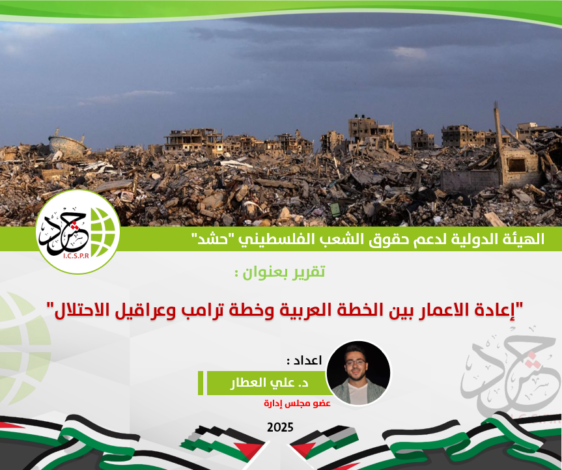
The International Commission to Support the Rights of the Palestinian People – ICSPR issued a comprehensive analytical report on the situation of Gaza’s reconstruction. Prepared by Dr. Ali Al-Attar, Board Member, the report highlights the massive destruction caused by the genocidal war launched by the Israeli occupation since October 7, 2023, and the ongoing obstacles hindering the early recovery process in the Strip.
The report confirmed that the residents of Gaza are living through the largest humanitarian and material devastation globally, with more than 102,067 homes completely destroyed and approximately 330,550 units partially damaged. In addition, the health system has been almost entirely destroyed, leaving only 17 hospitals partially operational. The report also documented the total destruction of 143 schools and universities, partial damage to 366 educational institutions, and the complete collapse of the judicial system, including courts, public prosecution offices, and legal files.
Dr. Al-Attar emphasized that the Israeli occupation continues to prevent civil defense and municipal teams from clearing rubble and removing debris, and hinders the recovery of the remains of martyrs, despite the implementation of the ceasefire agreement.
The Comprehensive Arab Plan – The Egyptian Initiative for Reconstruction
The report highlighted that the Arab Republic of Egypt has been providing humanitarian aid through the Rafah crossing since the beginning of the war. Subsequently, Egypt proposed a comprehensive reconstruction initiative for Gaza valued at $53 billion, approved by the Arab Emergency Summit in Cairo on March 4, 2025.
The initiative is divided into two main phases:
-
Early Recovery Phase (6 months, $3 billion): This phase includes clearing rubble from the central axis (Salah al-Din Axis) and other areas, providing 200,000 prefabricated temporary housing units, establishing seven sites to accommodate over 1.5 million people, and partially restoring 60,000 housing units to shelter approximately 360,000 individuals.
-
Reconstruction Phase (4.5 years, $50 billion): This phase includes constructing permanent housing units, rehabilitating 20,000 acres of agricultural land, building service and industrial facilities, a fishing port, a maritime port, and an airport, with a focus on integrating local communities and empowering civil society.
The report stressed that the plan protects the rights of the Palestinian population, prevents forced displacement, helps eliminate armed militias, and strengthens the authority of the Palestine Liberation Organization. However, it faces obstacles, including the Israeli occupation’s refusal to implement the plan and allow materials for reconstruction, as well as potential resistance from some Hamas factions to certain provisions.
U.S. President Donald Trump’s Plan
The report documented that President Trump’s plan, including the “Twenty-Point Plan,” despite being presented publicly as a peace initiative, poses a serious threat to Gaza’s territorial unity. It grants Israel control over more than 60% of Gaza, disarms Palestinian resistance, establishes an international transitional administration, provides guarantees for voluntary Palestinian relocation, and transforms the Strip into what is called the “Middle East Riviera” in economic and investment terms.
The report also noted that this plan affected Arab and Islamic positions after Israel made amendments, leading to a major discrepancy between official statements of support and the practical implementation on the ground. The report highlighted that Israel has violated the ceasefire agreement more than 740 times and continues to bomb residential areas deprived of essential services.
Israeli Delays and Their Consequences
The report emphasized that continued Israeli obstruction of essential materials and humanitarian aid could delay Gaza’s recovery for up to 350 years at the current pace, with costs exceeding $53 billion. It also confirmed that Israel is pursuing a systematic policy of “brain drain”, targeting highly skilled professionals, including doctors, academics, and journalists, to weaken Gaza and prevent rebuilding its human capacities.
Palestinian, Arab, and International Demands
ICSPR called for urgent action on the following levels:
-
Palestinian Level: Unify the national front under the PLO, consolidate arms, establish a technocratic committee to manage Gaza’s affairs, and conduct comprehensive elections.
-
Arab Level: Support the Egyptian initiative, pressure Israel to allow aid and implement the ceasefire, and participate in international litigation before the International Criminal Court.
-
International Level: Pressure Israel to allow reconstruction materials, monitor ceasefire violations, enable Palestinian civil society to participate in relief projects, and hold Israeli leaders accountable for war crimes in Gaza.
The report affirmed that reconstructing Gaza according to the comprehensive Arab plan is the way to ensure stability, protect the rights of its residents, and counter Israeli-American policies aiming to displace Palestinians and exploit their land.