
ICSPR Issues a Policy Paper on Israel’s Legal Obligations as an Occupying Power and Pathways to Advance International Accountability

Date: 13 September 2026
Press Release
ICSPR Issues a Policy Paper on Israel’s Legal Obligations as an Occupying Power and Pathways to Advance International Accountability
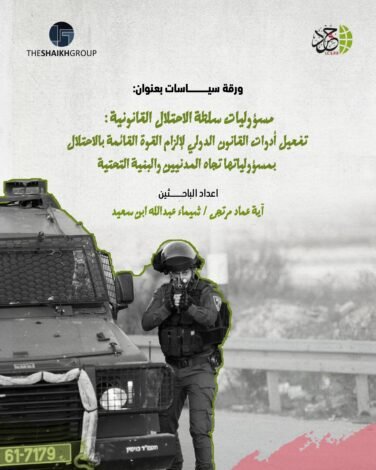
The International Commission to Support Palestinian Rights (ICSPR) has issued a policy paper on the legal obligations of the Israeli occupation authorities towards civilians and infrastructure in the Occupied Palestinian Territory, and on ways to activate international legal tools to transform resolutions and condemnations into practical measures that protect civilians and hold those responsible for crimes and violations accountable.
The paper explains that the international community faces an escalating challenge arising from Israel’s continued evasion of its legal and moral obligations towards the Palestinian population, despite the existence of an extensive body of international instruments and agreements, foremost among them the Fourth Geneva Convention of 1949, the Hague Regulations of 1907, and relevant United Nations resolutions.
The paper notes that the reality of occupation in the Occupied Palestinian Territory, particularly in the Gaza Strip, reveals a wide gap between international legal rules and the mechanisms available to enforce them. This gap persists amid continuing killing, widespread destruction, arbitrary detention, forcible displacement, siege, and obstruction of humanitarian assistance, alongside the absence of effective accountability and the continuation of impunity.
The paper reviews the direct responsibilities imposed by international humanitarian law on an occupying power. These responsibilities are not limited to administering territory under effective control; they include the duty to protect civilian lives and property, ensure their basic needs, and refrain from measures that alter the legal or geographic status of occupied territory.
The paper affirms that Article 27 of the Fourth Geneva Convention obliges the occupying power to respect and protect civilians and treat them humanely at all times. It explains that attacks against civilians, widespread forcible displacement, and continuing assaults on the population in the Gaza Strip constitute clear violations of these legal obligations.
The paper states that the continuation of military operations, evacuation orders, and forced displacement, even under ceasefire arrangements, demonstrates the persistence of violations against civilians. It also notes that women face compounded forms of abuse, including killing, forced displacement, direct physical attacks, and the loss of protection, health care, and privacy, contrary to the special protections afforded to them under international humanitarian law.
The paper explains that Article 55 of the Fourth Geneva Convention requires the occupying power to ensure the provision of food and medical supplies to civilians and to take appropriate measures to meet their basic needs. However, according to the paper, the situation in the Gaza Strip continues to be marked by control over crossings and obstruction of fuel, humanitarian assistance, medicines, and medical supplies, contributing to the worsening health and humanitarian crisis and leaving hospitals unable to provide life-saving care.
The paper stresses that the systematic deprivation of food, medicine, water, and fuel, and the use of starvation and obstruction of aid as instruments of pressure, do not merely represent a failure in humanitarian response. They constitute serious violations of international humanitarian law and collective punishment against civilians.
The paper further notes that Article 53 of the Fourth Geneva Convention prohibits the destruction of private and public property in occupied territory except in cases of imperative military necessity. It affirms that the widespread destruction of homes, civilian facilities, hospitals, schools, water networks, electricity systems, and sanitation infrastructure in the Gaza Strip contradicts these obligations and undermines the duty of an occupying power to protect civilian objects.
The paper warns that the destruction of civilian infrastructure is not limited to immediate losses. It creates a long-term humanitarian catastrophe characterised by the disruption of health and education services, the spread of disease and epidemics, the collapse of water and sanitation systems, and restrictions on the population’s ability to survive and live in dignity.
The paper attributes Israel’s continued evasion of its legal responsibilities to several factors, foremost among them the political protection provided by certain major powers and the use of the veto in the UN Security Council to obstruct resolutions related to ceasefires, humanitarian access, and accountability for those responsible for crimes. It also points to the exploitation of legal loopholes and the use of broad interpretations of self-defence and military necessity to evade legal responsibility.
The paper affirms that the structural weakness of the international system and the absence of effective enforcement mechanisms have turned many international resolutions and condemnations into unimplemented texts. This has encouraged the continuation of violations and weakened the confidence of victims and peoples in the capacity of international law to achieve justice.
The paper reviews available international legal tools for advancing accountability, foremost among them the judicial process before the International Criminal Court, which has affirmed its territorial and criminal jurisdiction in the Occupied Palestinian Territory and issued arrest warrants for Israeli Prime Minister Benjamin Netanyahu and former Defence Minister Yoav Gallant in connection with allegations of war crimes and crimes against humanity.
It also points to the importance of proceedings before the International Court of Justice in the case concerning genocide in the Gaza Strip, affirming that the international prosecution of those responsible is an essential tool for challenging political and military immunity and reaffirming the principle of individual criminal responsibility for international crimes.
The paper explains that, despite its importance, the judicial track requires considerable time and is affected by political pressure and the absence of enforcement mechanisms. It therefore calls for pursuing this track in parallel with diplomatic, economic, popular, and legal forms of pressure.
The paper proposes resorting to the United Nations General Assembly under the “Uniting for Peace” framework in order to overcome Security Council paralysis caused by the veto and advance broader international measures related to boycotts, sanctions, and political pressure, drawing on the numerical majority of states that support Palestinian rights.
It also calls for building a transcontinental international coalition comprising countries of the Global South, Latin American states, South Africa, and Arab and Islamic countries to activate diplomatic, economic, and legal pressure tools, including reducing or severing diplomatic relations, halting trade exchanges, and imposing embargoes on arms and military technology exports to Israel.
The paper recommends adopting an integrated accountability strategy that combines international judicial processes, diplomatic action, and international alliances. It calls for establishing a unified Palestinian and international legal front to follow up on cases before the International Criminal Court and the International Court of Justice, supported by continuous digital and field documentation of crimes and violations.
It further calls for diplomatic investment in the positions of friendly states that support Palestinian rights, particularly countries of the Global South, to form an international pressure bloc that adopts political, economic, and diplomatic sanctions, imposes an arms embargo on Israel, and raises the cost of its continued violations of international law.
The paper stresses the need to activate Common Article 1 of the four Geneva Conventions, which obliges States Parties to respect and ensure respect for the Conventions in all circumstances. This includes taking practical measures to end violations and prevent the continued provision of arms and military equipment used in crimes against civilians.
ICSPR affirms that activating international legal tools is no longer a theoretical legal choice or a matter of political luxury. It is an urgent necessity to save Palestinian civilian lives, protect what remains of infrastructure, and end impunity.
The Commission concludes by stressing that confronting the bias of major powers requires moving from a policy of waiting and complaint to a policy of integrated legal and diplomatic action that ensures the prosecution of those responsible for crimes, compels the occupying power to fulfil its legal and historical responsibilities, and protects the inalienable rights of the Palestinian people.
ICSPR affirms that this paper is issued in partnership with The Shaikh Group (TSG) as part of efforts to strengthen international legal accountability, mobilise diplomatic and political pressure, protect Palestinian civilians, and ensure respect for international humanitarian law and human rights.