
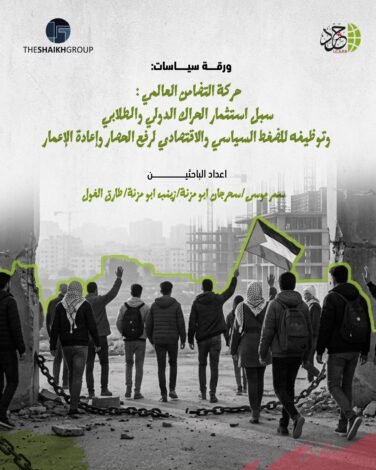
ICSPR Issues a Policy Paper on the Global Solidarity Movement with the Palestinian People and Ways to Develop It

Date: 12 September 2026
Press Release
ICSPR Issues a Policy Paper on the Global Solidarity Movement with the Palestinian People and Ways to Develop It
The International Commission to Support Palestinian Rights (ICSPR), in partnership with The Shaikh Group (TSG), has issued a policy paper on the global solidarity movement with the Palestinian people. The paper examines the rapid developments witnessed by the international solidarity movement since the start of the Israeli aggression against the Gaza Strip on 7 October 2023 and explores ways to move from scattered popular initiatives towards a sustainable Palestinian institutional strategy capable of transforming global solidarity into an effective political, legal, and economic force of pressure.
The paper explains that the global solidarity movement with the Palestinian people has expanded in an unprecedented manner in recent years, with demonstrations and popular protests taking place in hundreds of cities worldwide. Student, trade union, human rights, media, and civil society campaigns have emerged calling for an end to the war, the lifting of the siege, the protection of Palestinian civilians, and accountability for perpetrators of crimes and violations.
The paper notes that this movement is no longer limited to statements of solidarity and symbolic protests. It has expanded into diverse forms of popular, political, and legal action, including public demonstrations, student campaigns at universities, legal and human rights initiatives, boycott, divestment and sanctions campaigns, digital media campaigns, initiatives to break the siege, and pressure on governments, institutions, and companies linked to the Israeli occupation or benefiting from violations committed against the Palestinian people.
The paper affirms that student activism at international universities has helped place the Palestinian cause at the centre of global public debate. This has occurred through organising sit-ins and student encampments, demanding an end to university investments in companies involved in supporting the occupation or benefiting from its practices, and calling on university administrations to disclose their financial and academic policies and end partnerships that may contribute to supporting or justifying occupation violations.
It highlights that student movements have created a new space for discussion within universities and academic institutions regarding the ethical and legal responsibilities of educational institutions, their duty to respect human rights, and the need to avoid affiliation with projects or companies accused of benefiting from or supporting violations.
The paper explains that the Boycott, Divestment and Sanctions movement represents one of the important peaceful civil tools for pressuring the occupation. This is achieved by boycotting institutions and companies implicated in supporting its policies, calling for divestment from them, and demanding that governments and international institutions take economic and legal measures to prevent impunity.
The paper affirms that the importance of boycott extends beyond its economic dimension to include political, ethical, and legal dimensions. It contributes to increasing the cost of violations, expanding global awareness of Palestinian rights, strengthening demands for respect for international law and human rights, and establishing the principle that companies and institutions must not benefit from occupation, settlement expansion, or human rights violations.
The paper notes that the global solidarity movement has played an important role in highlighting the catastrophic humanitarian needs in the Gaza Strip, documenting violations committed against civilians, and supporting demands to open crossings, allow humanitarian aid to enter, stop attacks on infrastructure and health and educational facilities, and launch serious efforts towards reconstruction and recovery.
It explains that the Gaza Strip faces immense humanitarian and development needs as a result of the widespread destruction caused by the war to homes, infrastructure, economic facilities, and essential services. The paper indicates that rebuilding the Strip requires more than 71 billion US dollars over the coming decade. This requires broad international mobilisation and the use of popular, human rights, trade union, and media solidarity to press for funding and guarantee the unrestricted entry of assistance and reconstruction materials without political conditions.
The paper warns that the continuing siege and restrictions imposed on the movement of people, goods, construction materials, and aid obstruct recovery and reconstruction efforts and prevent the population from restoring its ability to live, produce, and work. It stresses that any reconstruction process must be Palestinian-led and linked to ending the siege and safeguarding the Palestinian people’s national rights, rather than becoming a tool for imposing political or security arrangements that undermine those rights or reproduce control over the population.
The paper notes that the global solidarity movement faces multiple challenges, foremost among them the continuing Palestinian political division, weak coordination between Palestinian institutions and international movements, restrictions imposed on solidarity activists and pro-Palestinian organisations in some countries, media disinformation campaigns, inadequate funding, and the slow international response to violations committed against Palestinians.
It points out that disinformation campaigns, attempts to discredit the solidarity movement, and restrictions on freedom of expression and assembly pose serious obstacles to expanding the international influence of the Palestinian cause. The paper stresses the need to invest in multilingual digital media, present a documented Palestinian narrative based on facts, develop tools to counter misleading information, and protect activists, human rights defenders, journalists, and solidarity advocates from incitement and targeting campaigns.
The paper affirms that confronting these challenges requires building broad and sustainable partnerships between Palestinian institutions, universities, trade unions, student movements, human rights organisations, global media outlets, and civil society institutions that support Palestinian rights. Such partnerships should ensure coordinated messages, the exchange of expertise and information, and the expansion of popular, legal, and political influence.
The paper recommends establishing a national committee composed of governmental bodies, civil society organisations, and universities to coordinate and follow up on policies supporting the global solidarity movement. It also calls for preparing a time-bound implementation plan that identifies responsibilities, required resources, performance indicators, and mechanisms for monitoring and evaluation.
The paper further calls for strengthening international partnerships with universities, trade unions, human rights organisations, and media institutions that support the Palestinian cause. It recommends creating a multilingual digital media platform to coordinate media messaging, document violations, and highlight humanitarian and reconstruction needs in the Gaza Strip.
It also recommends developing a national database to document international solidarity initiatives, helping improve coordination, information exchange, and the effective direction of efforts, while preserving the documentary memory of the global solidarity movement. The paper further calls for mobilising financial and technical resources in cooperation with international institutions and donor bodies to ensure the sustainability of solidarity work and develop its legal, media, and public-mobilisation tools.
The paper stresses the importance of using international legal mechanisms to protect solidarity activists and human rights defenders, hold perpetrators of violations accountable, and support judicial efforts aimed at combating impunity. It also affirms the need to broaden international alliances with popular, trade union, academic, and cultural movements and to link solidarity efforts to clear rights-based demands, including ending the occupation and the siege and guaranteeing Palestinian national rights.
ICSPR affirms that the global solidarity movement with the Palestinian people represents an unprecedented strategic opportunity to strengthen the international presence of the Palestinian cause. Transforming this momentum into tangible results requires moving beyond seasonal action and fragmented initiatives towards institutional national policies based on coordination, partnership, and sustainability.
The Commission concludes that implementing the proposed policy alternatives in an integrated manner, while prioritising the development of an international partnership network, a multilingual media platform, and a national database of solidarity initiatives, can help transform global solidarity into an effective pressure force that supports ending the siege, strengthens international accountability, accelerates reconstruction in the Gaza Strip, and protects the inalienable national rights of the Palestinian people.
ICSPR affirms that this paper is issued in partnership with The Shaikh Group (TSG) as part of efforts to support the global solidarity movement with the Palestinian people, strengthen its capacity to protect Palestinian rights and expose violations, and advance practical international positions and actions that ensure justice, freedom, and the Palestinian people’s right to self-determination.