
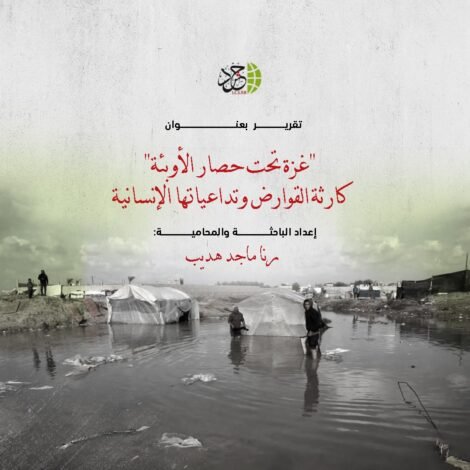
ICSPR Publishes an Expanded Report Titled “Gaza Under Epidemic Siege: The Rodent Disaster and Its Humanitarian Consequences”

Date: April 26, 2025
Press Release
ICSPR Publishes an Expanded Report Titled: “Gaza Under Epidemic Siege: The Rodent Disaster and Its Humanitarian Consequences”
The International Commission to Support Palestinian People’s Rights (ICSPR) has published an expanded human rights report titled “Gaza Under Epidemic Siege: The Rodent Disaster and Its Humanitarian Consequences,” prepared by lawyer and human rights researcher Rana Majed Hdeib. In the report, the Commission warns that the Gaza Strip is facing an escalating environmental and public health disaster that is no longer limited to the direct effects of war, but has evolved into a compounded epidemic environment caused by the accumulation of rubble and waste, the destruction of infrastructure, and the prevention of the entry of tools and materials needed to combat rodents and pests. The Commission stressed that this crisis can no longer be viewed as an incidental phenomenon or merely a side effect of war, but rather as one of the most dangerous manifestations of environmental and health collapse threatening the lives of the population, especially displaced persons living in tents and shelters, amid total local incapacity to respond because of the blockade and widespread destruction.
The report explained that the spread of rodents in the Gaza Strip is directly linked to the systematic destruction of the urban and service infrastructure. Estimates indicate that there are around 70 million tons of rubble across the Strip, a figure that reflects an unprecedented level of devastation and turns the urban landscape into a permanent and ideal breeding ground for rats, mice, and various pests. The report pointed out that this enormous volume of debris does not merely constitute physical waste, but creates what resembles a vast network of burrows, passages, and isolated environments that provide rodents with protection from natural factors and make it far more difficult to combat them or reach their nests using conventional means.
ICSPR further noted that the disruption of rubble removal, the destruction of sewage networks, the accumulation of waste, and its mixing with wastewater and spoiled food supplies have produced a highly dangerous biological environment that allows rodents to multiply at an accelerated rate and drives them from beneath the ground and from destroyed sewers into the surroundings of tents, displacement centers, and food supplies stored inside them. The report added that the prevention of the entry of pesticides, poisoned bait, and specialized pest-control materials for months has aggravated the scale of the disaster and left municipalities and local teams completely unable to limit the spread of this threat or contain it.
The report affirmed that the danger is no longer merely environmental, but has become a direct epidemic and health threat, especially in light of warnings from the Ministry of Health that Gaza has reached the brink of disease outbreaks amid the growing rodent threat, the sharp deterioration of health and environmental conditions, and the increasing likelihood of the spread of serious diseases through bites, urine, droppings, or parasite vectors such as fleas and ticks. Among the most prominent diseases identified in the report are leptospirosis, salmonella, tularemia, plague, hantavirus, intestinal parasites, and the dangers associated with rat-bite fever, all of which become even more threatening under conditions of severe displacement, lack of clean water, and the absence of hygiene and bathing materials.
The report pointed out that the disaster is striking on multiple levels at once. There is a direct threat to hundreds of thousands of displaced persons living in tents or in the open. Published health data indicate that more than one million people are living in extremely fragile shelter conditions, which intensifies their direct exposure to rodents, their bites, their droppings, and the contamination of food and water. In addition, international reporting has warned that disease is increasing across more than 1,600 displacement sites, and that residents in nearly half of those sites are suffering from skin diseases and deteriorating health conditions, placing the spread of rodents at the heart of a broader health crisis that is at risk of exploding.
The report also documented field testimonies confirming that rodents no longer hide or move only at night, but now appear in broad daylight among tents, food stocks, clothes, and blankets, in increasingly aggressive behavior reflecting a severe ecological imbalance and food pressure that has pushed them into sustained proximity with human beings. Statements documented in the report indicate that mothers are living in constant fear that their children may be bitten while asleep, especially amid a noticeable increase in cases of bites from rats and mice, at a time when the health system is in a state of near-total collapse and suffering from an acute shortage of medicines, antibiotics, and preventive supplies.
The report further explained that the effects of this disaster do not stop at public health, but extend to food, psychological, and social security. Thousands of families are forced to store flour, legumes, and humanitarian food aid inside tents because safe storage spaces do not exist, making these supplies vulnerable to destruction or contamination by rodent droppings and thereby leading to the loss of part of an already scarce food supply. The report added that rodents are tearing blankets and clothes, damaging the little property displaced people still possess, and destroying even modest attempts at home gardening or self-sufficiency, which adds a new dimension to the crisis of hunger and food insecurity.
On the psychological level, the report stressed that fear of rodents has become a daily source of anxiety and terror inside displacement camps, particularly among children who suffer from persistent sleep disturbances and acute fear because of hearing gnawing sounds and movement inside tents, or feeling rodents brush against their bodies at night. Mothers are also experiencing immense psychological pressure and feelings of helplessness over their inability to protect their children from a danger that cannot be warded off in an environment lacking the most basic conditions of safety, cleanliness, and health care, thereby deepening the collective trauma already caused by war and displacement.
ICSPR emphasized in its report that this situation cannot be classified merely as an emergency environmental crisis, but is instead the direct result of compounded violations of international humanitarian law and international human rights law, foremost among them the right to health, the right to a dignified life, the absolute prohibition of collective punishment, and the legal obligation of the occupying power to ensure public health, prevent the spread of epidemics, and take necessary precautionary measures. The Commission considered that preventing the entry of rodent-control materials and hygiene supplies, obstructing waste management, and leaving civilians in an environment infested with rodents and pests constitute a pattern of subjecting the population to destructive living conditions and require urgent international accountability.
In light of this, ICSPR called on the international community, the United Nations, the World Health Organization, and humanitarian agencies to take immediate action to break what it described as the “environmental siege” imposed on the Gaza Strip, and to allow the entry of pesticides, specialized chemical materials, mechanical traps, mosquito nets, and secure storage tools for food aid, in addition to providing fuel and heavy machinery for municipalities so that they can reach breeding hotspots inside the rubble and begin carefully planned operations to level debris, fill burrows, and sanitize areas surrounding shelters. The Commission also called for the adoption of urgent health protocols in medical points to deal with rodent bites, and for the provision of antibiotics, vaccines, and treatments related to rodent-borne diseases, as well as the supply of strategic stockpiles of emergency response materials to health facilities.
The Commission concluded its report by stressing that what is happening in Gaza is not simply a temporary rodent infestation or a short-term service problem, but a compounded disaster in which war, blockade, environmental collapse, and health breakdown intersect, placing the population before an open epidemic threat that may extend beyond the Strip if international paralysis continues. ICSPR affirmed that confronting rodents in Gaza is not a battle with nature, but a battle against policies of siege, abandonment, starvation, and destruction, and that every injury, death, or illness resulting from this contaminated environment must be understood as a direct consequence of systematic policies that require accountability and an end to impunity.