
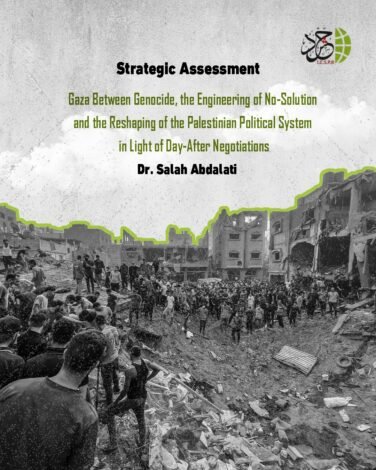
New Strategic Position Assessment by Dr. Salah Abdalati Gaza Between Genocide, the Engineering of No-Solution, and the Reshaping of the Palestinian Political System in Light of Day-After Negotiations

Date: 5 June 2026
Press Release
New Strategic Position Assessment by Dr. Salah Abdalati: Gaza Between Genocide, the Engineering of No-Solution, and the Reshaping of the Palestinian Political System in Light of Day-After Negotiations
The International Commission to Support Palestinian Rights (ICSPR) has issued a new strategic position assessment prepared by Dr. Salah Abdalati, Chairman of ICSPR, titled: “Gaza Between Genocide, the Engineering of No-Solution, and the Reshaping of the Palestinian Political System in Light of Day-After Negotiations.” The paper addresses the most dangerous transformations affecting the Palestinian cause in light of the genocidal war on the Gaza Strip and attempts to re-engineer the Palestinian reality politically, geographically, and demographically.
Through the paper, Dr. Salah Abdalati stressed that what is taking place in Gaza is no longer merely a military aggression or another round of conflict, but has become a comprehensive project aimed at reshaping the Palestinian environment in its political, social, and economic dimensions, in a manner that redefines the relationship between the Palestinian people, their land, their institutions, and their political future. He explained that the ongoing war is being managed through a dangerous approach he describes as the “engineering of no-solution,” based on managing the conflict rather than resolving it, keeping the Palestinian reality in a state of permanent suspension, preventing the establishment of a sovereign Palestinian state, and linking reconstruction and humanitarian aid to political and security conditions, foremost among them disarmament.
Dr. Salah affirmed that the paper demonstrates how Gaza has been transformed into an “open laboratory” for reshaping Palestinian reality on several simultaneous levels: beginning with the demographic level through mass killing, forced displacement, and population redistribution; passing through the geographic level by destroying cities and neighborhoods and establishing buffer zones; the economic level by striking productive sectors and infrastructure; and reaching the political level through attempts to reshape the Palestinian political system and produce new arrangements for governance, administration, and security that serve a long-term Israeli vision.
The Chairman of ICSPR further stressed that one of the most dangerous findings of the paper is the shift from “direct genocide” to “compound genocide,” which targets the very conditions of life through starvation and deprivation of water, medicine, fuel, and basic services, in parallel with the dismantling of families and social protection networks, and the targeting of Palestinians’ ability to produce a unified, effective, and independent political system, in an effort to reshape Palestinian political representation according to Israeli security priorities.
Dr. Salah Abdalati also explained that the paper reveals the limits of the Israeli project of “military decisiveness” after more than two years of aggression, as Israel has failed to eliminate the resistance, impose an alternative leadership, or achieve the permanent mass displacement of the population of the Gaza Strip, while at the same time facing mounting international pressure, legal scrutiny, and internal crises. This, he noted, has pushed matters toward a model of conflict management and no-solution engineering instead of decisiveness or a just political solution.
He added that the paper closely tracks the substance of the Cairo negotiations and talks in other capitals, explaining that the essence of these negotiations goes far beyond a ceasefire and the entry of humanitarian aid, extending instead to the reshaping of the Palestinian political scene as a whole, including the future of governance in Gaza, transitional administrative arrangements, the nature of the security apparatus, reconstruction mechanisms, the relationship between Gaza and the West Bank, the future of the Palestinian Authority and the Palestine Liberation Organization, and the fate of the resistance’s weapons.
Dr. Salah stressed that the paper warns against turning projects such as the “Board of Peace,” transitional administration arrangements, and international stabilization forces into tools for shifting the Palestinian cause from the framework of national liberation and ending occupation to the framework of “managing the cause” and “managing the population,” whereby the focus is placed on administering the consequences of war and the humanitarian file instead of addressing the roots of the conflict, ending the occupation, and securing the inalienable national rights of the Palestinian people.
He further affirmed that the paper shows how reconstruction is being treated in many initiatives as a tool of political and security pressure, tied to prior conditions, amid continued Israeli military control over large parts of the Gaza Strip and the absence of genuine and effective funding. This, he explained, turns reconstruction into part of the no-solution engineering model, one that neither allows full collapse nor permits real and sustainable rebuilding.
Dr. Salah also pointed out that the assessment sheds light on the deep structural crisis affecting the Palestinian political system, which the genocidal war and the long-standing division have exposed, including the erosion of legitimacy, the disruption of democratic life, the persistence of division, the decline in the effectiveness of national institutions, and the widening gap between the people and their institutions. He emphasized that rebuilding the Palestinian political system, renewing legitimacy, and restoring partnership and national unity have become inseparable from the broader battle for steadfastness and for protecting the Palestinian cause from projects of fragmentation and political re-engineering.
The Chairman of ICSPR stressed that the paper proposes a possible national program for the coming phase, based on consolidating a permanent end to the war, preventing a return to cycles of escalation, pressing for a full Israeli withdrawal from the Gaza Strip and an end to all forms of direct and indirect control, ensuring the sustained and unconditional flow of humanitarian aid, and treating reconstruction as a humanitarian and legal right rather than a tool of blackmail, alongside the creation of effective international mechanisms to protect civilians and prevent the use of food, medicine, and water as weapons in the conflict.
He further explained that the paper outlines a number of strategic scenarios for the future of Gaza and the Palestinian cause, and considers the continuation of the no-solution engineering model the most likely in the near term unless the Palestinian national initiative is restored on the basis of ending division, rebuilding the Palestine Liberation Organization, forming a unified national leadership, and developing a comprehensive struggle strategy capable of protecting Palestinian national rights.
In his concluding remarks, Dr. Salah Abdalati affirmed that the paper stresses that the coming phase will involve a dual battle: a battle to protect the Palestinian human being from killing, starvation, displacement, and humanitarian collapse, and a battle to protect the political meaning of Palestine as a cause of freedom, return, self-determination, and independence. He warned that the greatest danger lies in turning the humanitarian catastrophe into a gateway for liquidating national rights, instead of turning Palestinian steadfastness into a starting point for rebuilding national unity and restoring the national project on democratic and participatory foundations capable of protecting the Palestinian people and their inalienable historical rights.