
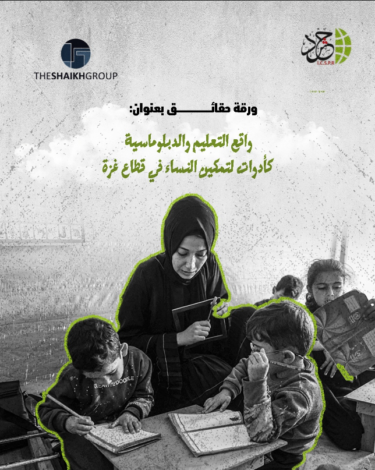
ICSPR Issues a Fact Sheet Titled “Education and Diplomacy as Tools for Empowering Women in the Gaza Strip”

Date: 28 July 2026
Press Release
In partnership with The Shaikh Group (TSG) and as part of the Youth Civil Society Activists Diploma Program
ICSPR Issues a Fact Sheet Titled: “Education and Diplomacy as Tools for Empowering Women in the Gaza Strip”
The International Commission to Support Palestinian Rights (ICSPR), in partnership with The Shaikh Group (TSG) and as part of the Youth Civil Society Activists Diploma Program, has issued a fact sheet titled: “Education and Diplomacy as Tools for Empowering Women in the Gaza Strip.” The paper examines the situation of Palestinian women amid the ongoing genocidal war and continuing blockade, with a focus on the role of education, popular diplomacy, and digital diplomacy in strengthening women’s resilience and empowering them economically, socially, politically, and in the field of human rights.
The paper explains that women in the Gaza Strip face mounting humanitarian, economic, and social challenges as a result of the war, displacement, the loss of family members and breadwinners, and the deterioration of opportunities for education, employment, and health care. It notes that these conditions have placed additional burdens on women, while education remains among the most important tools for empowerment and for strengthening resilience and participation in public life.
According to the indicators reviewed in the paper, the number of women in the Gaza Strip exceeds 1.1 million, representing approximately 49% of the total population, while the number of women killed has exceeded 14,500. The paper also refers to the displacement of more than 800,000 women and girls, approximately 57,000 female-headed households after the war, and more than 22,057 widowed women, amid widespread deterioration in humanitarian and economic conditions.
The paper notes that around 60,000 pregnant women face increased risks due to the deterioration of the health system, while approximately 290,000 women have been affected by the loss of sources of income and around 350,000 women require psychosocial support services. It stresses that these figures reflect the depth of the war’s cumulative impact on women, particularly with regard to economic security, social protection, and the rights to health and education.
The paper indicates that women and girls in the Gaza Strip had achieved notable progress in educational access before the war, with female students accounting for more than 60% of total enrolment in higher education institutions, while female illiteracy rates remained below 2%. Education contributed to increasing women’s participation in the education, health, civil society, and media sectors and opened wider opportunities for social and economic engagement.
The paper explains that the genocidal war has disrupted education to an unprecedented extent due to the destruction of schools, universities, and training centres, as well as the conversion of educational institutions into shelters for displaced persons. This has deprived hundreds of thousands of female students of regular access to education, reduced opportunities for higher education and vocational training, and increased the risk of educational dropout due to displacement, poverty, deteriorating living conditions, and the growing family responsibilities placed on women and girls.
According to the paper, more than 350,000 female students have been affected by the disruption of education, while more than 450 schools, universities, and educational institutions have sustained damage. Opportunities for online education also face significant constraints due to repeated electricity and internet outages, weak infrastructure, and limited technical capacity, at a time when unemployment among female graduates has exceeded 80%.
The paper affirms that digital education and community-based educational initiatives have helped, despite limited resources, to mitigate the effects of educational disruption. Online platforms and distance-training programmes have enabled some female students and graduates to acquire skills in languages, technology, media, and vocational fields. It further considers education a means of economic and social empowerment through the development of professional and technical skills, expanded opportunities for self-employment and remote work, increased legal and human rights awareness, and greater self-confidence and decision-making capacity.
In the area of diplomacy, the paper highlights the growing role of Palestinian women in conveying the Palestinian narrative to the international community and participating in advocacy, documentation, and human rights defence through diverse popular, community-based, and digital channels. It emphasises that women’s testimonies about war, displacement, and loss have become an influential tool in shaping international public opinion and strengthening global solidarity with the rights of the Palestinian people.
The paper explains that digital diplomacy has gained particular importance amid the blockade, closure, and limited opportunities for movement and travel, enabling women and girls to overcome geographical restrictions and reach a global audience. Women have used social media platforms to document violations, highlight civilian suffering, share human stories related to war and displacement, and participate in international digital campaigns advocating for Palestinian rights.
The paper also addresses the increasing involvement of Palestinian women in international advocacy activities through preparing and presenting testimonies and human rights reports, participating in international conferences and events, communicating with United Nations and international human rights institutions, and contributing to pressure and accountability campaigns concerning violations committed against civilians in the Gaza Strip. It affirms that this role strengthens the presence of Palestinian women’s issues in international discussions concerning armed conflicts and human rights.
The paper presents a range of challenges that hinder women’s empowerment through education and diplomacy, most notably the destruction of educational infrastructure, repeated displacement, deteriorating humanitarian conditions, increasing poverty and unemployment, weak technological infrastructure, and the psychological and social effects of war, in addition to women’s limited participation in leadership positions and political and diplomatic decision-making.
The paper concludes that education and diplomacy are two fundamental pillars for empowering women in the Gaza Strip and strengthening their resilience and social and human rights participation, despite the severe challenges imposed by the genocidal war and blockade. It stresses that Palestinian women’s achievements in education, training, advocacy, popular diplomacy, and digital diplomacy constitute an essential asset in communicating the Palestinian narrative and exposing violations against civilians in the Gaza Strip.
The paper puts forward a set of recommendations, foremost among them protecting educational institutions and ensuring the continuity of education for women and girls in situations of conflict and emergency; supporting alternative education, online education, and vocational training programmes; and providing scholarships and specialised educational programmes for women and girls affected by war and displacement. It also calls for strengthening women’s economic empowerment and linking educational outcomes to employment opportunities, entrepreneurship, and remote work.
The paper further recommends developing the technological infrastructure necessary for digital education and engagement in online human rights and diplomatic activities; expanding psychosocial support programmes for women and girls; strengthening women’s participation in decision-making positions, public institutions, leadership bodies, and diplomatic institutions; and supporting women-led initiatives working in international advocacy, popular diplomacy, and digital diplomacy.
ICSPR affirms that this paper, issued in partnership with The Shaikh Group (TSG), forms part of efforts to raise awareness of the compounded impact of the genocidal war on Palestinian women and to highlight the importance of education and diplomacy as tools for protection, empowerment, and advocacy, thereby strengthening women’s resilience and their role in defending their rights and the rights of their people.
It should be noted that this fact sheet does not necessarily reflect the views of ICSPR or The Shaikh Group (TSG).