
ICSPR issues a fact sheet titled “Women’s Economic Empowerment in Gaza as a Shield Against Gender-Based Violence”

Date: 4 June 2026
Press Release
As part of the Youth Civil Society Activists Diploma Program
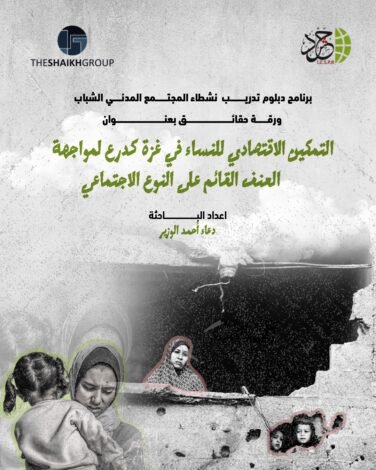
ICSPR issues a fact sheet titled: “Women’s Economic Empowerment in Gaza as a Shield Against Gender-Based Violence”
The International Commission to Support Palestinian People’s Rights (ICSPR), in partnership with The Shaikh Group (TSG), and as part of the Youth Civil Society Activists Diploma Program, has issued a fact sheet prepared by researcher Doaa Ahmad Al-Wazir titled “Women’s Economic Empowerment in Gaza as a Shield Against Gender-Based Violence,” examining the relationship between economic dependency and the escalation of gender-based violence in the context of displacement and the deepening humanitarian crisis in the Gaza Strip.
The fact sheet explains that the Gaza Strip is facing an unprecedented humanitarian and protection crisis amid repeated forced displacement and the deterioration of protection infrastructure, noting that around one million women and girls have been forcibly displaced and become increasingly exposed to compounded risks and violations inside camps and shelters. It stresses that this surge in violence cannot be separated from the broader economic collapse, as material dependency and the absence of independent income sources create a fertile environment for the continuation of domestic and societal violence against women.
The paper indicates that the total number of women and girls in the Gaza Strip stands at about 1.06 million, and that the sharp increase in the number of people killed has triggered a profound shift in family support structures, leading to an unprecedented rise in households headed by women. According to the fact sheet, 22,057 women have lost their husbands, while the proportion of female-headed households rose from 12% during the first nine months of 2023 to around 18% during the war, forcing thousands of women to become sole breadwinners for their families amid conditions of displacement and famine.
The fact sheet further notes that the crisis has intensified with some 23,769 women sustaining direct injuries since the start of the assault, including permanent disabilities and amputations, leaving many of them less able to protect themselves or report violations, and exposing them to compounded forms of violence targeting both their physical vulnerability and material deprivation.
The paper presents the findings of a recent survey of 2,602 displaced women, which showed that 61.12% of them suffer from both physical and psychological violence as a result of forced displacement, severe overcrowding, and constant fear of loss and death. It also found that 37.63% of women endure direct economic violence alongside physical and psychological abuse, due to the complete loss of their independent income sources during the current crisis, a figure the fact sheet describes as clear evidence that the absence of financial security intensifies women’s vulnerability and strips them of protective alternatives.
In its analysis of economic dependency, the fact sheet explains that the destruction of women’s small businesses and independent livelihoods as a result of widespread devastation in the Gaza Strip has deepened their forced reliance on others, at a time when unemployment among women seeking work has reached 92%, compared to 81% among men. It also highlights that aid distribution mechanisms in shelters are often built around a traditional, male-headed family model, leaving some women—particularly “suspended women”—vulnerable to being deprived of their basic food and medical entitlements and to having assistance used as a tool of coercion and subjugation.
The paper argues that, in this context, economic empowerment is no longer merely a means of securing temporary income, but has become a direct protection tool that touches the core of women’s personal and physical safety, by strengthening their ability to make decisions, reducing their exposure to exploitation and blackmail, and giving them a realistic option to leave violent environments. It considers women’s access to resources and skills to be a first line of defense against structures of violence rooted in acute material need.
The fact sheet concludes with a set of procedural recommendations, most notably calling on relief agencies and donors to redirect humanitarian funding toward “protective economic empowerment” by supporting rapid, home-integrated projects that enable women to immediately secure essential living needs away from the control or coercion of abusive parties. It also recommends institutionalizing the separation of aid entitlements as a structural protection measure by dismantling the administrative system that restricts aid receipt to the male head of household and introducing flexible, rapid mechanisms that allow women to separate their own and their children’s food, medical, and cash shares as soon as family disputes or separation are established in the field.
ICSPR affirms that this fact sheet is part of broader efforts to deepen rights-based and protection-focused understanding of the link between women’s economic independence and their ability to resist violence, and to promote humanitarian responses in the Gaza Strip that are more gender-sensitive and more firmly grounded in protection principles.
It should be noted that this fact sheet does not necessarily reflect the views of ICSPR or The Shaikh Group (TSG).