
ICSPR Publishes an Analytical Paper Titled: “Deir al-Balah 2026: Elections Between the Rubble and the Reproduction of Palestinian Legitimacy”

Date: April 24, 2025
Press Release
ICSPR Publishes an Analytical Paper Titled: “Deir al-Balah 2026: Elections Between the Rubble and the Reproduction of Palestinian Legitimacy”
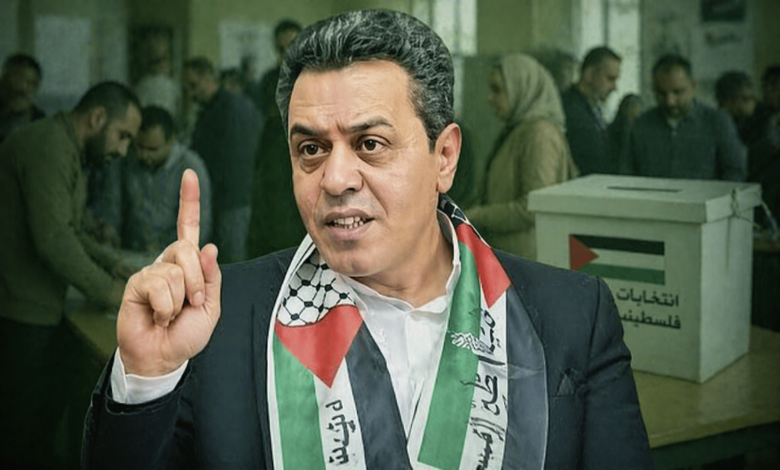
Dr. Salah Abd Alati – President of the International Commission (ICSPR)
First: The General Context – Elections at the Heart of Catastrophe and Political Vacuum
The 2026 Palestinian local council elections come at an exceptional and complex moment, where three pressing trajectories intersect: the continuation of the Israeli aggression and the comprehensive destruction and humanitarian catastrophe it has left in the Gaza Strip; the continuation of political division and the suspension of democratic life since 2006; and attempts to reshape the Palestinian political system in the post-war phase, despite the faltering transitional frameworks and the freezing of reconstruction plans.
In this context, more than one million male and female voters are heading to the polls in the West Bank, while Deir al-Balah stands out as the only electoral case in the Gaza Strip among 420 local authorities, reflecting a structural imbalance in the unity of the political and geographic system and raising profound questions about the nature of the transitional phase Palestinians are living through.
At a deeper level, these elections cannot be read in isolation from the state of “open political vacuum,” in which the legitimacy of existing institutions is eroding and the presence of effective political representation is declining, making the electoral process as much an attempt to manage this vacuum as it is an attempt to overcome it.
Second: Deir al-Balah as an Exceptional Electoral Case (Numbers and Implications)
Deir al-Balah constitutes a unique electoral model carrying political dimensions that go beyond its service-related character, and its most prominent data can be summarized as follows:
-
Number of voters: 70,449 male and female voters.
-
Number of electoral lists: 4 lists.
-
Number of candidates: 60 male and female candidates.
-
Number of seats: 15 seats in the municipal council.
-
Number of polling centers: 12 centers.
-
Number of polling stations: approximately 96–100 stations.
These figures do not merely reflect a technical electoral process, but indicate a serious attempt to reactivate the democratic path in a nearly collapsed environment, where elections become a tool for restoring the minimum functioning of institutions.
Third: Elections as an Act of Civil Steadfastness… and a Management of Reality
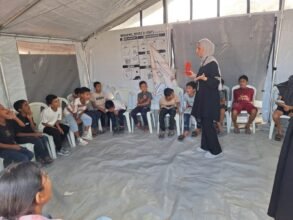
In a scene that appears almost surreal, tents are erected as polling centers, and voters line up among the rubble. Here, the elections do not appear to be merely an administrative procedure, but rather an act of political and social steadfastness.
The electoral process in Deir al-Balah represents:
-
Breaking the democratic stagnation that has lasted for two decades.
-
An attempt to revive legitimacy through the popular will.
-
A political message rejecting the entrenchment of separation between Gaza and the West Bank.
At the same time, however, the elections reflect another equally important dimension: they are a tool for managing the existing reality, in light of the limited ability to bring about genuine political change, making them closer to an emergency response aimed at filling an escalating administrative and service vacuum.
In other words, democracy here is not practiced under normal conditions; it is wrested by force, and at the same time used as a tool for survival.
Fourth: A Technical Decision or a Political Test?
Although the choice of Deir al-Balah as the location for holding the elections has been presented as a technical decision, the political reading reveals deeper dimensions, as the decision appears closer to a “political test” for the possibility of restarting the electoral process in a relatively less damaged environment.
This choice was based on:
-
The city being less damaged compared to other areas.
-
The possibility of holding elections there despite the collapse.
-
Using it as an initial model for generalizing the experience later.
However, this model carries a sharp paradox:
-
Either it becomes an entry point for restoring political unity.
-
Or it turns into an entrenchment of fragmentation and the management of division.
Herein lies both its danger and its value.
Fifth: Municipalities as Emergency Administration and a Crisis of Legitimacy
In light of the widespread collapse of infrastructure and services, municipalities in Gaza appear more like units of “extended emergency administration” than traditional local government institutions.
This reality raises serious questions about:
-
The ability of elected councils to bring about real change.
-
The limitation of resources and capacities.
-
The continuation of restrictions on reconstruction.
-
The ambiguity of the political and administrative role in the coming phase.
At a deeper level, these elections reveal a structural crisis of legitimacy, as existing institutions are no longer able to produce genuine political representation or restore citizens’ trust, making the elections a partial attempt to repair legitimacy rather than rebuild it in full.
Sixth: Between Recovery and the Reproduction of Crisis
The elections carry two contradictory faces:
-
The recovery dimension:
-
Restoring citizens’ trust in institutions.
-
Improving local services.
-
Restoring the value of political participation.
-
The risk dimension:
-
Limited impact in the absence of comprehensive elections.
-
Reproducing incomplete legitimacy.
-
Entrenching geographic and political division.
Accordingly, the elections may be a partial remedy, or merely a “political painkiller” in the absence of a radical solution to the crisis.
Seventh: The Social Dimension – Family Instead of Politics
One of the most prominent structural challenges of these elections is the possibility that they may turn into an arena for reproducing traditional social influence, instead of being a democratic competition based on programs.
The “independent” lists may conceal:
-
Family alignments.
-
Undeclared alliances.
-
Social representations more than political ones.
The nature of society in Deir al-Balah, with its diversity of families, refugees, and different social components, also reinforces the presence of the clan-based dimension at the expense of partisan and programmatic action, especially in light of the weakness of organized political life.
Eighth: The Service Dimension – Electoral Realism
The public mood in Deir al-Balah reflects a clear practical orientation, with voters’ priorities centered around basic life issues:
-
Water and electricity.
-
Sanitation.
-
Service recovery.
-
Reconstruction.
-
Employment opportunities.
-
Confronting the crisis of forced displacement.
The voter here does not ask: who politically represents me?
Rather, the voter asks: who will restore to me the minimum conditions for life?
Ninth: Youth as a Decisive Force
Youth constitute 57 percent of the electoral register, making them the most influential actor in this process.
However, the challenge lies in their weak representation within the electoral lists and decision-making positions, which calls for aligning the electoral process with international standards, especially United Nations Security Council Resolution 2250, which emphasizes the importance of involving youth in governance and peacebuilding.
Tenth: Integrity and Oversight in a Fragile Environment
Despite the complexities, measures have been taken to enhance integrity, most notably:
-
The use of electoral ink.
-
The geographic organization of polling centers.
-
The involvement of civil society institutions in oversight.
Meetings with the Elections Commission also revealed the adoption of exceptional solutions to ensure the process proceeds under coercive circumstances, which relatively enhances its credibility despite the unstable environment.
Eleventh: Possible Scenarios
-
The positive scenario:
Success of the experience, then its generalization in Gaza, followed by the resumption of the democratic path. -
The realistic scenario:
Partial success, improved services, but continued division. -
The negative scenario:
Failure of the experience, erosion of trust, and entrenchment of stagnation.
Twelfth: Conclusions and Recommendations
Conclusions:
-
Deir al-Balah’s elections represent an existential political test.
-
They reflect an attempt to revive the political system from the margins.
-
They reveal the limits of the ability to reproduce legitimacy.
Recommendations:
-
Generalize elections throughout the Gaza Strip.
-
Link them to a comprehensive national path to end division.
-
Strengthen the representation of youth and women.
-
Support the independence of the electoral process.
-
Link the elections to reconstruction and service improvement.
Conclusion
In Deir al-Balah, it is not only 96 ballot boxes that are being opened.
Multiple windows are also being opened between hope and test.
The elections here are not merely a conventional democratic process, but a mirror of a profound crisis, and at the same time an attempt to rebuild what is possible within a reality that is nearly impossible.
The real question is not: how many votes will be cast?
Rather, it is: will this experience be transformed from an exception under the rubble into a rule that rebuilds the political system?
Because democracy here is not measured only by the number of participants, but by its ability to remain alive even when everything else lies beneath the ruins