
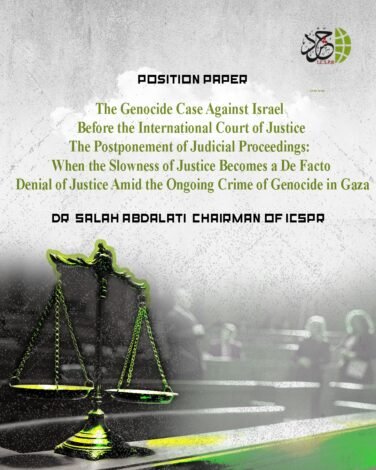
ICSPR Issues New Paper by Dr. Salah Abdalati on the Genocide Case Against Israel Before the ICJ and the Transformation of Delayed Justice into a De Facto Denial of Justice
 wasem aa
Send an email
wasem aa
Send an email
Date: 18 June 2025
Press Release
ICSPR Issues New Paper by Dr. Salah Abdalati on the Genocide Case Against Israel Before the ICJ and the Transformation of Delayed Justice into a De Facto Denial of Justice
The International Commission to Support Palestinian Rights (ICSPR) has issued a new legal and human rights position paper authored by Dr. Salah Abdalati, Chairman of ICSPR, titled: “The Genocide Case Against Israel Before the International Court of Justice: Postponement of Judicial Proceedings, When the Slowness of Justice Becomes a De Facto Denial of Justice Amid the Ongoing Crime of Genocide in Gaza.” The paper examines the legal, ethical, and political implications of prolonging judicial proceedings in one of the most serious cases ever brought before an international court since the establishment of the United Nations, namely the case filed by the Republic of South Africa against Israel under the 1948 Convention on the Prevention and Punishment of the Crime of Genocide.
Dr. Salah Abdalati stressed that the gravity of this case stems not only from its legal nature as it relates to alleged violations of the Genocide Convention, but also from its link to facts that are alleged to be occurring on a daily basis in the Gaza Strip, in the context of a devastating war that has caused tens of thousands of deaths, injuries, and disappearances, and has led to large-scale forced displacement, systematic starvation, and the comprehensive destruction of civilian infrastructure and the means of human survival. This, he noted, makes time itself an integral part of the substance of the case, rather than a mere procedural or organizational issue.
Dr. Salah emphasized that international justice in genocide cases cannot be measured solely by the formal soundness of procedures and the integrity of the judicial process, but also by its ability to arrive in time to prevent the continuation of the crime, protect civilians, and effectively enforce international law. He warned that any excessive prolongation of proceedings in such cases raises serious and legitimate concerns that justice may be transformed from an instrument of protection, deterrence, and accountability into nothing more than a delayed historical record that documents the crime only after its effects have fully materialized.
Through the paper, the author reviewed the chronological background and procedural developments of the case, explaining that South Africa filed its application before the International Court of Justice on 29 December 2023, and that the Court held hearings on the request for provisional measures on 11 and 12 January 2024, before issuing its first Order on provisional measures on 26 January 2024. The Court then issued additional provisional measures on 28 March 2024 and 24 May 2024, requiring Israel to prevent acts that may fall within the scope of the Genocide Convention, ensure the provision of humanitarian assistance and basic services, halt military operations in Rafah, keep crossings open, and guarantee access for commissions of inquiry and relevant international missions.
The paper further notes the more recent procedural development whereby, in 2026, the Court extended the time limits for the completion of written pleadings, setting 22 November 2027 as the deadline for South Africa to file its Reply and 22 May 2029 as the deadline for Israel to file its Rejoinder. This means, in practical terms, that final oral hearings may not be held before late 2029 or sometime in 2030, and that the delivery of a final judgment could be further delayed, raising profound legal and ethical questions about the ability of international justice to keep pace with ongoing mass atrocities.
Dr. Salah Abdalati underlined that the paper clearly distinguishes between the slowness of judicial proceedings and the claims recently circulated regarding an alleged “freezing” or “suspension” of the case. He pointed out that, as of the date of the paper, the International Court of Justice has issued no decision to halt, suspend, or strike the case from its list, and that South Africa has neither withdrawn nor requested the postponement of the proceedings. On the contrary, it has reaffirmed its full commitment to pursuing the case and holding Israel legally accountable, while the time limits fixed by the Court fall strictly within its procedural authority to manage the exchange of written pleadings.
He stressed that the core problem does not lie in the mere formal continuation of the case, but in the risk that procedural time will be extended at the expense of effective justice, particularly since the case does not concern past events that have ended but rather acts alleged to be ongoing, including large-scale killing of civilians, mass forced displacement, systematic destruction of infrastructure, starvation, siege, and the direct targeting of the conditions necessary for human existence in the Gaza Strip. In this context, every day of delay has a direct impact on civilians’ lives and their fundamental rights.
The paper explains that the slowness of justice in genocide cases cannot be regarded as procedural neutrality, because the philosophy of international justice is based on preventing crimes or limiting their effects as they occur, not merely describing them after they have run their course. From this perspective, justice in such cases must be preventive justice, aimed at stopping the continuation of the crime and directly protecting the right to life. Subjecting genocide cases to the same temporal rhythm as ordinary inter-state disputes, the paper argues, reveals a deep structural flaw in the very philosophy of international justice.
The author further notes that the paper addresses the limited impact of the Court’s provisional measures, despite their legal importance, pointing out that they lack effective self-executing enforcement mechanisms, depend to a large extent on states’ political will, face major challenges in implementation, and have not yet succeeded in securing a full halt to the reported violations. This, he concludes, makes their existence insufficient to justify prolonging the litigation and instead underscores the need to expedite adjudication as the decisive path for determining international responsibility and enforcing justice.
Dr. Salah Abdalati stressed that the paper warns of one of the most dangerous consequences of prolonged proceedings: the transformation of time itself into a tool of impunity. Over years of litigation, time can become a space for the continuation of the very acts in dispute, a means of reshaping facts on the ground, a factor affecting evidence and witness testimony, and a tool undermining the deterrent effect of future accountability. In this way, procedural slowness may become an objective factor that reinforces practical impunity even in the absence of any explicit judicial decision to that effect.
The paper also clearly articulates the tension between procedural legality and the broader legitimacy of justice, asserting that while the Court’s exercise of its procedural powers and the parties’ right to present their defense are undeniable, procedural legality alone cannot justify outcomes that, in effect, disable effective legal protection, weaken deterrence, undermine victims’ confidence in international justice, and widen the gap between crime and accountability. Justice, the paper insists, must be measured not only by the correctness of procedure but also by its ability to arrive in time.
In his recommendations, Dr. Salah Abdalati calls on South Africa and the states that have joined the case to shoulder their legal, ethical, and political responsibilities by demanding that the case be given exceptional priority by the Court, working to shorten the intervals between procedural stages, continuing to file legal requests aimed at expediting the proceedings, mobilizing international support to ensure implementation of the Court’s Orders, strengthening political and legal pressure to prevent Israel’s impunity, and supporting parallel accountability mechanisms before the International Criminal Court and national courts applying universal jurisdiction.
In conclusion, Dr. Salah reiterates that timely justice is not a privilege for victims but a fundamental right and an essential condition for the effectiveness of international law and for achieving protection, deterrence, accountability, and non-repetition. He affirms that the real danger does not lie in the formal existence or continuation of the case, but in the transformation of delayed justice in genocide cases into a practical form of denial of justice itself, because justice that does not arrive in time loses its capacity to protect human life, even if it retains value in documenting historical truth.