
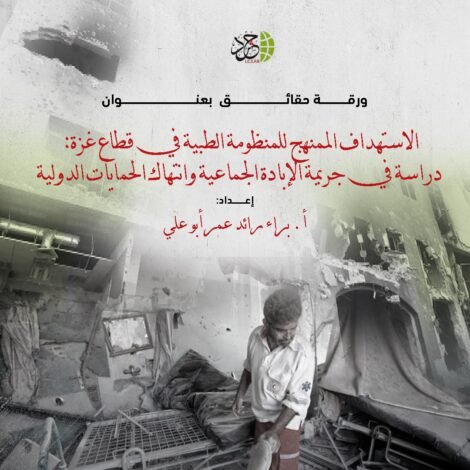
“ICSPR” Issues a Paper Titled: “The Systematic Targeting of the Medical System in the Gaza Strip A Study of the Crime of Genocide and the Violation of International Protections”

Date: May 4, 2026
Press Release
The International Commission “ICSPR” Issues a Paper Titled “The Systematic Targeting of the Medical System in the Gaza Strip: A Study of the Crime of Genocide and the Violation of International Protections”
The International Commission to Support Palestinian Rights (ICSPR) has issued a legal and human rights paper prepared by Mr. Baraa Raed Omar Abu Ali under the title: “The Systematic Targeting of the Medical System in the Gaza Strip: A Study of the Crime of Genocide and the Violation of International Protections.” The paper addresses the catastrophic collapse that has struck Gaza’s health sector since October 2023 amid widespread attacks on hospitals, health centres, and medical personnel, and the resulting near-total destruction of the foundations of healthcare and humanitarian rescue.
The paper stresses that what has taken place in the Gaza Strip cannot be classified as collateral damage resulting from armed conflict, but rather amounts to a comprehensive and systematic policy of destruction targeting the health infrastructure as an essential condition for the survival of the civilian population, in direct violation of the rules of international humanitarian law, which provide special protection to hospitals, medical facilities, ambulances, and healthcare personnel.
In its legal framework, the paper explains that the Fourth Geneva Convention, particularly Articles 18 and 19, together with Additional Protocol I, establish strict protection for civilian hospitals and do not permit the loss of that protection except in narrow and conditional cases involving acts harmful to the enemy, and only after a formal warning has been issued with a reasonable time limit. The paper argues that the occupation forces disregarded these conditions through direct bombardment, siege, starvation, and the obstruction of life-saving medical supplies from reaching health facilities.
On the level of field facts, the paper documents the scale of destruction inflicted on the health infrastructure, noting that 34 out of 38 hospitals were put out of service, while a UN report showed that the number of health service points functioning either fully or partially remained extremely limited, reflecting the depth of the structural collapse affecting Gaza’s health system. The paper also points to direct damage affecting hundreds of medical facilities, health points, and ambulances as part of repeated attacks on health care, with international monitors documenting thousands of incidents of violence against or obstruction of access to health care in the occupied Palestinian territory since October 2023.
The paper further explains that the targeting was not limited to facilities and equipment, but also extended to medical staff themselves within what it describes as a policy of “eliminating the health intellect.” It documents the killing of more than 1,700 healthcare workers, in addition to the detention of hundreds of others, including doctors and hospital directors, in harsh detention conditions and without sufficient legal or humanitarian safeguards. It also notes that human rights and media reports have documented the continued detention of dozens of doctors and healthcare workers from Gaza without charge for prolonged periods, alongside allegations of ill-treatment and deprivation of adequate medical care and food.
The paper highlights what it terms “slow killing” resulting from the siege and the prevention of the entry of fuel, medicines, and medical supplies, stressing that hundreds of thousands of patients, especially those suffering from chronic illnesses, have become vulnerable to death because of interrupted treatment, reduced services, and the breakdown of life-saving equipment, including dialysis, oncology, and intensive care services. It argues that the continued closure of crossings and obstruction of international medical teams and reconstruction materials entrenches the state of health collapse even during periods when direct military operations diminish.
In the section on reproductive health, the paper states that the targeting of maternity and obstetric departments, combined with the destruction of hospitals and shortages of electricity, fuel, and medicines, has placed tens of thousands of pregnant women and newborns at severe risk amid the absence of specialized care, rising deliveries under inhumane conditions, and the endangerment of premature infants in incubators. It adds that UN agencies have warned that tens of thousands of pregnant and breastfeeding women in Gaza face escalating risks linked to malnutrition and the collapse of reproductive health services, and that one in five newborns is born prematurely or underweight according to recent estimates.
The paper concludes that this pattern of broad and sustained targeting of the health sector does not merely constitute a violation of the special protection afforded to medical facilities, but also represents a material element of the crimes of genocide and war crimes, by creating conditions of life that are incompatible with civilian survival and destroying the population through the systematic deprivation of treatment and essential health care. It further stresses that the continuation of these crimes despite repeated international appeals and warnings reveals the failure of international monitoring and accountability mechanisms and reflects the use of the health file as a tool of collective punishment and political coercion.
In conclusion, ICSPR calls on the International Criminal Court to open an immediate and independent investigation into the targeting of the medical system in Gaza and to issue arrest warrants for those responsible for attacking hospitals and medical personnel. It also calls on the Independent International Commission of Inquiry to document the damage and investigate the circumstances surrounding the deaths of doctors in places of detention. The paper further urges States Parties to the Geneva Conventions, the World Health Organization, the International Committee of the Red Cross, and donor bodies to act urgently to lift the medical blockade, ensure the free flow of medicines, equipment, and construction materials, establish an emergency international fund for rebuilding Gaza’s health system, and support reproductive health services, including the establishment of specialized field maternity hospitals and the protection of midwifery and reproductive care teams.