
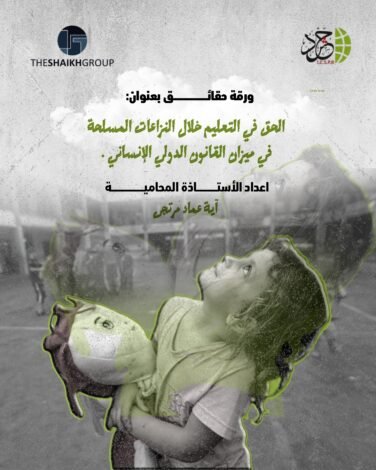
ICSPR issues a fact sheet titled “The Right to Education During Armed Conflicts Under International Humanitarian Law”

Date: 2 July 2026
Press Release
In partnership with The Shaikh Group and as part of the Youth Civil Society Activists Diploma Program
ICSPR issues a fact sheet titled: “The Right to Education During Armed Conflicts Under International Humanitarian Law”
The International Commission to Support Palestinian People’s Rights (ICSPR), in partnership with The Shaikh Group and as part of the Youth Civil Society Activists Diploma Program, has issued a fact sheet prepared by attorney Aya Eyada Mhanna titled: “The Right to Education During Armed Conflicts Under International Humanitarian Law,” addressing the reality of the right to education during wars and armed conflicts, highlighting the international legal frameworks that protect educational institutions, students, and academic staff, and documenting the grave field violations that have affected the education sector, particularly in Gaza and Palestine up to 2026.
The paper explains that the right to education is a fundamental pillar of human dignity and a core driver of the social fabric, and that it is not a secondary right that collapses when wars break out, but rather a vital protective tool that becomes even more necessary in times of crisis to save children and youth from ignorance and loss. It also affirms that international humanitarian law provides education with a dual protective framework by classifying educational institutions as civilian objects whose bombardment is criminalized, and by considering their systematic targeting a war crime not subject to statutory limitations under the Rome Statute of the International Criminal Court.
The paper indicates that the field reality in contemporary armed conflicts, especially in Gaza and Palestine, reveals a shocking gap between legal texts and practical implementation, as schools and universities have turned into direct targets of bombardment, while tents and displacement centers have become forced alternatives lacking even the minimum requirements for the educational process, leading to the deprivation of hundreds of thousands of students of their right to education and the near-total destruction of the academic system.
According to the figures and facts cited in the paper, 20,480 students have been killed, including 19,101 in school education and 1,379 university and college students, while more than 31,400 students have been injured and left with permanent disabilities. The data also indicate that in the West Bank, 128 school students and 39 university students were killed, while 861 school students and more than 278 university students were injured, in addition to the arrest of 421 school students and more than 487 university students.
The paper notes the killing of 1,048 educational staff members, including teachers, academics, and administrators, among them 802 in schools and 246 university professors and lecturers. It also documents the deliberate killing and targeting of more than 130 scholars, professors, presidents of Palestinian universities, and deans of colleges in the Gaza Strip, in what the paper describes as a systematic process of “epistemicide” targeting the intellectual and scientific capacities of Palestinian society.
With regard to educational infrastructure, the paper states that 179 government schools were completely destroyed, 105 schools affiliated with the United Nations Relief and Works Agency for Palestine Refugees (UNRWA) were bombed and vandalized, and 63 university buildings were entirely destroyed, while nearly 80% of all educational buildings sustained damage. It also explains that the West Bank witnessed repeated attacks on 9 universities and colleges, in addition to continued attacks on a number of schools and settler assaults on students.
The paper further explains that early childhood education also suffered a severe blow, with 619 kindergartens taken completely out of service, depriving 65,000 kindergarten-age children of early educational development. It also estimates that more than 25,000 students remain stranded and prevented from traveling to join their scholarships and universities abroad as a result of the destruction and total closure of the Rafah land crossing.
Despite this reality, the paper notes that attempts to resume alternative education and field initiatives reflected determination to confront policies of enforced ignorance, as around 400,000 students were able to enroll in alternative forms of education despite 619,000 students being cut off from conventional education. It also states that the Ministry of Education reopened 175 government schools as emergency administrative centers, alongside the opening of 820 field schools across the Strip accommodating around 400,000 students.
In the legal framework, the paper stresses that the occupation has crossed all red lines set out in international agreements and treaties by violating the principle of distinction and the principle of military necessity set forth in Article 52 of Additional Protocol I of 1977, under which schools and universities are classified as civilian objects enjoying absolute protection from attack. It explains that the direct bombardment of academic buildings without any imperative military necessity or legal evidence of their use in combat constitutes a grave violation amounting to a war crime.
The paper also points to the blatant violation of Article 50 of the Fourth Geneva Convention of 1949, which obliges the occupying power to facilitate the proper functioning of institutions devoted to the care and education of children. It emphasizes that the occupation not only failed to meet this obligation, but deliberately destroyed schools, prevented the entry of books and school supplies, and imposed a siege on the education system, thereby constituting a direct breach of peremptory rules of international humanitarian law.
The paper also addresses the crime of the “militarization of education,” explaining that customary international humanitarian law absolutely prohibits the use of educational institutions for military purposes. Nevertheless, according to the paper, the occupation stormed and rigged universities and UNRWA schools, turning them into military barracks, command centers, and sites for interrogation and detention, thereby stripping them of their protected status and exposing them to destruction.
In another context, the paper notes that the targeting, killing, and assassination of university professors, scholars, and intellectuals, as well as the destruction of historic universities in Gaza, may be legally characterized as “cultural and epistemic genocide” under the 1948 Convention on the Prevention and Punishment of the Crime of Genocide. It also states that the imposition of a comprehensive siege, the destruction of crossings, and the prevention of thousands of students from traveling to take up their places at universities abroad constitute a violation of the right to freedom of movement and education, and amount to collective punishment prohibited under Article 33 of the Fourth Geneva Convention.
The paper also examines the problem of the internet and digital infrastructure as one of the main obstacles to online and remote learning, noting that the deliberate targeting of broadcast towers, telecommunications exchanges, and fiber lines caused an almost complete shutdown of internet services across most areas of the Strip for weeks and months at a time. It adds that students in tents and displacement centers rely on primitive, slow, and costly networks, while also facing electricity and energy crises and the absence of an appropriate learning environment, making online learning an added burden rather than an effective solution.
The paper reviews the experience of Al-Azhar University in Gaza as a model of challenge and resilience, noting that the university’s buildings in Al-Mughraqa and its main campus were subjected to total and partial destructive bombardment, causing major material and academic losses and the killing of a number of its scholars and professors. Despite that, the university launched emergency plans to resume education electronically through learning platforms, opened free enrollment for high school graduates, and then, in early 2026, under the supervision of Vice President Dr. Mohammad Shubair, managed to launch a process of optional in-person education on its main campus in Gaza City after extensive efforts to restore and rehabilitate damaged classrooms, with face-to-face lectures resuming first for medical students and then gradually for the rest of the faculties.
The paper concludes that the right to education during armed conflicts is not merely a secondary option, but the last line of defense for protecting the future of generations and preserving human dignity. It affirms that the systematic targeting of schools and universities and the destruction of the educational process represent a flagrant violation of international humanitarian law and the Fourth Geneva Convention, and amount to a fully constituted war crime under international criminal law, requiring serious action that goes beyond statements of condemnation toward decisive measures to protect educational institutions and activate accountability mechanisms.
In light of this, the paper presents a number of urgent recommendations and rights-based demands, most notably the immediate, complete, unconditional halt to all attacks targeting educational infrastructure, the activation of international criminal accountability through a call on the Prosecutor of the International Criminal Court to open an immediate investigation into crimes committed against the education sector, ending the militarization of schools and education centers, providing educational corridors and safe alternative learning environments, adopting and supporting the Safe Schools Declaration, and incorporating psychosocial rehabilitation programs for students and teachers into humanitarian response and reconstruction plans.
ICSPR affirms that this paper comes within the framework of its efforts to expose the grave violations suffered by the education sector in Palestine, to defend the right to education as a fundamental right that must not be denied even in times of war, and to strengthen international protection and legal accountability tools in the face of deliberate policies of enforced ignorance and systematic targeting of educational institutions.
It should be noted that this paper does not necessarily reflect the views of ICSPR or The Shaikh Group.