
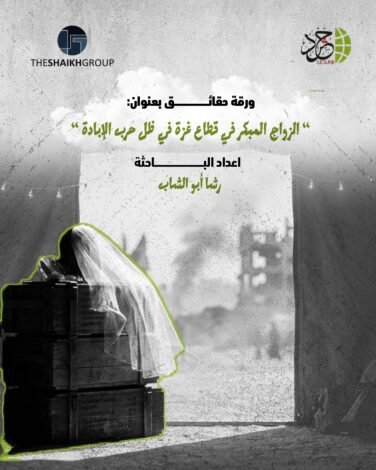
ICSPR issues a fact sheet titled “Child Marriage in the Gaza Strip: The Tragedy of a Generation Under the Weight of Genocide and Displacement”

Date: 8 July 2026
Press Release
In partnership with The Shaikh Group and as part of the Youth Civil Society Activists Diploma Program
ICSPR issues a fact sheet titled: “Child Marriage in the Gaza Strip: The Tragedy of a Generation Under the Weight of Genocide and Displacement”
The International Commission to Support Palestinian People’s Rights (ICSPR), in partnership with The Shaikh Group and as part of the Youth Civil Society Activists Diploma Program, has issued a fact sheet titled: “Child Marriage in the Gaza Strip: The Tragedy of a Generation Under the Weight of Genocide and Displacement.” The paper addresses the growing phenomenon of early marriage in the Gaza Strip amid the genocide war and the accompanying repeated displacement, life in tents, loss of breadwinners, and the collapse of the educational, economic, and judicial systems, all of which have turned this phenomenon into one of the most dangerous negative coping mechanisms imposed by coercive circumstances on Palestinian families.
The paper explains that the ongoing genocide war in the Gaza Strip has led to severe structural transformations that have dismantled the social and psychological stability of families. It has contributed to turning the marriage of girls from a practice shaped by social traditions into an “illusory protective measure” or a means of reducing the “economic burden” in an environment lacking safety and privacy. The paper stresses that this form of marriage constitutes a compounded violation of children’s rights, deprives girls of education and healthy development, places them under responsibilities beyond their capacities, and exposes them to severe health and psychological risks amid the collapse of the medical environment.
The paper indicates that early marriage, or child marriage, refers to any formal or informal marriage contract in which a boy or girl under the age of 18 is married, which is the legal age of majority under the Convention on the Rights of the Child. It is also legally classified as a form of gender-based violence because it involves the absence of free and full consent.
According to the statistics contained in the paper, data from the Palestinian Central Bureau of Statistics updated through the first quarter of 2026 show an unprecedented surge in the rates of marriages involving girls between the ages of 14 and 17 in displacement camps and shelters, with these contracts rising by an estimated 45% compared with the period before October 2023. Reports by the United Nations Population Fund for 2025 also stated that 85% of child marriage contracts concluded in displacement tents were driven by purely economic factors aimed at reducing the number of individuals dependent on scarce food parcels within the same family.
The paper points out that the Palestinian Ministry of Health documented, in its report issued in December 2025, the deaths of 140 underage girls, below the age of 18, during pregnancy or childbirth in the remaining field hospitals as a result of biological complications caused by incomplete physical development, alongside the absence of specialized medical care and the high rates of severe anemia affecting 72% of pregnant women in the Gaza Strip. It also notes that UNICEF child protection committees recorded in February 2026 that around 60% of girls married early in displacement centers were subjected to direct physical and psychological violence by the husband or his family, amid a complete absence of safe spaces or dedicated protection mechanisms for reporting abuse.
With regard to access to justice, the paper shows that the destruction of Sharia court headquarters in the Gaza Strip and the killing of a number of Sharia judges and legal registrars caused a complete paralysis of the official judicial system. It also highlights the emergence of “external marriage contracts,” locally known as oral or informal marriages “on paper,” without official registration in the suspended courts, which strips the girl of her legal rights such as deferred dowry, alimony, and proof of lineage in the event of divorce or the husband’s death.
The paper stresses that underage girls suffer from “compound legal violence,” as guardianship instruments are granted to the girl’s grandfather or uncle if the father is killed, and this guardianship is sometimes exploited to force underage girls into marriage in order to avoid the burden of supporting them or to seize the relief allocations granted to them as orphans.
In presenting the effects of child marriage during the war, the paper notes that health and physical risks are multiplied with early pregnancy amid the collapse of the health system, including an increased risk of death during childbirth, chronic illness, malnutrition, severe anemia, and bone fragility, as a result of the overlap between early pregnancy, famine, and acute malnutrition in the Gaza Strip. It adds that this reality leaves permanent health scars on girls married at an early age.
On the psychological and emotional level, the paper shows that the girl faces a compounded trauma resulting from being uprooted from her childhood and educational world and placed before exhausting marital and sexual responsibilities beyond her mental and psychological capacity. This has led to a sharp increase in severe depression, separation anxiety, and silent suicide attempts inside tents.
Socially and educationally, the paper confirms that early marriage, amid the destruction of schools and universities, completely eliminates any future opportunity for these girls to return to school after the aggression ends, thereby entrenching ignorance and illiteracy among females. It also leads to the girl’s social isolation and the loss of her family support network and friends, leaving her confined to the “marital tent” under the weight of absolute dependency.
At the economic level, the paper indicates that marrying off an unqualified girl to a husband who is often unemployed and has lost his source of income because of the war deepens the cycle of intergenerational poverty and prevents women’s future economic empowerment, thereby entrenching what the paper describes as the “institutionalization of poverty.”
Within the legal framework, the paper explains that the occupying power bears responsibility under international humanitarian law for protecting civilians, especially children and women, and that pushing society to the brink of famine and displacement, and the resulting catastrophic social phenomena including child marriage, is a direct consequence of the crime of genocide in violation of the 1948 Genocide Convention. It also notes that the Convention on the Rights of the Child, particularly Articles 1 and 24, guarantees the child’s right to protection from all forms of exploitation and the right to health and education, while Article 16 of the Convention on the Elimination of All Forms of Discrimination against Women (CEDAW) affirms the invalidity of child betrothal and child marriage and calls for setting a minimum age for marriage.
The paper notes that a number of international and local actors play a role in limiting this phenomenon, including UNICEF, the United Nations Population Fund, and UN Women, in addition to women’s and human rights centers in the Gaza Strip, which operate mobile legal clinics inside camps to provide consultations, document cases of unregistered marriage, and press for the provision of independent relief alternatives for mothers and girls in order to prevent forced marriage. It also stresses the importance of the media’s role in highlighting real stories of girls whose lives were destroyed by marriage in shelters and in shaping public opinion within the displaced community against exploiting economic hardship to marry off girls.
In light of this, ICSPR recommends the immediate cessation of the genocide war and the siege as the primary cause of the collapse of the social, economic, and moral structures that protect girls. It also calls for the activation of mobile Sharia courts or temporary venues in central and southern Gaza to regulate and scrutinize marriage contracts and to prohibit the registration of any contract involving a girl under the age of 18 under any justification. The paper further calls for linking relief aid to individuals rather than to the head of household to ensure that food and financial support reaches girls and their mothers directly, providing intensive emergency reproductive health care for underage girls who have already been married, and supporting funding and networking for alternative mediation while training family councils, community elders, and local committees in legal rights so they can prevent and invalidate child marriage contracts before they are carried out.