

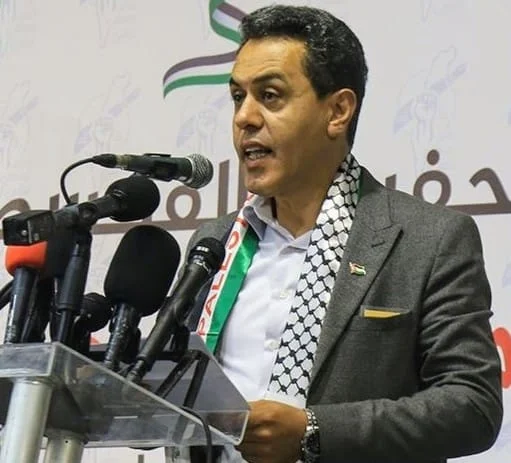
Dr. Salah Abd Alati: Palestine Is No Longer a Passing Cause of Solidarity, but a Global Way of Life and a Struggle for Justice, International Law, and the Future of the World Order

Date: August 5, 2026
Press Release
Dr. Salah Abd Alati: Palestine Is No Longer a Passing Cause of Solidarity, but a Global Way of Life and a Struggle for Justice, International Law, and the Future of the World Order
The International Commission to Support Palestinian Rights (ICSPR) affirmed that Dr. Salah Abd Alati, President of ICSPR, stressed that the Palestinian cause has transcended the boundaries of geography and politics. It is no longer merely a national cause of a people struggling for its freedom; rather, it has become a global symbol of justice and human dignity, a daily test for the conscience of the world, and a moral, political, and legal standard by which the commitment of states, institutions, and individuals to the values of freedom, justice, and human rights is measured.
Dr. Abd Alati explained that solidarity with Palestine is no longer a transient political position or a seasonal expression of sympathy. It has gradually evolved into a global approach to thought, conduct, and practice, and into a human culture that redefines the relationship between peoples, justice, and international law. He stressed that the Palestinian national challenge lies in transforming this global moral, cultural, and legal momentum into tangible political and national achievements.
Dr. Salah Abd Alati, President of ICSPR, stated that Palestine is no longer merely a cause of solidarity, but has become a moral, political, and legal standard through which the commitment of states, institutions, and individuals to the values of freedom, justice, and human rights is assessed.
He added that this transformation is not simply a reaction to the genocide to which the Palestinian people are being subjected. Rather, it represents a structural change in global consciousness, revealing a growing crisis in the legitimacy of the Israeli occupation and in the ability of the traditional narrative—which enjoyed broad political and media support for decades—to retain its previous influence.
He noted that solidarity with Palestine is no longer confined to demonstrations or political statements. It is now reflected in the ballot box, sports stadiums, theatre stages, cinemas, universities, trade unions, media outlets, social media platforms, and even in consumers’ decisions about what to buy or boycott.
He affirmed that Palestine has become a moral benchmark that tests the positions of individuals, institutions, and states. The more awareness expands regarding the reality of occupation, settler colonialism, apartheid, and genocide, the wider the support for Palestinian rights becomes.
In the political sphere, Dr. Abd Alati explained that positions on Palestine and Gaza have become an influential factor in elections in the United States and Europe. Voters, particularly young people, have become more inclined to hold candidates accountable for their positions on war, international law, and human rights.
In sports, he said, stadiums are no longer merely arenas for competition. They have become platforms for solidarity, where Palestinian flags are raised, chants supporting freedom are heard, and players and fans express their rejection of injustice, making sport part of a struggle over values rather than merely a competition for titles.
In art and culture, he pointed to a significant transformation, with writers, directors, actors, musicians, and visual artists engaging in the defense of Palestine and refusing silence in the face of crimes committed against civilians, alongside the growing cultural boycott of institutions complicit in the occupation.
At universities, the President of ICSPR affirmed that students and professors are leading an unprecedented movement in defense of freedom and justice, demanding an end to partnerships with institutions linked to the occupation and emphasizing that the university is not only a space for knowledge, but also a space for moral responsibility and the creation of awareness.
He added that popular rallies and marches have become a recurring scene in capitals around the world, with millions taking to the streets to demand an end to genocide, the occupation, and violations of international law. This is a clear indication that global public opinion has become a key actor in shaping policies.
Dr. Salah Abd Alati noted that boycott, divestment, and sanctions have become choices available to individuals and institutions, as well as effective means of peaceful pressure. Consumers, universities, trade unions, and companies have thus become part of the struggle for accountability, imposing increasing economic, political, and moral costs on the occupation and those who support it.
This transformation has also extended, according to Dr. Abd Alati, to the fields of economics and investment, where companies, investment funds, professional unions, and financial institutions have begun reassessing their relationships with companies involved in the occupation or operating in settlements. This is occurring not only in response to moral considerations, but also because of increasing legal risks and institutional reputational concerns, reflecting the entry of the Palestinian cause into the core calculations of global markets and investments.
With regard to digital media, he explained that this sphere has broken the monopoly over the narrative, transformed the mobile phone into a tool of documentation and resistance, and enabled every eyewitness to convey the truth to the world, despite attempts at misinformation and censorship.
He affirmed that Palestine is no longer present only in arenas of popular solidarity. It has also become the focus of a global legal struggle against impunity through the activation of the principle of universal jurisdiction, recourse to the International Court of Justice and the International Criminal Court, and the use of United Nations mechanisms, alongside human rights efforts to document crimes, collect evidence, prepare legal files, expose the crimes of the occupation, and defend the Palestinian narrative.
He stated that international justice has become one of the principal arenas of struggle in confronting occupation and settler colonialism, noting that the growing global transformation has not passed without counter-resistance.
He explained that Israel and its allies, particularly pro-Israel lobbying groups, led by AIPAC and other political, media, and legal organizations and networks, have recognized that the struggle is no longer taking place only on the battlefield, but also in the arenas of public opinion, universities, courts, media, and culture.
He pointed out that these actors have intensified their efforts to contain the growing wave of solidarity with Palestine through broad political, legislative, and media pressure campaigns targeting the criminalization of boycotts, restrictions on freedom of expression, pressure on universities and cultural institutions, the pursuit of activists, students, academics, and journalists, the imposition of administrative or professional sanctions against them, and attempts to intimidate voices critical of the occupation’s policies.
He added that these actors have also sought to deliberately blur the distinction between antisemitism—as an unacceptable form of racism and discrimination—and legitimate criticism of Israeli occupation policies or calls to hold it accountable under the rules of international law. This has been aimed at delegitimizing the global solidarity movement, weakening boycott campaigns, and discrediting defenders of Palestinian rights.
The President of ICSPR affirmed that, despite the smear campaigns, restrictions on freedom of expression, disciplinary measures, arrests, visa cancellations, and, in some cases, dismissals from jobs or academic institutions faced by thousands of students, professors, legal professionals, journalists, artists, and human rights defenders, these policies have not achieved their objectives.
He said that, on the contrary, these measures have contributed to broadening the global debate on Palestine, exposing the extent of the pressure exerted to shield the occupation from accountability, and reinforcing the conviction that defending Palestinian rights is a defense of the universal principles of justice, human rights, and the rule of law.
Dr. Abd Alati indicated that experience confirms that whenever attempts to silence voices in solidarity with Palestine intensify, the solidarity movement becomes more widespread and organized. It develops its legal, media, cultural, and popular tools, and consolidates its presence in universities, trade unions, parliaments, courts, media outlets, and the digital space.
He stressed that reliance on intimidation, defamation, or criminalization is no longer capable of stopping this historic transformation. Indicators show that solidarity with Palestine has become part of a broader global movement to defend freedom, justice, and human rights, and to oppose settler colonialism, racism, and impunity.
He added that these transformations are also evident in social culture, where language and concepts are changing, and narratives that justified the occupation for decades are receding. At the same time, recognition of Palestinian rights is growing, along with a broader global understanding that what is taking place is not a conflict between equals, but rather a question of national liberation, human rights, and international justice.
He affirmed that Palestine has transcended the limits of geography and politics and has become a global symbol of the struggle between justice and injustice, and between international law and the logic of power. Every act that supports justice, every position rejecting racism and colonialism, every boycott campaign, every electoral victory for forces defending human rights, every artistic work, every demonstration, every legal case, and every media or human rights effort constitutes a new building block in an unprecedented global solidarity movement with the Palestinian people.
He clarified that this does not mean that international balances of power have been permanently reversed, or that government policies will change at the same pace as public opinion. However, historical experience confirms that major transformations usually begin with changes in political and social culture, then gradually move into elected institutions, public policies, and eventually the rules of international law.
From this perspective, Dr. Abd Alati considered what is happening today to be the beginning of a long-term historic transformation in the place of the Palestinian cause within the international system.
He affirmed that the most significant lesson revealed by these transformations is that the Palestinian cause is no longer only the cause of a people living under occupation. It has become a mirror reflecting the future of the international order itself. Positions on Palestine have become a test of the extent to which states and institutions respect the principles of international law, human rights, and the right of peoples to self-determination, as well as the international community’s ability to enforce its rules without selectivity or double standards.
He added that the struggle surrounding Palestine goes beyond its geographical boundaries to become a struggle over the credibility of the international system, the limits of power, and the future of global justice in the twenty-first century.
The President of ICSPR stated that the struggle for Palestine is no longer the struggle of Palestinians alone. It has become a global struggle to protect international law, defend human rights, and preserve shared human values. Therefore, for millions of people, solidarity with Palestine has become a way of life, an ethical choice, and a daily commitment to justice.
He stressed that this global transformation, despite its significance, will not automatically turn into political and national achievements unless Palestinians succeed in investing in it effectively.
He affirmed that what is required today is to rebuild the Palestinian political system on the foundations of national partnership and democracy, end the division, renew legitimacy, and formulate a unified national strategy that employs all tools of political, legal, diplomatic, media, and popular struggle.
He also called for strengthening international legal accountability, defending the Palestinian narrative, and building solid partnerships with the international solidarity movement, in a manner that transforms this global moral momentum into political and legal achievements that end the occupation and settler colonialism, and realize freedom, independence, return, and justice.
Dr. Salah Abd Alati, President of ICSPR, concluded by affirming that the world has become more prepared to listen to the Palestinian narrative and more sensitive to the suffering of the Palestinian people. He stated that political, cultural, legal, and social indicators confirm that the path of global solidarity with Palestine has become more established and expansive, and is likely to be among the most important factors influencing the reshaping of international positions and policies in the coming years.
He affirmed that the question is no longer whether Palestine is capable of attracting global solidarity, but rather how this moral, cultural, and legal transformation can be converted into an organized political force. He stressed that the real struggle is no longer only over land, but also over consciousness, narrative, legitimacy, and the future of the international order itself.