
ICSPR Issues a Fact Sheet Titled: “The Reality of Farmers in Bani Na’im Amid Land Confiscation and Settlement Expansion”

Date: 1 August 2026
Press Release
In partnership with The Shaikh Group (TSG) and as part of the Youth Civil Society Activists Diploma Program
ICSPR Issues a Fact Sheet Titled: “The Reality of Farmers in Bani Na’im Amid Land Confiscation and Settlement Expansion”
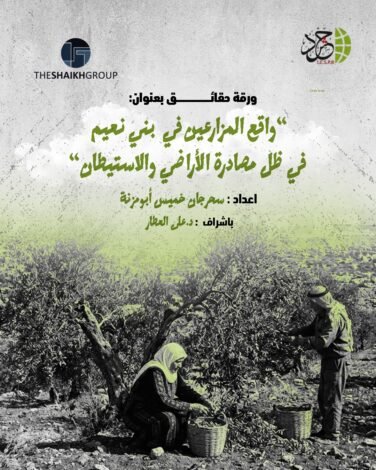
The International Commission to Support Palestinian Rights (ICSPR), in partnership with The Shaikh Group (TSG) and as part of the Youth Civil Society Activists Diploma Program, has issued a fact sheet prepared by Sarhan Khamis Abu Mzna, titled: “The Reality of Farmers in Bani Na’im Amid Land Confiscation and Settlement Expansion.” The paper examines the conditions of farmers and livestock breeders in the town of Bani Na’im, east of Hebron, amid escalating land confiscation, restrictions on access to land, settlement expansion, and the spread of pastoral outposts, and the resulting direct threat to Palestinian agricultural and economic presence in the area.
The paper explains that land is a fundamental pillar of Palestinian national identity and of the Palestinian people’s right to self-determination and the establishment of their independent state. It notes that, since the occupation of the West Bank, Israeli occupation authorities have employed a range of military, administrative, and legal tools to control Palestinian land and reshape its geography in service of the settlement project.
The paper indicates that Bani Na’im is located east of Hebron and has a total area of 23,309 dunams, while its historical extent, including the structural plan, agricultural land, and eastern wilderness, is estimated at around 71,000 dunams. Nearly two-thirds of the town’s residents depend on agriculture and livestock breeding as a primary economic and livelihood base, while agricultural work accounts for approximately 19% of its workforce.
The paper explains that Bani Na’im’s lands extend into Area C, which comprises more than 65% of the town’s total area. These areas are under full Israeli civil and military control and are subject to ongoing settlement activity and land confiscation. The town is also surrounded by the Bani Hefer settlement to the south, Kiryat Arba and its surrounding area to the west, and pastoral settlement outposts in the eastern areas.
According to the paper, approximately 330 dunams of the town’s land were directly taken for the construction of Bypass Road 60. It also documents the 2019 confiscation declaration concerning 318 dunams of Bani Na’im land, in addition to a settlement plan targeting approximately 32.183 dunams in the areas of Munayzil and Al-Martoum to expand the Bani Hefer settlement and establish new settlement units and public facilities.
The paper notes that Bani Na’im possesses extensive agricultural resources, with approximately 9,751 dunams of cultivated land, including tree crops, field crops, vegetables, and protected agriculture. Nearly 17,973 dunams are suitable for cultivation, while around 90 greenhouses cover an area of 110 dunams, in addition to natural grazing areas used for sheep farming and livestock breeding.
The paper warns that the targeting of land, grazing areas, and water resources has sharply reduced the areas available for farming and grazing, increased production and feed costs, and led to an estimated 40% decline in livestock numbers in the town and its surrounding areas. It also refers to the control of more than 15 water springs and rainwater collection wells in the eastern areas and the transfer of their effective control for the benefit of settlers, further deepening the hardship faced by farmers and herders and undermining their ability to continue production.
The paper outlines several mechanisms used by Israeli occupation authorities to seize land in Bani Na’im, including declaring land as “state land,” issuing military confiscation orders, closing land under the pretext of natural reserves, imposing closed military zones, expanding settlements, and constructing bypass roads. It stresses that these measures isolate agricultural land, restrict farmers’ access to it, and gradually transform it into space serving settlements and settlement outposts.
The paper highlights the danger of pastoral settlement expansion as one of the most consequential forms of control. Small settlement outposts based on livestock grazing are established, through which effective control is imposed over thousands of surrounding dunams. Palestinian farmers and herders are prevented from accessing their lands and grazing areas through threats and attacks, forcing some to sell their livestock due to rising feed costs and the lack of open grazing areas.
The paper includes testimonies from farmers and livestock breeders in the Umm Al-Dhahab area of Masafer Bani Na’im, who reported being denied access to land cultivated with field crops while settlers graze their livestock there under the protection of the Israeli army. These testimonies show that restrictions on grazing and access to land have resulted in the loss of productive land, shrinking grazing areas, and the transformation of livestock breeding into an economic burden that threatens families’ traditional livelihoods.
The paper indicates that land confiscation and settlement policies have led to the loss of agricultural land and a decline in farming activity, as well as displacement and continuing pressure on Bedouin and rural communities, particularly in Area C. These policies have also exacerbated poverty, unemployment, and dependence on aid amid limited work opportunities and restrictions on movement through metal gates, earth mounds, bypass roads, and coordination procedures that do not give farmers enough time to tend their land or harvest their crops.
The paper documents direct attacks against farmers and shepherds, including beatings, warning gunfire, the use of trained dogs, and the detention or theft of livestock. It also addresses the leveling of reclaimed land, the uprooting of olive and almond trees, the demolition of stone terraces, and the destruction of rainwater harvesting wells under the pretext of lacking permits.
From a legal perspective, the paper affirms that land-control policies in Bani Na’im contradict the rules of international humanitarian law, particularly the Fourth Geneva Convention, which prohibits the transfer of the occupying power’s population into occupied territory, the forcible displacement of the local population, and the confiscation of property except for imperative military necessity. It also points to violations of the Hague Regulations and the Rome Statute, which criminalizes the transfer of an occupying power’s civilian population into occupied territory and the extensive appropriation of property not justified by military necessity, as well as a contradiction of UN Security Council Resolution 2334, which affirmed the illegality of settlements.
The paper concludes that the situation in Bani Na’im represents a strategy of “silent displacement” aimed at emptying the eastern geographic extension of Hebron Governorate of its indigenous Palestinian population and reshaping the demographic and geographic reality in favour of settlement expansion. It warns that farmers and livestock breeders are being transformed from productive groups into groups seeking alternative sources of income after losing their land and traditional grazing areas, thereby deepening an unequal system of land and resource management.
The paper recommends that the international community take practical and binding measures to halt settlement activity, freeze settlement expansion, and prevent the establishment of new outposts. It also calls for legal and economic measures against settlement-related activities, including banning settlement products and preventing investment in them, as well as supporting international accountability efforts before the International Criminal Court regarding settlement crimes, land confiscation, and attacks against farmers.
It further stresses the need to strengthen international protection mechanisms for Palestinian land through monitoring and documentation, and to support the resilience of farmers and landowners in Area C and in areas adjacent to settlement outposts through development and economic programmes that reinforce their presence on their land and protect their role as its first line of defence.
ICSPR affirms that this paper, issued in partnership with The Shaikh Group (TSG), is part of efforts to document violations against Palestinian farmers, expose policies of land confiscation and settlement expansion, and promote serious international action to protect land, natural resources, and the economic and social rights of the Palestinian people.
It should be noted that this fact sheet does not necessarily reflect the views of ICSPR or The Shaikh Group (TSG).