
ICSPR Warns against the Use of Weapons in Community Disputes and Calls for Withdrawing Protection from Perpetrators and Upholding Recourse to the Judiciary

Date: 24 October 2026
Press Release
ICSPR Warns against the Use of Weapons in Community Disputes and Calls for Withdrawing Protection from Perpetrators and Upholding Recourse to the Judiciary
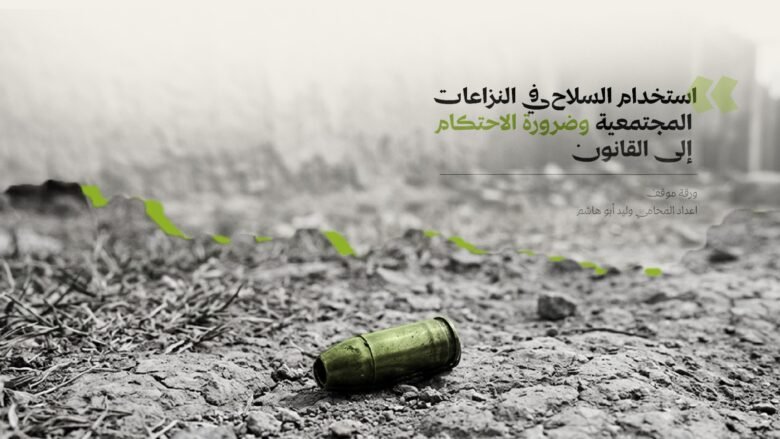
The International Commission to Support Palestinian Rights (ICSPR) has issued a position paper titled “The Use of Weapons in Community Disputes and the Need for Recourse to the Law,” prepared by lawyer Walid Abu Hashem. The paper warns of the dangers of resorting to weapons in family and individual disputes and calls for addressing armed lawlessness by strengthening the rule of law, safeguarding judicial independence, and withdrawing political and tribal protection from perpetrators of attacks.
The Commission affirms that using weapons to settle disputes threatens not only lives and property, but also civil peace and equality among citizens. It replaces the authority of the law with armed influence and family and factional loyalties. It stresses that protecting society requires rejecting revenge and the use of force to enforce claims, while ensuring that everyone is subject to accountability without discrimination or exception.
Occupation, Division, and Institutional Weakness Are Interconnected Factors That Do Not Justify Internal Violence
The paper explains that the proliferation of weapons in community disputes is not merely isolated individual behaviour. It is linked to the combined effects of occupation and aggression, political and institutional division, accumulated grievances, delays in resolving cases, and the declining capacity of the police, prosecution, and judiciary to respond and protect rights.
ICSPR considers that declining confidence in institutional effectiveness drives some individuals and families to seek protection from tribes or political organizations, or to resort to force to assert actual or alleged rights. This deepens lawlessness and increases the likelihood of revenge and recurring attacks.
At the same time, the Commission affirms that the occupation’s crimes and coercive policies do not absolve authorities, parties, and other components of society of their domestic legal and moral responsibilities. National unity and reconciliation must not become pretexts for covering up killings and assaults or obstructing justice for victims.
Rejection of Extrajudicial Killings and Summary Punishment
The paper stresses its unequivocal rejection of so-called “summary justice” or the enforcement of claims through weapons. It affirms that the seriousness of any accusation does not justify extrajudicial killing, torture, collective punishment, or summary execution.
ICSPR emphasizes that investigating crimes, determining responsibility, and imposing penalties must be carried out through competent institutions, with respect for the presumption of innocence, the right to defence, and fair-trial guarantees, free from incitement, defamation, and revenge.
It also calls for protecting judges, prosecutors, witnesses, and court premises from family-based or factional threats, and for providing the resources necessary to expedite case resolution and enforce judgments. These measures are essential to restoring public confidence in the judiciary as the authority responsible for protecting rights and resolving disputes.
Community Reconciliation Complements Justice Rather than Replacing It
The paper recognizes the role of community initiatives and reconciliation committees in easing tensions, preventing bloodshed, and reaching consensual civil settlements. However, it stresses the need to distinguish community mediation from the jurisdiction of the criminal justice system.
ICSPR calls for regulating the scope of tribal intervention so that reconciliation agreements do not become a means of shielding perpetrators or obstructing prosecution in serious crimes. It proposes prohibiting provisions in reconciliation documents that seek to extinguish the public right to prosecution or eliminate criminal responsibility for the use of weapons.
The Commission urges families, tribes, and national forces to adopt a clear position rejecting protection for anyone proven to have participated in an armed assault, cooperate with the competent judicial authorities, and refrain from using family or party affiliation to evade accountability.
A Practical Programme to Control Weapons and Strengthen the Rule of Law
The paper proposes a practical programme combining institutional reform, preventive measures, and accountability. It includes launching a national campaign to prevent the unlawful carrying and circulation of weapons in public places, seizing weapons used in attacks, expediting proceedings in cases involving armed crimes, and protecting witnesses and law-enforcement personnel.
It also calls for reviewing and updating legislation governing weapons, ammunition, and related penalties, and for strengthening the legal response to gunfire during disputes and social occasions, including weddings and funerals, as a threat to public safety.
ICSPR affirms that security measures must be professional, impartial, subject to the law, and under judicial oversight. Security-sector reform and the unification of its functions should focus on protecting rights and freedoms and combating crime, free from political manipulation or intervention in disputes on behalf of any party.
Preventing Disputes and Ensuring Fairness in Reconstruction and Aid Distribution
The paper proposes establishing a “National Authority for the Prevention of Community Disputes” to monitor flashpoints and major family and financial disputes, and coordinate preventive interventions and mediation in cooperation with the police and judiciary before disputes escalate into armed clashes.
It warns of the risks of using weapons in disputes over land, property, assistance, and compensation. It calls for clear, publicly available, and transparent rules for distributing services and reconstruction resources, subject to independent oversight that prevents property seizure or the use of force to influence beneficiary lists.
The paper also stresses the importance of securing land and civil records, strengthening the operational role of the civilian police, and curbing armed displays in residential neighbourhoods and public facilities. It identifies these as priorities for protecting society during transitional periods and recovery from crises and wars.
A National Code of Honour and Community Participation to Counter Violence
Through the paper, ICSPR proposes an initiative to develop a national code of honour to be signed by political, tribal, and civil society actors. It would include commitments to reject the use of weapons in internal disputes, withdraw protection from perpetrators of killings and shootings, respect judicial rulings, and reject political detention, torture, and extrajudicial killing.
The Commission calls on civil society institutions and universities to promote a culture of human rights and recourse to the judiciary. It also urges media outlets to refrain from disseminating incitement, accusations of treason, or glorification of armed violence, and to contribute to raising awareness of legal and social responsibility.
The paper links the restoration of trust in institutions to the renewal of democratic legitimacy through elections and reform, shifting competition over power and resources away from force and weapons toward peaceful competition based on programmes and citizens’ needs.
ICSPR concludes by emphasizing that protecting civil peace requires moving beyond temporary de-escalation to addressing the causes of violence and holding perpetrators accountable. Progress should be measured by reductions in shooting incidents and casualties, the speed of responses to reports, the enforcement of judgments, and the extent to which political forces and families fulfil their commitments to withdraw protection from perpetrators.
The Commission stresses that the law is the safeguard for protecting citizens and preserving their dignity. Confronting external challenges and maintaining national cohesion are inseparable from building fair institutions and rejecting the use of weapons to impose influence or settle disputes within society.