
ICSPR On the International Day of Solidarity with Palestinian Journalists The Blood of Palestinian Journalists in Gaza and the West Bank Systematic Targeting and a Test of International Justice

Date: September 27, 2026
Press Release
(ICSPR) On the International Day of Solidarity with Palestinian Journalists
“The Blood of Palestinian Journalists in Gaza and the West Bank: Systematic Targeting and a Test of International Justice”
Saturday, September 26, marks the International Day of Solidarity with Palestinian Journalists. The International Federation of Journalists established the day in 1996 following the Tunnel Uprising, in recognition of the defence of freedom of expression and the Palestinian presence.
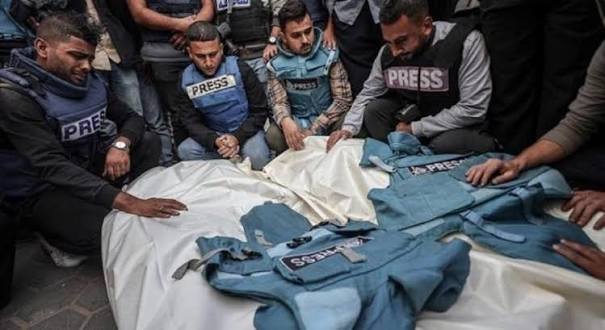
This year’s observance comes during one of the deadliest and most difficult periods in the history of Palestinian journalism. Palestinian journalists are no longer only witnesses to crimes and conveyors of the truth: they face the risks of being killed, injured, detained, displaced and subjected to abuse. Media institutions have been destroyed, equipment confiscated and coverage obstructed, threatening press freedom and the public’s right to information and the truth.
The International Commission to Support Palestinian Rights (ICSPR) stresses that protecting journalists is not solely a professional matter. It is an integral part of protecting civilians, safeguarding freedom of opinion and expression, and ensuring that violations and crimes can be documented and brought to the attention of the public and relevant international bodies.
Journalists in the Gaza Strip work under extremely dangerous humanitarian and field conditions amid killings, destruction, displacement, siege and restrictions on media access. According to cumulative figures released by the Palestinian Journalists Syndicate, approximately 264 journalists and media workers were killed between October 7, 2023, and the end of June 2026. Another 226 journalists were injured and 193 were arrested, while 4,127 violations against journalists and media workers were recorded. Attacks also destroyed 187 media institutions and targeted or destroyed 140 journalists’ homes. In addition, 713 members of journalists’ families were killed—an alarming indication that the consequences of these attacks extend to journalists’ families and communities. These are the Syndicate’s figures for the period specified; other organizations may use different methodologies and report different totals.arabnews+1
The suffering of journalists in Gaza extends beyond death and injury. Many have lost their homes, their sources of stability and income, and the offices and communications infrastructure they need to work. They face severe humanitarian conditions that directly affect their ability to continue carrying out their professional and humanitarian duties.
Violations continued throughout 2026. During the first half of the year, the Palestinian Journalists Syndicate documented 467 violations against journalists, including eight killings, 27 arrests, 22 incidents involving the seizure or destruction of journalistic equipment, and 192 instances in which journalists were prevented from covering events. It also recorded incidents involving gunfire, physical assault, threats with weapons, settler attacks, raids on journalists’ homes and media offices, the closure of institutions, and the blocking of websites.arabnews+1
In Gaza, restrictions on access for international journalists, together with extensive damage to communications and media infrastructure, make independent verification, the documentation of violations and access to information more difficult.
Journalism in the West Bank and occupied Jerusalem is likewise subject to serious threats. Press crews face attacks and intimidation while working, including physical assaults, obstruction of coverage, equipment confiscation, temporary detention and threats with weapons, as well as attacks by settlers. In September 2026, the Committee to Protect Journalists documented incidents in which journalists were assaulted, threatened or obstructed while covering demolitions and other events in the West Bank.
Israeli forces continue to target the equipment needed for journalistic work, including cameras, broadcasting devices, phones and personal protective equipment such as helmets and press-marked protective vests. Attempts to disrupt live reporting also weaken journalists’ ability to document violations and convey events to the public.
These violations coincide with continuing campaigns of arrest and detention of Palestinian journalists in connection with their professional work or media activity. Relevant organizations have documented detentions and the denial of legal safeguards and due process. According to the Palestinian Journalists Syndicate, 193 arrests of journalists were recorded between October 7, 2023, and the end of June 2026.
Missing journalists remain a matter of grave concern. Difficulties in obtaining information and verifying the fate of some journalists cause further suffering for their families and colleagues. The figures cited by ICSPR indicate that three journalists remain missing.
Against this backdrop, ICSPR recalls the gravity of the escalating violations against civilians, including journalists, and honours the courage and sacrifices of Palestinian journalists who continue their professional and humanitarian work under extreme danger. Press freedom and the protection of journalists are essential to safeguarding the right to the truth and documenting violations. The deliberate killing or targeting of journalists, attacks against them because of their work, the destruction of media institutions and the obstruction of journalistic activity constitute grave violations of international humanitarian law.
Accordingly, the International Commission to Support Palestinian Rights (ICSPR) calls for the following:
-
Release and legal protection: The United Nations, the International Committee of the Red Cross and all relevant international and human rights organizations must act urgently to press the occupying authorities to release journalists who have been arbitrarily detained, ensure that all detainees receive the legal and humanitarian protections guaranteed by international law, and end the use of arrest and detention to restrict press freedom and silence those reporting the truth.
-
Protection and access: Effective and urgent protection must be provided to journalists working in the field in the Gaza Strip, the West Bank and occupied Jerusalem. Their civilian status and professional role must be respected; they must not be targeted or obstructed. International media outlets and journalists must be allowed access to Gaza in accordance with relevant international rules and standards, to safeguard the public’s right to know and strengthen independent verification.
-
Investigation and accountability: The International Criminal Court and other competent international bodies must expedite investigations into all cases involving the killing and targeting of Palestinian journalists, preserve evidence relating to these crimes, and hold those found responsible to account in accordance with international justice standards, without immunity or impunity.
-
Support for journalists and families: The international community must establish urgent protection and support mechanisms for Palestinian journalists and their families, including humanitarian, professional and psychological assistance. Journalists who have lost their homes or livelihoods must have access to protection and assistance programs, and destroyed media institutions must be rebuilt.
-
Independent documentation: Relevant international bodies must provide independent and effective mechanisms to document violations against Palestinian journalists and preserve evidence, testimonies and media materials. This is essential to prevent the loss of evidence relating to violations and international crimes and to strengthen prospects for accountability and redress.
-
Respect for international humanitarian law: ICSPR renews its call on the international community and the States Parties to the Geneva Conventions to fulfil their legal obligations to respect and ensure respect for international humanitarian law, take serious action to prevent attacks on journalists and civilians, and end impunity for grave violations committed against the Palestinian people.
End
International Commission to Support Palestinian Rights (ICSPR)