
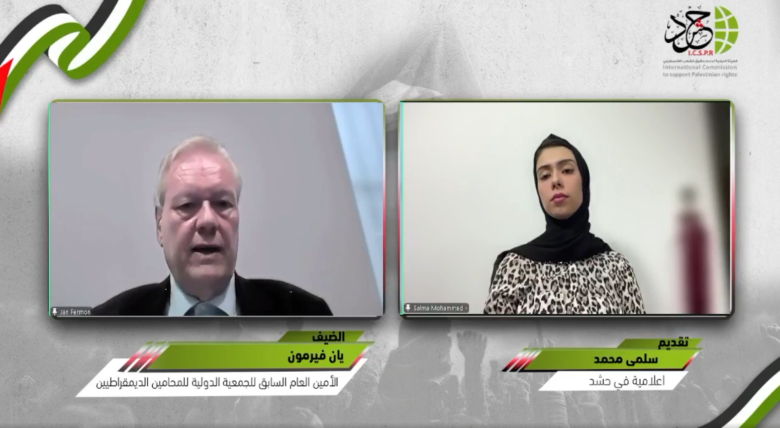
ICSPR Hosts Legal Expert Jan Fermon to Discuss Pathways to Justice and Accountability for Israeli Occupation Crimes

September 27, 2026
Press Release
ICSPR Hosts Legal Expert Jan Fermon to Discuss Pathways to Justice and Accountability for Israeli Occupation Crimes
“From Gaza to The Hague” — Hadith Al-Usbu’ Discusses Prospects for International and Domestic Prosecution and Ensuring that Perpetrators Do Not Escape Punishment
The International Commission to Support Palestinian Rights (ICSPR) hosted legal expert and international-law specialist Jan Fermon, President of the Union of Jurists in Brussels, in an episode of Hadith Al-Usbu’ (“Talk of the Week”), a program organized by ICSPR. The episode, entitled “From Gaza to The Hague,” was dedicated to examining pathways to justice and accountability for violations and crimes committed against the Palestinian people, particularly in the Gaza Strip. It was moderated by journalist and ICSPR human-rights activist Salma Mohammed.
The discussion addressed a range of legal and human-rights issues related to international accountability. These included mechanisms for prosecuting perpetrators of international crimes; the roles of the International Criminal Court and the International Court of Justice; and the possibility of activating domestic jurisdiction in a number of countries to pursue individuals accused of war crimes, crimes against humanity, and other crimes falling within the scope of national and international jurisdiction.
The session also discussed the importance of documenting violations and collecting and preserving evidence in accordance with legal and professional standards. Such work is a necessary foundation for building legal case files and enabling victims to access justice, particularly given the multiplicity of accountability pathways and the fact that legal action is not confined to a single judicial institution.
Jan Fermon praised the role played by ICSPR and Palestinian human-rights organizations in monitoring and documenting violations, collecting testimonies and evidence, and following legal files. He stressed the importance of continuing and developing this work and transforming the results of monitoring and documentation into legal files that can be relied upon before competent courts and judicial bodies.
Fermon is a lawyer at the Brussels Bar who specializes in criminal law, international humanitarian law, and human-rights law. He has served as a bureau member of the International Association of Democratic Lawyers since 2005 and has represented victims in cases concerning genocide and war crimes.zkm
He emphasized that work toward justice and accountability requires sustained institutional and legal accumulation over the long term. The length and complexity of judicial proceedings, he stated, must not become a reason to abandon efforts to prosecute alleged perpetrators. He noted that many experiences of international justice show that judicial outcomes may take years, and that continued documentation and legal follow-up are decisive in preserving the possibility of accountability.
The meeting further addressed the importance of complementarity between Palestinian and international efforts and the need to strengthen cooperation among lawyers, human-rights institutions, civil-society organizations, and victims. Such cooperation can help activate the widest possible range of available legal mechanisms and prevent crime files from being closed, lost, or undermined by the passage of time, in accordance with the applicable legal rules of each jurisdiction.
Fermon stressed that justice is not achieved through a single legal pathway. Rather, it requires the cumulative documentation of violations, multiple avenues of prosecution, sustained human-rights and legal work, and the expansion of international solidarity with victims. He emphasized the importance of maintaining efforts to secure accountability and prevent impunity.
At the conclusion of the meeting, Fermon addressed a message to the Palestinian people and the international community, calling for continued work toward justice and accountability. He urged that the length of judicial processes must not lead to the loss of hope or the weakening of legal and human-rights efforts, emphasizing that ongoing work, documentation, and legal action form an essential part of the path toward justice for victims.
ICSPR affirmed that organizing this meeting falls within its human-rights and national responsibility to support efforts to document violations and pursue accountability pathways. It also forms part of ICSPR’s commitment to strengthen dialogue with legal experts, lawyers, researchers, and international institutions, in a way that contributes to developing the legal tools available to the Palestinian people and victims of violations.
It is worth noting that Hadith Al-Usbu’ is a program organized by the International Commission to Support Palestinian Rights (ICSPR) to provide a recurring space for dialogue and discussion on key Palestinian, Arab, and international issues related to the Palestinian cause and the rights of the Palestinian people. Through hosting experts, specialists, legal professionals, researchers, and advocates, the program highlights relevant political, legal, human-rights, and humanitarian developments.