
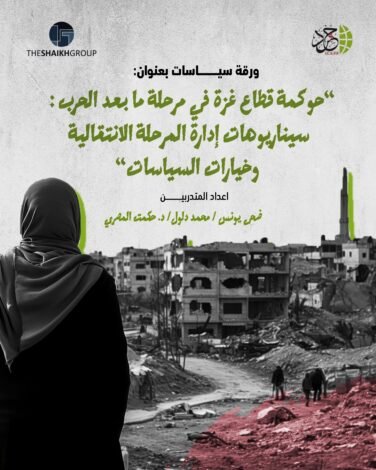
ICSPR Issues a Policy Paper on the Governance of the Gaza Strip in the Post-War Phase and Calls for a National Consensus Model Based on Legitimacy and Institutional Capacity

Date: 22 September 2026
Press Release
ICSPR Issues a Policy Paper on the Governance of the Gaza Strip in the Post-War Phase and Calls for a National Consensus Model Based on Legitimacy and Institutional Capacity
The International Commission to Support Palestinian Rights (ICSPR) has issued a policy paper on the governance of the Gaza Strip in the post-war phase. The paper examines the political and administrative transformations facing the Strip, the options proposed for managing the transitional period, and the criteria for building a governance model capable of achieving political legitimacy, institutional capacity, the rule of law, and sustainable recovery and reconstruction.
The paper explains that the Gaza Strip faces profound challenges concerning its future governance and the rebuilding of public institutions amid widespread destruction, continued political division, and growing regional and international involvement in shaping the post-war phase. It notes that discussions on this phase should not be confined to identifying which party will administer Gaza, but should focus on how institutions will be governed, the nature of decision-making mechanisms, and the degree of transparency, accountability, and public participation.
The paper affirms that governance in post-conflict settings is a fundamental pathway for moving from humanitarian relief to recovery, then to reconstruction and sustainable development. It emphasises that the success of any model for governing Gaza depends on its capacity to build legitimate, effective, and transparent institutions able to restore essential services, manage public resources, and respond to the humanitarian, social, and economic needs of the population.
The paper notes that comparative international experiences demonstrate that changing the governing authority does not necessarily improve the quality of governance or guarantee stability unless it is accompanied by comprehensive institutional reform, renewed political legitimacy, strengthened rule of law, and the creation of a public administration capable of managing resources efficiently and transparently.
The paper explains that the core challenge in the post-war phase is to move from the question of “Who governs Gaza?” to the more fundamental question of “How should Gaza be governed?” This includes the nature of the institutions that exercise authority, the distribution of responsibilities, safeguards for oversight and accountability, the inclusion of civil society and the private sector in planning and implementation, and the restoration of citizens’ confidence in public institutions.
The paper presents six main criteria for evaluating the proposed governance scenarios: political legitimacy, public acceptance, constitutional cover and national consensus; institutional capacity to manage public institutions and essential services; security and the rule of law; capacity to manage recovery and reconstruction; the degree of regional and international acceptance; and sustainability and the ability to prevent renewed division or conflict.
The paper indicates that the war has weakened the operational capacity of public institutions through the destruction of government facilities, disruption of essential services, and depletion of human and financial resources. It has also exposed the fragility of the institutional structure, which has been affected for years by political and administrative division, resulting in duplication of administrative structures, legislation, and public functions.
It affirms that rebuilding institutions in Gaza should not be limited to resuming their operations. It requires developing them on more effective and integrated foundations, ensuring the unification of administrative structures, strengthening transparency and accountability, modernising public administration, and building institutions capable of managing recovery, reconstruction, and public resources efficiently.
The paper highlights the crisis of legitimacy facing the Palestinian political system amid continued division, the suspension of general elections, and the diminished effectiveness of representative institutions. It affirms that sustainable legitimacy is based not only on legal recognition or external support, but also on public satisfaction, the ability to deliver services, respect for the rule of law, political participation, and the renewal of institutions through free and fair elections.
The paper notes that reconstruction is not merely a process of rebuilding homes and infrastructure. It is also a political and institutional process connected to the management of public resources, determination of spending priorities, oversight and transparency mechanisms, and the protection of the Palestinian national decision from politicisation or the use of international assistance to influence the structure of the political system or reshape internal balances of power.
It explains that no governance model in Gaza can succeed through internal consensus alone, just as external support cannot suffice in the absence of national legitimacy and effective institutions. The paper therefore stresses the need to build a balanced equation between the independence of Palestinian national decision-making and positive engagement with the regional and international environment, ensuring that external support serves Palestinian national priorities rather than redefining them.
The paper reviews the map of stakeholders in the post-war phase, including Palestinian political and institutional actors, Israel, Arab states, the international community and donor bodies, as well as civil society organisations and the private sector. It affirms that Palestinian actors remain the parties most directly affected and responsible for managing public affairs, and that the success of any transitional arrangement requires preserving Palestinian territorial and political-system unity, ensuring the continuity of public services, and strengthening community resilience.
The paper notes that the role of Arab states and the international community should focus on supporting stability, financing reconstruction, protecting humanitarian response, and assisting in Palestinian institution-building, without imposing political or security arrangements that undermine Palestinian national decision-making or turn financial support into a tool of tutelage or intervention in Palestinian affairs.
It explains that civil society organisations and the private sector have played central roles during the years of war in humanitarian response, service provision, and the implementation of community initiatives. Their role is expected to expand during recovery and reconstruction through participation in planning, project implementation, monitoring government performance, and strengthening social accountability.
The paper examines several future scenarios for the governance of the Gaza Strip, including restoring the Palestinian Authority’s role, forming a Palestinian national consensus government or an independent technocratic government, establishing an Arab- or internationally supported transitional administration, maintaining the status quo in different forms, or adopting a hybrid model combining more than one alternative.
The paper indicates that restoring the Palestinian Authority’s role would provide an existing institutional framework that is internationally recognised and could contribute to unifying administrative and financial structures between the West Bank and the Gaza Strip, attracting international funding, and managing recovery and reconstruction programmes. However, its success remains contingent on addressing the crisis of legitimacy, renewing representative institutions, restoring public confidence, and ending political division.
It also notes that forming a national consensus government or an independent technocratic government could offer a transitional formula with greater national acceptance if it is based on genuine Palestinian consensus. Such a government could manage relief, recovery, and reconstruction; unify public institutions; and prepare for general elections and the renewal of constitutional legitimacy.
The paper points out that this option could reduce the effects of political division, strengthen participation in managing the transitional phase, and improve public trust. However, it may face risks of becoming an arena for power-sharing and political quotas, slow decision-making, or the collapse of consensus under the pressure of political disagreements and external interventions.
The paper discusses the scenario of an Arab- or internationally supported transitional administration, which could help accelerate access to funding, launch reconstruction projects, and provide technical and administrative expertise during a time-limited period. However, it warns of the risks of this model lacking national legitimacy if it is not based on explicit Palestinian consensus or if it becomes a permanent substitute for the Palestinian political system.
The paper concludes that the most realistic and implementable option is a national consensus model for managing the transitional phase, based on a Palestinian national consensus or technocratic government operating within a defined time frame and enjoying clear national and political backing, alongside disciplined Arab and international support limited to technical, financial, and political assistance.
The paper recommends that this Palestinian transitional administration be responsible for restoring public services, managing relief, recovery, and reconstruction programmes, unifying public institutions and administrative structures, strengthening the rule of law and civilian security, ensuring transparency in the management of resources and aid, and preparing the conditions for general elections and the renewal of constitutional legitimacy.
It also calls for establishing an independent national oversight mechanism for reconstruction, comprising representatives of official institutions, civil society, the private sector, and experts, in order to ensure transparency, prevent corruption, protect public resources, and direct funding in line with the priorities and actual needs of the population.
The paper affirms the importance of involving civil society, the private sector, universities, trade unions, women, and young people in designing post-war policies and monitoring their implementation, thereby widening participation, strengthening public trust, and reducing the centralisation of decision-making.
ICSPR stresses that the future governance of the Gaza Strip must remain an integral part of the Palestinian national project. Any transitional arrangements that do not contribute to restoring the unity of the Palestinian political system, renewing its legitimacy, and building democratic and effective institutions will risk failure or reproducing division.
ICSPR affirms that this paper is issued in partnership with The Shaikh Group (TSG) as part of efforts to develop a realistic and rights-based national vision for the governance of the Gaza Strip in the post-war phase, strengthen good governance, accountability, and transparency, and support the Palestinian people’s right to manage their public affairs, exercise self-determination, and rebuild their institutions on democratic and national foundations.
To read the full paper, click here.