
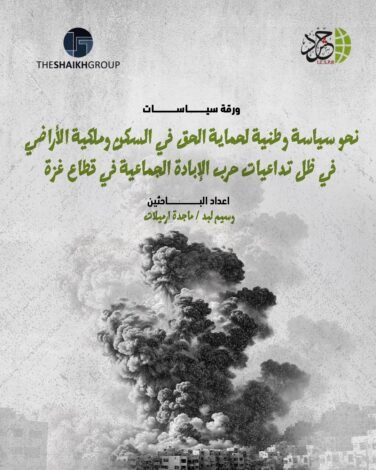
ICSPR issues a policy paper titled “Towards an Emergency National Policy to Protect the Right to Housing and Land Ownership in Light of the Consequences of the Genocidal War in the Gaza Strip”

Date: 17 July 2026
Press Release
In partnership with The Shaikh Group and as part of the Youth Civil Society Activists Diploma Program
ICSPR issues a policy paper titled: “Towards an Emergency National Policy to Protect the Right to Housing and Land Ownership in Light of the Consequences of the Genocidal War in the Gaza Strip”
The International Commission to Support Palestinian People’s Rights (ICSPR), in partnership with The Shaikh Group and as part of the Youth Civil Society Activists Diploma Program, has issued a new policy paper titled: “Towards an Emergency National Policy to Protect the Right to Housing and Land Ownership in Light of the Consequences of the Genocidal War in the Gaza Strip.” The paper, prepared by researchers Wasim Lebd and Majda Armelat, aims to outline the contours of an emergency national policy to protect the right to housing and property in light of the unprecedented destruction inflicted on the urban fabric and infrastructure of the Strip.
The paper indicates that the ongoing genocidal war in the Gaza Strip has led to the destruction or damage of more than 370,000 housing units according to international and UN estimates up to 2026, leaving over 60 million tons of rubble and causing a forcible shelter crisis affecting around 1.9 million displaced persons, most of whom rely on worn-out fabric and plastic tents unfit for human use. The paper stresses that continued reliance on tents not only constitutes a flagrant violation of the right to adequate housing, but also threatens to entrench a reality of internal forced displacement away from citizens’ original lands.
The policy paper explains that the wholesale destruction of residential blocks has not only deprived people of their homes, but has also erased the physical boundaries of properties and led to the loss of ownership documents (title deeds, sales contracts, land records) as a result of the bombing of official departments and homes. It emphasizes that this reality opens the door to wide-ranging property disputes during and after reconstruction and threatens housing, land, and property rights (HLP) of Palestinians unless a proactive national policy is adopted to protect them.
The paper is grounded in a solid legal framework affirming the illegality of deprivation of shelter and property. It notes that the Fourth Geneva Convention prohibits the destruction of real property except where rendered absolutely necessary by military operations, and that large-scale destruction of homes constitutes a war crime. It also recalls the Pinheiro Principles on the restitution of housing and property for refugees and displaced persons, which affirm the right of displaced people to return to their original homes and recover their properties or obtain fair compensation. In addition, the paper notes that the amended Palestinian Basic Law guarantees the right to private property and to adequate housing and does not permit expropriation except for public interest and with just compensation.
The paper draws attention to the problem of “areas behind the yellow line” as one of the most serious consequences of the genocidal war. It explains that geographic analyses indicate that Israeli occupation forces now control between 58% and 60% of the total area of the Gaza Strip—approximately 211 to 219 square kilometers—leaving Palestinians with about 40% of the territory, mainly along the coastal strip and western areas, to host more than two million people. It clarifies that control levels vary by governorate: the “yellow line” swallows about 68.3% of the area of Khan Younis, 64.3% of Gaza City, 62.9% of Rafah, 43.8% of North Gaza, and 21.9% of Deir al-Balah.
The paper confirms that the Israeli army has gradually shifted the “yellow line” concrete markers westwards in areas such as East Gaza and Shuja’iya, raising the control percentage from 53% at the time the scheme was first put forward to nearly 60% today, and turning large tracts—especially agricultural lands—into “deadly firing zones” that prevent the return of residents and deepen spatial cleansing. It stresses that what is termed “rehabilitation and expansion of the humanitarian zone” in Rafah and surrounding areas is, in substance, a forced process of demographic and property re-engineering, involving the seizure and alteration of ownership of original residents’ lands and their conversion into compulsory mass-shelter enclaves, road networks, and semi-permanent logistical facilities.
The paper warns that stacking hundreds of thousands of displaced persons on lands belonging to original owners in Rafah, Al-Mawasi and other areas, without involving Palestinian local authorities, creates a situation of “property and rights congestion” between the emergency shelter needs of the displaced and the rights of original landowners. This, it argues, undermines the possibility of reconstruction based on the cities’ original master plans. It further notes that confining humanitarian assistance to “humanitarian zones” imposed by the occupation effectively legitimizes internal displacement and entrenches “new refugees” within the Strip, in clear violation of international law and the Pinheiro Principles.
On the practical level, the paper proposes a set of transitional shelter alternatives tailored to conditions in the Gaza Strip, based on the principle of “shelter that reinforces resilience in the actual location of the home” and inspired by the “self-help” model led by the Palestinian Housing Council in cooperation with international partners. These alternatives include solid transitional units made of fiberglass and insulated sandwich panels, rapid partial rehabilitation of damaged-but-standing homes through small grants and direct support to families, and composite shelter solutions above or adjacent to rubble using neighborhood-based spatial approaches.
The paper presents two main public policy options. The first is to continue the “traditional relief” approach based on tents and camps, which it argues entrenches the new reality of displacement, deepens property-rights crises, and squanders donor funds on unsustainable solutions. The second, preferred option is to adopt a “national policy for transitional shelter and in-place protection of property,” moving from tents to solid transitional units and community-led rehabilitation at neighborhood level, while launching a comprehensive legal umbrella for documenting and safeguarding property and preventing expropriation or forced confiscation under planning or military pretexts.
Within its procedural recommendations, the paper calls on the Ministry of Public Works and the Palestinian Housing Council to ban the expansion of fabric tent camps and stop importing tents as a primary solution, replacing them with raw materials for constructing transitional units. It also urges expansion of the locally led “self-help” program overseen by the Palestinian Housing Council for rehabilitating partially damaged homes, and intensifying temporary and alternative shelter projects in areas adjacent to or lying behind the “yellow line” wherever conditions allow, in order to consolidate urban presence and prevent these zones from becoming deserted areas vulnerable to seizure.
The paper proposes a package of measures to protect land ownership and support legal documentation, including issuing “property steadfastness certificates” as temporary ownership documents through cooperation between the Land Authority, municipalities, and the Bar Association; accelerating digitalization via a secure electronic platform for registering ownership claims and uploading available documents; and using GIS and drone imagery to fix the coordinates of land parcels. It also calls for freezing emergency expropriation decisions in destroyed areas and behind the yellow line until property rights are comprehensively documented and ensuring that any new urban planning is based on in-kind compensation or alternative plots within the same neighborhood rather than forced evictions.
The paper stresses the importance of forming “community peace and property arbitration committees” in affected neighborhoods to resolve emergent boundary disputes and protect the rights of the most vulnerable, especially women and orphans. It further recommends that the Land Authority issue an exceptional circular allowing inheritance transfers for properties located behind the “yellow line” and in restricted-access areas without requiring on-site inspections, on the basis of force majeure. At the international level, the paper calls on the High Contracting Parties to the Geneva Conventions to act urgently to halt the crime of forced displacement, dismantle buffer zones and the yellow control line, enable unconditional return of residents to their lands and properties, and link reconstruction funding to respect for housing, land and property rights in line with the Pinheiro Principles.
The paper concludes that protecting the right to housing and land ownership in the Gaza Strip is a political and legal battle to entrench Palestinian presence and thwart schemes of displacement and demographic engineering. It recommends adopting participatory urban planning as a tool of legal resistance; institutionalizing a legal–engineering alliance through the formation of a “National Council for the Protection of Housing and Property Rights”; and moving immediately from the reality of worn-out tents to solid shelter alternatives and self-led rehabilitation at demolition sites, as a first step toward reviving the local economy and anchoring land rights as a cornerstone of any future Palestinian state.