
A new strategic position paper by Dr. Salah Abdel Ati on Palestinian elections between democratic renewal and the battle to reshape the political system

Date: 11 July 2026
Press Release
A new strategic position paper by Dr. Salah Abdel Ati on Palestinian elections between democratic renewal and the battle to reshape the political system
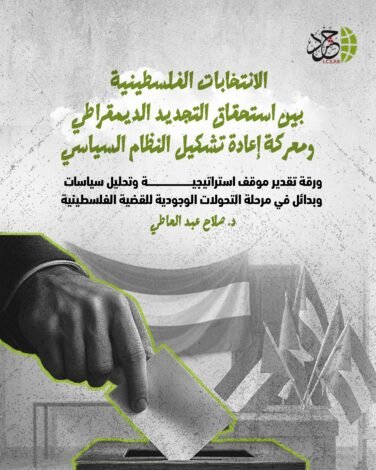
The International Commission to Support Palestinian People’s Rights (ICSPR) has issued a new strategic position paper authored by Dr. Salah Abdel Ati, President of ICSPR, entitled: “Palestinian Elections Between the Imperative of Democratic Renewal and the Battle to Reshape the Political System.” The paper analyzes the most critical challenges and stakes surrounding the Palestinian electoral track amid existential transformations affecting the Palestinian cause, and the opportunities and risks this track poses for national legitimacy and the reconstruction of the Palestinian political system.
Dr. Salah Abdel Ati stresses in the paper that the upcoming Palestinian elections are no longer merely a postponed constitutional entitlement or an administrative procedure to renew a legislative institution, but have become part of a broader struggle over the future of the Palestinian political system, the nature of the national project, and the relationship between the Palestinian people and their representative institutions, in a phase where the Palestinian cause faces its most serious attempts at reconfiguration in decades.
He explains that the paper starts from the premise that the political environment in which elections would be held is far from normal, and is shaped by three major determinants: firstly, the ongoing Israeli war on the Gaza Strip and the resulting humanitarian catastrophe, vast destruction, and attempts to redefine the future of Gaza and its relationship with the West Bank and the Palestinian cause as a whole; secondly, the escalation of annexation, settlement expansion, and Judaization in the West Bank and occupied Jerusalem; and thirdly, regional and international efforts to reorder the Palestinian scene under the banner of the “day after,” in ways that reduce the cause to managing security, economic, and humanitarian files without addressing the roots of the conflict in occupation, settler colonialism, and denial of Palestinian national rights.
Dr. Salah underscores that the paper affirms that elections are simultaneously an opportunity and a risk. They are an opportunity to renew popular legitimacy, rebuild institutions, open space for new generations and national capacities to access decision-making positions, and break the deadlock that has afflicted the Palestinian political system. But they become risky if reduced to a narrow electoral exercise that merely rearranges positions within the existing authority, reproduces traditional power balances, or grants fresh legitimacy to a political structure suffering from deep crises of representation, function, and role.
The paper stresses that the current Palestinian crisis goes far beyond the mere absence of elections, and that its roots lie in the nature of the political system itself, which emerged after the Oslo Accords as a transitional framework that, over time, turned into a permanent situation without achieving sovereignty or ending the occupation. It points out that this trajectory has produced a series of structural imbalances, including a crisis of legitimacy caused by prolonged suspension of general elections, a crisis of national representation, a political and geographic split between the West Bank and Gaza, a crisis of elite renewal, and a crisis in the basic function of the Palestinian Authority—whether it is an instrument of transition toward statehood or an administrative apparatus for managing a population under occupation.
Dr. Salah explains that the paper emphasizes that elections cannot be separated from the broader battle to redefine the Palestinian cause. The war on Gaza was not merely a military confrontation; it revealed a struggle over the future of Palestinian existence itself, amid an Israeli project seeking to separate Gaza from the West Bank, weaken the unity of the Palestinian people, prevent the emergence of a unified Palestinian political center, and transform the cause from one of liberation and inalienable rights into a set of humanitarian and administrative arrangements.
The paper affirms that Palestinian national interests require rebuilding a political system capable of dealing with the current phase as a phase of national liberation and struggle for rights, not merely a phase of crisis management. It stresses that the central question is no longer whether the Palestinian people need elections—since elections are a democratic and national right that must not be obstructed—but rather what kind of elections are needed, and what national function they must serve at this historical juncture. The paper asks whether elections will be a gateway to reconstructing the political system and enhancing the capacity to confront occupation and plans to liquidate the cause, or whether they will become a tool to manage an accumulated crisis within a system that has lost much of its effectiveness and legitimacy.
Dr. Salah further clarifies that the paper warns against reducing democracy to the ballot box alone. It confirms that elections are meaningless unless they are embedded in a comprehensive democratic framework that guarantees freedom of political action, judicial independence, respect for the rule of law, freedom of expression and association, equal opportunities, respect for results, and participation of all components of the Palestinian people. It argues that holding elections without addressing these conditions may have reverse effects, turning them into a formal instrument for reproducing the political crisis rather than opening a path to resolve it.
In its reading of the current electoral decree, the paper notes serious problems, particularly the tendency to hold legislative elections separately from presidential elections in the first phase, which may produce partial legitimacy for a single institution without addressing the crisis of presidential legitimacy, the nature of the relationship between the presidency, government, and the legislature, or the relationship between the Palestinian Authority and the Palestine Liberation Organization. It stresses that the nationally required elections are not confined to the Legislative Council, but must be part of a process that re-establishes the relationship between the people and their institutions under a unified political vision for rebuilding the Palestinian political system.
The paper also examines amendments to the electoral system—such as increasing the number of Legislative Council members to 200, lowering the threshold to 1%, and expanding the participation of youth and women—considering them positive in principle, as they broaden political participation and representation. At the same time, it warns that such changes may, in the absence of a unifying national vision, lead to further political fragmentation, weaken the council’s ability to form clear majorities, and reinforce individual and localized politics at the expense of national programs.
Dr. Salah Abdel Ati notes that the paper raises a central question about whether the current electoral amendments will lead to wider democracy or greater fragmentation. It emphasizes that the core problem lies not in technical changes themselves, but in the lack of a political framework that defines their function. The paper also warns of the ongoing impact of political restrictions on candidacy, the weakness of judicial independence, and imbalances in the separation of powers, which may keep key levers of control outside the elected institution even if elections are held.
The paper devotes a significant section to what it calls “re-engineering the Palestinian political system,” highlighting the crucial distinction between democratic rebuilding of the system—based on national consensus, popular participation, comprehensive elections, reform of the PLO, and expanded representation—and administrative rearrangement of the system—based on redistributing positions, stabilizing existing balances of power, producing more manageable institutions, and keeping the real center of decision-making beyond popular accountability. It warns that the danger lies in turning reform processes into mere re-packaging of the old system with new tools.
The paper stresses that legislative elections, despite their importance, cannot by themselves resolve the question of national representation. The Legislative Council represents residents of the territory occupied in 1967, whereas the Palestinian National Council and the PLO are supposed to embody representation of the entire Palestinian people wherever they reside. Hence, the paper argues that any serious rebuilding of the political system must engage the PLO file, and that developing mechanisms for the participation of Palestinians in the homeland and diaspora—through unified voter registration, secure electronic voting, remote voting, and independent oversight—is now essential to translate the unity of the Palestinian people into institutional reality.
The paper also analyzes the map of key actors in the electoral arena, showing that the Palestinian Authority views elections as a chance to renew part of its legitimacy and regain political traction, while simultaneously seeking to preserve existing power balances. It explains that Fatah faces challenges of organizational and leadership renewal and rhetorical adaptation; that Hamas approaches elections in a context radically different from that of 2006; that other factions, youth, independents, and civil society face challenges of influence, organization, and resources; and that the Israeli occupation remains the most influential external actor through control over Jerusalem, movement, arrests, and restrictions on political activity.
Importantly, the paper stresses that the upcoming elections are not merely a competition between lists and programs, but a battleground over the future shape and function of the Palestinian political system, amid overlapping struggles concerning internal legitimacy, the nature of the system, representation of the Palestinian people, and the future of the Palestinian cause itself in the face of attempts to convert it into an issue of population, economy, and security management.
Within this context, the paper outlines several possible scenarios: proceeding with legislative elections alone as per the current track, holding comprehensive and simultaneous national elections, postponing elections, or conducting incomplete or fragmented elections if Jerusalem or Gaza are excluded or if diaspora participation is weak. It considers legislative elections alone the most likely scenario but stresses that such a course could be a limited step forward that fails to address structural crises, while comprehensive simultaneous elections remain the best national option despite the difficulty of achieving them under current circumstances.
Dr. Salah Abdel Ati emphasizes that the paper does not stop at diagnosing risks; it also presents political options for national forces, including boycotting elections, participating without conditions, participating conditional on reforms, or building cross-factional national renewal lists. It argues that the most realistic and effective option is conscious national participation through reformist lists including independent figures, youth, women, legal, economic, and social experts, and national personalities from various currents, in order to transcend binary polarization, protect rights and freedoms, reform institutions, combat corruption, end division, and rebuild the national project.
The paper sets out a national roadmap before, during, and after elections, starting with the call for a genuine national dialogue addressing major questions about the nature of the coming phase, the role of the Palestinian Authority, rebuilding the PLO, ending division, and articulating a national program capable of safeguarding Palestinian rights. It demands political and democratic guarantees, including an end to political arrests, protection of freedom of expression and association, equal opportunities, judicial independence, and prior commitment to respecting election results, as well as maximum possible synchronisation between legislative, presidential, and National Council elections.
Furthermore, the paper underscores the need to protect the integrity of the electoral process through an independent Central Elections Commission, national and international monitoring, transparent campaign financing, prohibition of the misuse of public resources, media freedom, and independent judicial avenues for electoral challenges. It calls for turning elections into a battle of programs and visions, shifting public debate from “who wins seats?” to “what project will the winners carry?”, particularly regarding confronting occupation, protecting Jerusalem, rebuilding Gaza, ending division, economic reform, social justice, judicial independence, and public freedoms.
In its concluding assessment, the paper stresses that the forthcoming Palestinian elections are not a ready-made solution to the crisis, but can become part of the solution if transformed into a gateway for rebuilding Palestinian national capacity. It warns that the real danger lies not in holding elections per se, but in holding elections that change nothing in the structure of the political system or in the rules of decision-making. Conversely, the opportunity lies in turning this limited entitlement into the beginning of a new national trajectory that restores popular legitimacy, strengthens national unity, and shields the Palestinian cause against projects of fragmentation and political re-engineering.