
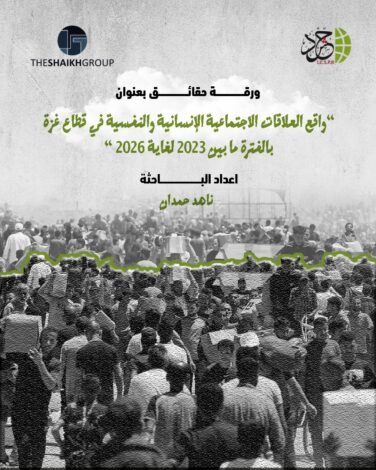
ICSPR issues a fact sheet titled: “The Reality of Social, Humanitarian, and Psychological Relations in the Gaza Strip” as part of the Youth Civil Society Activists Diploma Program

Date: 22 June 2026
Press Release
In partnership with The Shaikh Group (TSG) and as part of the Youth Civil Society Activists Diploma Program
ICSPR issues a fact sheet titled: “The Reality of Social, Humanitarian, and Psychological Relations in the Gaza Strip”
The International Commission to Support Palestinian People’s Rights (ICSPR), in partnership with The Shaikh Group (TSG) and as part of the Youth Civil Society Activists Diploma Program, has issued a new fact sheet prepared by researcher Nahed Hamdan titled: “The Reality of Social, Humanitarian, and Psychological Relations in the Gaza Strip,” which highlights the profound transformations affecting the social fabric of the Strip and the deep psychological impacts resulting from the ongoing war of genocide since 7 October 2023, along with the comprehensive blockade, forced displacement, and collapse of infrastructure and basic services.
The paper explains that the continuous aggression on the Gaza Strip has not only targeted people’s bodies and homes, but has also struck at the core of social and human relations, forcibly reshaping family and community ties under the pressure of displacement, fragmentation, and loss of breadwinners, leading to what can be described as the “demolition of the core nucleus of Gazan society” and turning the social and psychological environment into a space of prolonged, layered trauma affecting almost every individual to varying degrees.
It notes that nearly two million people in the Gaza Strip have been living, for more than two and a half years, in a constant cycle of fear and insecurity amid systematic destruction of homes, the conversion of schools into overcrowded shelters, and the repeated displacement of hundreds of thousands of families, which has resulted in the breakdown of extended families, the weakening of traditional support networks, and a heavy increase in responsibilities borne by women, children, and the elderly in an environment that lacks the minimum requirements for dignified living.
Drawing on recent UN and field data, the fact sheet records alarming indicators regarding the collective psychological situation: estimates indicate that 99.7% of displaced people living in tents suffer from acute anxiety symptoms, 99.5% of the displaced community experience various symptoms of depression, and 93.7% suffer from severe stress-related trauma, while it is likely that 54% of adults meet diagnostic criteria for three concurrent disorders: major depression, acute anxiety, and post-traumatic stress disorder (PTSD). The paper also points out that between 17,000 and 20,000 children have become unaccompanied or completely separated from their families, and that around 1.2 million children in the Gaza Strip are now in urgent need of psychological and social support services, amid the near-total collapse of mental health infrastructure and the destruction or disabling of most community care centers.
The fact sheet delves deeply into “demographic shifts and identity struggles among children,” explaining that the killing, injury, and detention of large numbers of young men and adults has led to the disappearance of traditional family safety nets and an unprecedented rise in households headed by women or children, alongside soaring numbers of widows and orphans and a shrinking role for the extended family that historically provided a social safety net in times of crisis. This reality, it adds, has created a disturbance in demographic and social balance and imposed new roles on women and children, forcing the most vulnerable groups to shoulder burdens far beyond their physical and psychological capacity.
In a dedicated section, the paper addresses the phenomenon of the “generation of tents,” noting that nearly three years of continuous life in tents and improvised shelters, together with an almost complete interruption of formal education, have deprived hundreds of thousands of children of a stable school environment and turned their relationship with home and school into one associated with danger, destruction, and displacement. Many children, it explains, now perceive themselves as “displaced” before seeing themselves as “students,” which threatens to create a deep cognitive, psychological, and social gap between them and their peers in normal educational settings.
The paper offers a multi-dimensional analytical reading of the situation and first examines the impact of the war on social relations, pointing out that repeated displacement and family overcrowding in tents or small rooms inside schools and shelters have created a state of lost privacy and widespread tension within individual families and raised levels of daily friction between family members in the absence of safe spaces or any infrastructure that guarantees the most basic conditions of rest and stability. These conditions, it notes, have pushed many families towards negative coping mechanisms such as child labor, early marriage for girls, and reliance on unstable family patterns as forced methods of facing poverty, hunger, and deprivation.
On the psychological level, the paper stresses that the concept of “post-trauma” no longer accurately describes the condition of Gaza’s population, as they are not living after a single traumatic event but in a state of ongoing, renewed trauma due to the continued threat of death, repeated loss of loved ones, and daily exposure to scenes of destruction, bodies, and the wounded. It notes that worrying proportions of children suffer from elimination disorders such as involuntary bed-wetting and that a large number experience recurring nightmares, severe sleep disorders, and aggressive or withdrawn behavior, while many women exhibit symptoms of severe depression and chronic anxiety as they bear responsibility for their families in the absence of breadwinners and amid severe scarcity of resources.
The paper further indicates that approximately 38% of women who underwent medical and psychological assessment suffer from major depression and that a large segment of parents now live in a state of chronic “psychological exhaustion” after having exhausted all coping mechanisms over successive years of blockade, war, and displacement. This collective exhaustion, it warns, directly affects parenting patterns, levels of verbal and physical violence within households, and the ability to provide stable psychological and emotional care for children.
From a legal and human rights perspective, the fact sheet affirms that the environment imposed on Gaza’s population clearly violates the obligations of the occupying power under international humanitarian law and international human rights law, as civilians are effectively denied their right to physical and mental health as recognized in Article 12 of the International Covenant on Economic, Social and Cultural Rights. It also underlines that the targeting and destruction of health, psychological, and educational facilities, and the prevention of their reconstruction, is consistent with a pattern of violations that may amount to inhuman and degrading treatment prohibited under the Fourth Geneva Convention and stands in stark contradiction to the Convention on the Rights of the Child, especially the provisions related to protection from violence and exploitation and the right to education and a safe environment for healthy development.
The paper concludes with several key findings, including the near-total collapse of traditional psychological and social protection systems in the Gaza Strip, the inability of national and international humanitarian actors to meet the massive needs in mental health and psychosocial support, and the emergence of an entire generation of children growing up in an environment saturated with trauma and deprivation, which threatens their future learning and social integration prospects. It also notes that limited international funding and the failure to adequately meet the 2026 humanitarian response plans have further widened the gap between the scale of needs and the scope of actual intervention on the ground.
In light of these findings, the fact sheet presents a set of recommendations, including integrating the psychological and social dimension as a central pillar in any reconstruction and recovery plan, not merely rebuilding physical infrastructure while neglecting the human and relational fabric of society. It calls for establishing and expanding safe community centers for children and women in various displacement areas, providing sustainable psychosocial support programs based on trained local professionals, and supporting psychologists and social workers who themselves are exposed to direct and secondary trauma in the course of their work.
The paper urges the international community, the United Nations, and specialized agencies to act urgently to stop the war of genocide on the Gaza Strip, provide genuine international protection for civilians, and ensure the safe and sufficient entry of humanitarian aid, while giving particular priority to community mental health and psychosocial support programs, and developing mechanisms to monitor the occupying power’s compliance with its legal obligations toward the civilian population.
ICSPR affirms that this fact sheet is part of its efforts, in partnership with The Shaikh Group (TSG) and within the framework of the Youth Civil Society Activists Diploma Program, to document the deep repercussions of the war on the social and psychological structure of the Gaza Strip and to emphasize that rebuilding people and human relationships is no less important than rebuilding homes and institutions, and that neglecting this dimension would mean leaving an entire generation to face the consequences of complex, continuous trauma alone.