
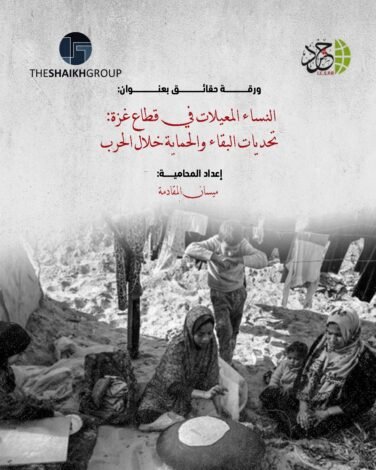
ICSPR issues a fact sheet titled: “Women Breadwinners in the Gaza Strip: Challenges of Survival and Protection During the War”

Date: 11 June 2026
Press Release
In partnership with The Shaikh Group (TSG) and as part of the Youth Civil Society Activists Diploma Program
ICSPR issues a fact sheet titled: “Women Breadwinners in the Gaza Strip: Challenges of Survival and Protection During the War”
The International Commission to Support Palestinian People’s Rights (ICSPR), in partnership with The Shaikh Group (TSG), and as part of the Youth Civil Society Activists Diploma Program, has issued a fact sheet prepared by researcher Maisan Al-Maqadma titled: “Women Breadwinners in the Gaza Strip: Challenges of Survival and Protection During the War,” examining the situation of women breadwinners in Gaza during the war and the economic, social, psychological, and legal challenges they face in the context of mass displacement and the collapse of basic services.
The fact sheet explains that women breadwinners in the Gaza Strip have been facing extremely harsh humanitarian and living conditions since the outbreak of the war in October 2023, amid the killing of more than 72,983 Palestinians and the injury of more than 172,919 others, in addition to thousands of missing persons, which has caused thousands of families to lose their sources of income and primary providers and has forced many women to assume responsibility for supporting their families and meeting their children’s basic needs amid economic and humanitarian deterioration, insecurity, and instability.
The paper indicates that more than 38,000 women and girls were killed in Gaza between October 2023 and December 2025, and that around 16,000 women lost their husbands during the war, while nearly one in every seven families in the Gaza Strip is now headed by a woman, reflecting the emergence of a new generation of widows carrying the burdens of loss, caregiving, and life-altering decisions amid famine, displacement, and the collapse of basic services. It also notes that the proportion of female-headed households rose from 12% before the war to around 18%, that approximately 57,000 women have become the primary breadwinners of their families since the beginning of the war, that the number of widows in the Gaza Strip is estimated at around 26,370, and that unemployment has risen to more than 80%.
The fact sheet highlights that the response of UN agencies, including UNRWA, UN Women, and the World Food Programme, has constituted the first humanitarian line of defense for protecting women breadwinners and their families through emergency food and cash assistance, psychosocial support services, case management, and the provision of some protection spaces within displacement centers. However, it stresses that the continuation of the war, the closure of crossings, and restrictions on the entry of humanitarian aid have created a major gap in the response compared with the growing needs of women breadwinners and their children.
The paper shows that women breadwinners face multiple survival challenges, foremost among them food insecurity, loss of income and employment, and deepening extreme poverty, in addition to displacement and loss of housing, as many are living in tents or shelters that lack privacy, safety, and basic health services. It adds that women bear additional burdens inside displacement centers, including childcare, securing water and food, coping with harsh health conditions, difficulty accessing healthcare, especially reproductive health services, and rising psychological and social pressures resulting from loss and the burden of responsibility under extremely difficult conditions.
On the protection side, the fact sheet points to weak legal and social protection for women inside displacement centers, heightened risks of gender-based violence, lack of privacy and safety, and the difficulty women face in accessing protection services and psychosocial support, in addition to the growing marginalization of women and girls as a result of the broader humanitarian deterioration.
The paper reviews the legal framework governing the protection of women breadwinners, emphasizing that the 1949 Geneva Conventions, the 1977 Additional Protocol I, the Convention on the Elimination of All Forms of Discrimination against Women (CEDAW), and the International Covenant on Economic, Social and Cultural Rights all provide clear legal foundations for the protection of women and for guaranteeing the rights to food, shelter, healthcare, work, and social protection during armed conflict. It also refers to the role of the UN Protection Cluster and local human rights and women’s organizations in documenting violations and providing legal support.
The fact sheet concludes with a number of recommendations, most notably intensifying legal monitoring and documentation of violations and crimes committed against women in the Gaza Strip, and pursuing accountability for the Israeli occupation through international judicial mechanisms, alongside adopting emergency and sustainable economic response programs to support women breadwinners through small income-generating projects and financing mechanisms suited to the reality of destruction, blockade, and economic collapse. It also calls for strengthening psychosocial support services, establishing and equipping shelters and safe spaces that respect the privacy of women and children, and ensuring fair, safe, and non-discriminatory access for women to humanitarian assistance, while prioritizing female-headed households, widows, displaced women, and women with disabilities.
ICSPR affirms that this fact sheet comes within the framework of efforts aimed at shedding light on the conditions of women breadwinners in the Gaza Strip and raising awareness of the urgent needs of this especially vulnerable group, in a way that supports their human and legal rights and strengthens their resilience in the face of war and humanitarian collapse.
It should be noted that this fact sheet does not necessarily reflect the views of ICSPR or The Shaikh Group (TSG).