
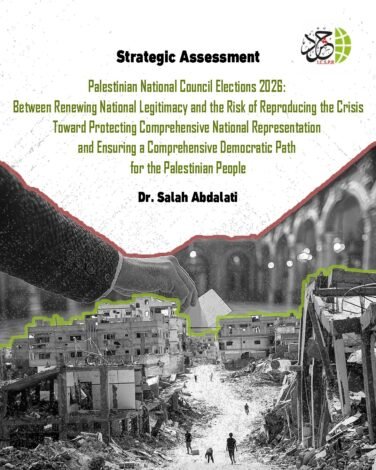
Strategic Position Assessment by Dr. Salah Abdalati Palestinian National Council Elections 2026 Between Renewing National Legitimacy and the Risk of Reproducing the Crisis

Date: 7 June 2026
Press Release
Strategic Position Assessment by Dr. Salah Abdalati: Palestinian National Council Elections 2026 Between Renewing National Legitimacy and the Risk of Reproducing the Crisis
The International Commission to Support Palestinian Rights (ICSPR) has issued a new position paper titled: “Palestinian National Council Elections 2026: Between Renewing National Legitimacy and the Risk of Reproducing the Crisis – Toward Protecting Comprehensive National Representation and Ensuring a Comprehensive Democratic Path for the Palestinian People.” The paper, authored by Dr. Salah Abdalati, Chairman of ICSPR, examines the implications of the call to hold elections for the Palestinian National Council at one of the most dangerous moments the Palestinian cause has faced since the Nakba.
The paper stresses that this call comes amid a genocidal war in the Gaza Strip, escalating settlement expansion and displacement in the West Bank and Jerusalem, and an ongoing assault on the refugee question and the right of return, alongside regional and international attempts to re-engineer the Palestinian political system and redefine who represents Palestinians politically and legally. ICSPR notes that elections for the Palestinian National Council cannot be treated as a mere administrative or technical step, but rather as a “battle over the future of Palestinian national representation” and a foundational moment affecting the core of the national project and the future of the Palestine Liberation Organization (PLO) as the overarching representative framework for Palestinians in the homeland and the diaspora.
Through the paper, Dr. Salah Abdalati emphasized that the key question is no longer simply “how do we elect a new National Council?”, but rather “what political system is being reproduced, what PLO is being reconstituted, and what national project is being solidified or dismantled?” He warned that any electoral process that is not grounded in comprehensive national consensus and does not guarantee the participation of all Palestinians may turn from an opportunity for reconstruction into a tool for reproducing the crisis, deepening division, and reshaping national representation in an incomplete way.
The paper explains that the crisis of the Palestinian political system goes far beyond the mere absence of elections. The system is suffering from the erosion of the PLO’s representative legitimacy, the paralysis of democratic renewal mechanisms, geographic and political division between the West Bank and Gaza, the inflation of executive power at the expense of representative institutions, the absence of the Legislative Council and the suspension of oversight, the decline in judicial independence, and a widening gap between society and its institutions. This has led to a gradual shift from a comprehensive national liberation project to the management of restricted self-rule under occupation.
The paper reviews the key features of the newly proposed electoral system for the National Council, which provides for the election of 350 members, including 200 seats for Palestinians in the homeland and 150 seats for Palestinians in the diaspora, under a full proportional representation system, with each diaspora region treated as an electoral district and recourse to consensus, electoral colleges, or appointment where elections cannot be held. While welcoming the importance of proportional representation and ensuring diaspora participation, the paper warns that turning the “exception” – appointment or consensus – into a de facto rule due to the difficulty of holding elections in several arenas risks producing a hybrid council that reproduces quota-sharing instead of genuine democratic representation.
The paper underlines that the Palestinian National Council is the highest representative body of the Palestinian people in the West Bank, Gaza Strip, Jerusalem, the 1948 territories, refugee camps, and the diaspora, and that any imbalance in representing these components effectively amounts to redefining “who the Palestinian people are politically,” with direct implications for the nature and foundational legitimacy of the PLO.
It further explains that holding comprehensive traditional elections faces serious structural obstacles, including Israel’s control over land and crossings and its restriction of freedom of movement, its refusal to allow elections in Jerusalem, geographic and political division between Gaza and the West Bank, differing legal systems in countries of asylum, and political constraints on Palestinian refugees in countries such as Lebanon, Syria, and Jordan. These factors make comprehensive traditional elections “extremely difficult, if not impossible,” without innovative solutions that overcome geographic and political constraints.
In this context, the paper highlights the risks of extensive reliance on appointment and electoral colleges, which could result in a composite National Council built on partial elections, partial appointments, and factional consensus. This would reproduce a quota-based system, marginalize youth, women, and independents, and weaken genuine popular representation. As an alternative, the paper calls for a comprehensive national foundational path that includes ending unilateral decision-making, overcoming division between Gaza and the West Bank, rebuilding the political system on the basis of national partnership, adopting a transitional national charter, and moving from managing the occupation to a renewed national liberation project.
The paper proposes electronic voting as a “strategic national option” and the most realistic way to ensure inclusive National Council elections. Electronic voting would enable the participation of Palestinians in Jerusalem without direct Israeli approval, allow broad participation of Palestinians in the diaspora, overcome geographic and political barriers, enhance the participation of youth and women, reduce the need for electoral colleges and appointments, and open the door to more regular periodic elections. It stresses that success in this approach requires an advanced cybersecurity system, independent judicial and human rights oversight, transparent national and international monitoring, and a unified, regularly updated electoral registry, turning e-voting into a political necessity to protect the Palestinian democratic right, not just a technical tool.
The paper also calls, as Dr. Salah Abdalati explains, for shifting the Palestinian debate from procedural and technical details to foundational questions: how to redefine the national project after recent profound transformations; whether the PLO is reformable or requires a refounding process; how to integrate various tools of struggle into a single national strategy; and how to restore the unity of the Palestinian people at home and in the diaspora to produce a comprehensive, legitimate national leadership.
ICSPR’s position paper concludes that the 2026 Palestinian National Council elections stand at a critical historical crossroads: either they become a genuine entry point for rebuilding the PLO and renewing its legitimacy on comprehensive democratic foundations, or they turn into a formal process that reproduces the current political crisis in new forms. It stresses that the measure of success lies not in merely holding elections, but in the degree of inclusiveness, the nature of the rules governing them, the breadth of national consensus around them, and their ability to represent all Palestinians wherever they may be, in a manner that keeps the Palestinian national project alive and capable of renewal.
The International Commission to Support Palestinian Rights (ICSPR) emphasizes that protecting comprehensive national representation and ensuring a democratic path for the Palestinian people requires a consensual national process that removes the National Council elections file from narrow factional tug-of-war and restores it to its proper context as a battle over the future of the national project, over who represents the Palestinian people, and over every Palestinian’s right—at home and in the diaspora—to freely and equally determine their political destiny.