
The International Commission “ICSPR” Issues a Fact Sheet Titled “Epidemics as a Weapon of War”

Date: April 29, 2026
Press Release
The International Commission “ICSPR” Issues a Fact Sheet Titled “Epidemics as a Weapon of War”
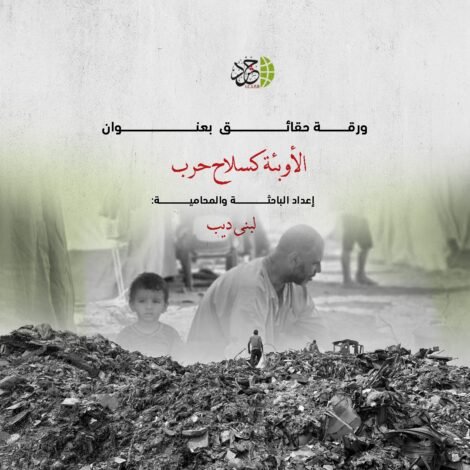
The International Commission to Support Palestinian Rights (ICSPR) has issued a fact sheet prepared by researcher Lubna Deeb under the title “Epidemics as a Weapon of War.” The paper sheds light on the escalating health and environmental collapse in the Gaza Strip and on how epidemics and infectious diseases have become a widespread daily threat pursuing civilians amid mass displacement, the near-total destruction of infrastructure, the blockade, and restrictions on the entry of medical supplies and hygiene materials.
The paper states that the reality faced by Gaza’s population since the war of October 7 has gone beyond bombardment and direct killing, extending into a parallel war marked by starvation, lack of clean water, and the overcrowding of displaced people in polluted and unsafe environments, conditions that have created fertile ground for the rapid and dangerous spread of disease. It notes that more than two million Palestinians are living in catastrophic conditions in a confined area, amid severe deterioration in water, sanitation, hygiene, and health services, making the spread of infection an almost inevitable outcome.
The paper explains that the destruction of essential infrastructure has been one of the main drivers of the health crisis, including damage to water, sewage, and electricity networks, alongside widespread destruction of hospitals and health facilities and the paralysis of municipal capacity to remove waste and manage wastewater, all of which have increased environmental contamination and the likelihood of infectious disease outbreaks in camps and shelters. It adds that this collapse has coincided with acute shortages of medicines and essential medical supplies, further weakening the health system and limiting its ability to respond to mounting needs.
The paper places particular emphasis on the devastating impact on women and children, noting that women and children account for more than 70 percent of the victims of the assault, including those killed, injured, and missing, and that pregnant and breastfeeding women are facing severe health and nutritional risks in the context of food scarcity, inadequate healthcare, and the breakdown of psychosocial support services. It further highlights that acute malnutrition among mothers, pregnant women, and breastfeeding women has become a multiplying factor for health risks, including anemia, hemorrhage, premature birth, low birth weight, and increased mortality among newborns.
In the section on famine and malnutrition, the paper argues that famine is no longer a future threat but a present reality in Gaza, where hundreds of thousands are experiencing acute food insecurity and tens of thousands of pregnant and breastfeeding women are at risk of severe hunger and malnutrition. It notes that more than 12,000 children were treated for acute malnutrition in July 2025 alone, and that severe wasting and weakened immunity caused by hunger have contributed to rising indirect deaths linked to starvation, particularly among children and other highly vulnerable groups.
With regard to the epidemiological map, the paper states that the spread of infectious diseases in Gaza has reached dangerous and unprecedented levels, amid declining capacity for prevention, detection, and treatment and the near-total collapse of minimum public health conditions. It points to the re-emergence of the poliovirus after 25 years of absence, with the virus still detected in the environment through sewage samples, prompting UNICEF and the World Health Organization to carry out mass vaccination campaigns targeting hundreds of thousands of children.
The paper also documents the widespread outbreak of Hepatitis A, noting that more than 40,000 cases have been recorded since the outbreak of the war, compared with only 85 cases during the same period before the war, with 800 to 1,000 new cases being reported each week, a sharp indication of the direct relationship between water contamination, overcrowding, deteriorating hygiene conditions, and the spread of the disease. It stresses that this epidemiological surge cannot be separated from the severe restrictions on humanitarian access and the lack of preventive and adequate medical measures.
The paper further explains that skin, respiratory, and gastrointestinal diseases have become among the most common illnesses in camps and shelters, with cases of scabies, lice, and various skin infections spreading because of the absence of cleaning materials, overcrowding, and the difficulty of changing and disinfecting clothes and bedding. Acute respiratory infections and acute diarrhea also rank among the most prevalent illnesses, in the context of air pollution caused by burning alternative fuels, unsafe drinking water, and the collapse of sanitation systems.
In this context, the fact sheet includes field testimonies underscoring the seriousness of the health situation, including that of epidemiologist Dr. Mohammad Muammar, who stated that unsanitary conditions, the lack of safe drinking water, and the concentration of displaced people in specific areas without an effective health system are all factors accelerating the spread of disease and making containment nearly impossible in the absence of medicines and the inability to treat entire camps collectively. He also warned of the emergence of new diseases associated with rodents, waste, and contaminated water, and said that the camps have effectively become an “ideal epidemic environment” for transmission and proliferation.
The paper stresses that people with chronic illnesses, persons with disabilities, and older persons are facing heightened risks because of the interruption of essential medicines, damage to treatment facilities, and the difficulty of accessing healthcare, all of which are increasing the likelihood of death among patients suffering from diabetes, hypertension, cardiovascular disease, kidney failure, cancer, and psychological disorders. It also notes that thousands of wounded people and chronically ill patients are in urgent need of medical evacuation and specialized treatment that is no longer available inside Gaza because of the collapse of the health system and the continued restrictions on bringing in medicines and supplies.
ICSPR argues in the paper that what is taking place cannot be understood as merely an incidental consequence of war, but rather reflects a systematic policy that has created a lethal environment in which epidemics, disease, and malnutrition function as tools of collective attrition against the civilian population. It states that the displacement of civilians, their confinement in overcrowded spaces, the prevention of the entry of medicines and hygiene materials, and the destruction of health and water infrastructure have together turned Gaza into an open health disaster zone on the verge of total collapse.
From a legal perspective, the paper stresses that the deliberate worsening of public health conditions for civilians, or the creation of circumstances leading to the spread of disease, constitutes a grave violation of international humanitarian law and international human rights law, including the Geneva Conventions, Additional Protocol I, the Rome Statute of the International Criminal Court, and the International Covenant on Economic, Social and Cultural Rights. It considers the destruction of health facilities, the disabling of objects indispensable to civilian survival, and the obstruction of medical and humanitarian response to be practices that require international accountability and legal prosecution.
In conclusion, ICSPR calls for the activation of international accountability mechanisms and for the deliberate spread of disease or obstruction of health services to be treated as a war crime requiring immediate investigation, in addition to pressure to ensure the entry of medical supplies and disinfectants and the establishment of an independent international epidemic monitoring mechanism in conflict zones under the supervision of the World Health Organization. The paper also recommends strengthening emergency response programs that integrate public health and food security, supporting alternative solutions for damaged infrastructure, deploying mobile medical teams, developing a local early warning system for epidemics, and systematically documenting health and environmental violations for use in international legal accountability efforts.