
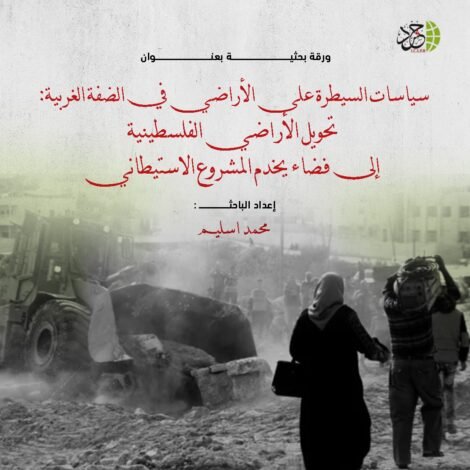
ICSPR Publishes a Research Paper Titled: “Land Control Policies in the West Bank: Transforming Palestinian Land into a Space Serving the Settlement Project”

Date: April 28, 2026
Press Release
ICSPR Publishes a Research Paper Titled: “Land Control Policies in the West Bank: Transforming Palestinian Land into a Space Serving the Settlement Project”
The International Commission to Support Palestinian Rights (ICSPR) has issued a research paper prepared by researcher Mohammad Asleem, titled: “Land Control Policies in the West Bank: Transforming Palestinian Land into a Space Serving the Settlement Project.” The paper examines the accelerating transformations in Israeli policies aimed at tightening control over West Bank land and systematically converting it into a geographic and functional space that serves settlement expansion and gradual annexation.
The paper stresses that land lies at the core of the Palestinian-Israeli conflict, as it constitutes the foundation of Palestinian national identity, historical presence, and the exercise of the right to self-determination. It explains that, since 1967, the occupation authorities have not treated the West Bank as occupied territory subject to temporary administration, but rather as an open field for geographic, demographic, and legal reengineering in service of a long-term settlement project.
The paper further explains that the Oslo Accords and the resulting division of the West Bank into Areas A, B, and C helped entrench a fragmented structure of control, with Area C making up around 60 percent of the West Bank and remaining under full Israeli administrative and security control, making it the central arena for the settlement project and for policies of confiscation, restriction, isolation, and land reallocation. It notes that this reality no longer reflects a conventional military occupation alone, but rather an extended structural system of control that redistributes land, resources, and infrastructure in a deeply unequal manner in favor of settlements at the expense of Palestinian presence.
The paper reviews the main mechanisms used by the occupation authorities to seize Palestinian land, foremost among them the declaration of land as “state land,” confiscation under the pretext of military purposes, the designation of natural reserves, the construction of bypass roads, the expansion of settlements and outposts, and pastoral settlement, which in recent years has become one of the most dangerous tools of creeping land seizure and of forcing Bedouin and rural communities into displacement. It emphasizes that these mechanisms do not operate separately, but rather as part of an integrated system that ultimately shrinks Palestinian space, isolates communities, and entrenches physical facts on the ground that are increasingly difficult to reverse.
The paper also explains that seized lands do not remain frozen, but are systematically repurposed to serve the settlement project through their allocation for settlement expansion, the development of integrated infrastructure networks including roads, water, electricity, and communications, and the linking of settlements to one another and to إسرائيل proper, thereby strengthening their functional integration and consolidating their status as part of an extended Israeli territorial sphere. In parallel, Palestinian communities are pushed into greater fragmentation and isolation through restrictions on construction, movement, and access to land and natural resources, particularly water, agricultural land, and grazing areas.
The paper highlights recent developments in land control policies, noting that the past years have witnessed a qualitative shift from traditional military administration to forms of direct civilian administration with a settlement-oriented character, through the transfer of powers relating to planning, construction, land registration, demolition, and infrastructure to political bodies driving de facto annexation without formal declaration. It adds that this path has been accompanied by accelerated approval of new settlement units and the legalization of existing outposts, as well as the establishment of new ones, as part of what the paper describes as a “comprehensive reengineering” of the land control system.
In this context, the paper notes that recent data reflect an unprecedented acceleration in settlement expansion. A United Nations report documented that Israeli authorities advanced or approved the construction of 36,973 housing units in settlements in East Jerusalem and around 27,200 units in the rest of the West Bank, in addition to the establishment of 84 new settlement outposts during the reporting period, a figure described as unprecedented. Palestinian data also show that the number of settlements and settlement outposts in the West Bank has exceeded 542 entities, housing more than 780,000 settlers, while around 42 percent of the West Bank is now subject to direct or indirect settlement measures.
The paper affirms that these policies have generated severe humanitarian and economic consequences for Palestinian society, including the loss of agricultural land, the decline of farming activity, increased forced displacement of Bedouin and rural communities, erosion of local income sources, rising poverty and unemployment, and the weakening of the social fabric of threatened communities and their ability to remain resilient. It adds that the coercive environment created by settler violence, denial of access to resources, and restrictions on movement and construction is forcing many Palestinians to leave their lands, turning land control into a tool of gradual displacement rather than merely a planning policy.
From a legal perspective, the paper stresses that land control and settlement policies in the West Bank are clearly incompatible with international humanitarian law, including the Fourth Geneva Convention and the Hague Regulations, and may amount to war crimes under the Rome Statute of the International Criminal Court, particularly with regard to the transfer of the occupying power’s population into occupied territory, the extensive seizure of property, and the imposition of permanent changes on occupied land. It also recalls that UN Security Council Resolution 2334 reaffirmed the illegality of settlements and called for their complete cessation, while developments on the ground show continuing disregard for that international consensus.
ICSPR concludes in the paper that what is taking place in the West Bank goes far beyond the confiscation of land or the expansion of settlements, and instead reflects a comprehensive political project aimed at reshaping Palestinian geography in a way that increasingly undermines the possibility of an independent, territorially contiguous, and viable Palestinian state. It emphasizes that bypass roads, military zones, natural reserves, pastoral outposts, and settlement infrastructure all function as tools within an integrated colonial engineering process designed to impose a creeping annexation reality that will become increasingly difficult to dismantle.
In the conclusion of the paper, ICSPR calls on the international community to move beyond verbal condemnation and adopt practical and binding measures to halt settlement activities, including freezing settlement expansion, preventing the establishment of new outposts, and imposing legal and economic measures on activities linked to settlements, including banning settlement products and prohibiting investment in them. It also calls for support to international accountability efforts, the strengthening of international protection mechanisms for Palestinian land, and urgent developmental and economic support for Palestinian communities, particularly in Area C, in order to reinforce their resilience and enable them to remain on their land in the face of policies of exclusion and displacement.