
ICSPR Discusses with the Regional Director of the Central Elections Commission in Gaza the Integrity Safeguards and Challenges of the Deir al-Balah Municipal Elections

Date: April 24, 2025
Press Release
ICSPR Discusses with the Regional Director of the Central Elections Commission in Gaza the Integrity Safeguards and Challenges of the Deir al-Balah Municipal Elections
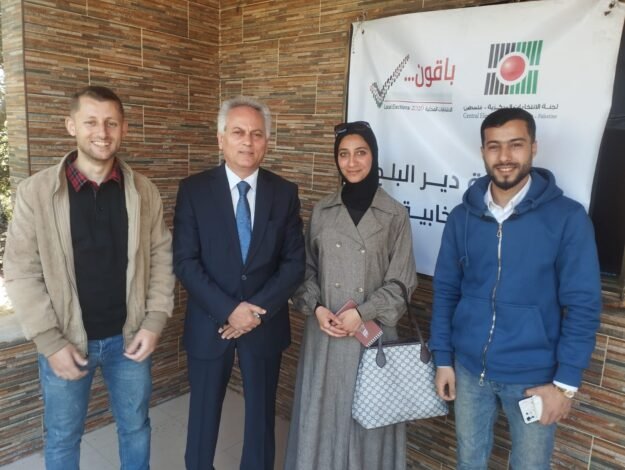
In a highly complex political and humanitarian scene, and at a moment considered among the most sensitive in contemporary Palestinian political history, a delegation from the International Commission to Support Palestinian People’s Rights (ICSPR) held an extensive meeting with the Regional Director of the Central Elections Commission in Deir al-Balah, Dr. Jamil Al-Khalidi, to discuss the ongoing preparations for the electoral process, the guarantees of integrity and transparency, as well as the legal, political, and logistical challenges surrounding this exceptional electoral process.
This meeting comes two days before the start of the voting process, amid unprecedented conditions in the Gaza Strip, where the repercussions of the Israeli aggression, the widespread destruction it has caused, and the resulting humanitarian catastrophe intersect with the continuation of political division and the suspension of democratic life since 2006, in addition to the stalled efforts to rebuild the political system and the freezing of reconstruction efforts.
In this context, more than one million male and female voters in the West Bank are heading to the ballot boxes, while Deir al-Balah stands out as the only electoral case in the Gaza Strip among 420 local authorities, in a clear indication of the depth of the dysfunction in the unity of the Palestinian political and geographic system.
Dr. Al-Khalidi explained that Deir al-Balah represents an exceptional electoral model, not only because it is the only area witnessing elections in Gaza, but also because of the political significance it carries beyond the service-related dimension, in an attempt to revive the democratic path in a near-collapsed environment.
Available data indicate that the number of registered voters stands at 70,449, competing through 4 electoral lists comprising 60 male and female candidates for 15 seats in the municipal council, through 12 polling centers containing around 96 to 100 polling stations.
During the meeting, the ICSPR delegation, which included lawyer Lubna Dhib, Coordinator of the Advocacy Department, and lawyer and researcher Adham Al-Majdalawi from the Legal Department, raised a series of fundamental questions touching the core of the democratic process, particularly with regard to the legal bases used in updating the electoral register in Deir al-Balah, and the related issues of inclusiveness and representation in light of the reality of forced displacement.
The delegation also discussed with the Commission the guarantees of security protection, mechanisms for appeals, the independence of the competent judicial bodies, and the need to fully insulate them from the authority organizing the process, in a way that strengthens the integrity of legal procedures and citizens’ confidence in the results. The issue of the legitimacy of the timing of the elections in light of the ongoing repercussions of the war and the humanitarian collapse was also raised.
For his part, Dr. Al-Khalidi confirmed that the measures taken by the Commission came as a response to a coercive reality that imposed exceptional solutions. He explained that due to time constraints, reliance was placed on personal identity data, place of residence, and the civil registry as primary references for identifying voters, alongside the implementation of the “name removal” mechanism immediately after voting and the use of electoral ink to ensure non-repetition.
He pointed out that restricting the elections to Deir al-Balah is due to the massive destruction in the rest of the Gaza Strip, in addition to its relative readiness in terms of geographic and logistical infrastructure, as well as the political objective of linking the Gaza Strip to the electoral process in the West Bank and strengthening the unity of the political system.
He also stressed the urgent need for an elected municipal council in Deir al-Balah in light of the major service-related challenges and the presence of large numbers of displaced persons, which would enhance the ability of local authorities to respond to humanitarian and service needs and rebuild citizens’ trust in institutions.
Exceptional measures to expand participation
As part of broadening political participation, Al-Khalidi explained that the Commission had adopted a set of exceptional measures, including waiving the requirement for a “certificate of good conduct” for candidates, exempting candidates from electoral campaign fees, forming an electoral court composed of five members to consider appeals, and deploying trained monitoring and administrative teams to ensure the proper conduct of the process.
He affirmed the Commission’s openness to the observations of ICSPR and civil society organizations, considering them an essential element in enhancing integrity and correcting performance.
Full readiness and security arrangements
Regarding field preparations, Al-Khalidi announced complete readiness for the start of voting on Saturday, with 12 polling centers containing around 100 polling stations set to open to receive nearly 70,000 male and female voters, amid ongoing coordination with various partners to ensure the success of this electoral process.
On the security level, he explained that the civil police would secure the process from outside the polling centers and at an appropriate distance, in order to guarantee a safe and neutral environment enabling citizens to exercise their voting rights freely and without any pressure.
ICSPR’s position
For its part, ICSPR expressed its appreciation for the efforts being made, considering these elections an important step toward reactivating the democratic path despite the challenges and reservations related to the timing and the broader context.
The delegation stressed the necessity of making this experience successful so that it can serve as a model to be generalized in the rest of the municipalities in the Gaza Strip, emphasizing the importance of strengthening community oversight and the role of civil society organizations in ensuring integrity and transparency.
The delegation also affirmed that these elections represent an act of civil steadfastness and an open political test aimed at breaking the democratic stagnation resulting from division, and supporting the rebuilding of the institutions of the political system on democratic foundations based on the popular will.
In its reading of the public mood, the delegation pointed out that citizens’ priorities, especially in Deir al-Balah, are focused on basic life issues such as water, electricity, sanitation, reconstruction, and the provision of employment opportunities, in light of the worsening crisis of forced displacement, which reflects a shift toward “electoral realism” linked to securing the minimum requirements for life.
At the conclusion of the meeting, the ICSPR delegation expressed its thanks to Dr. Jamil Al-Khalidi and the Central Elections Commission for their efforts, affirming that making this experience successful constitutes an important gateway to reviving democratic life in local authorities, despite the national, humanitarian, and legal complexities.
This electoral process remains a real test of the ability of the Palestinian political system to recover and to reproduce its legitimacy through the ballot box, even amid the rubble and humanitarian catastrophe in Gaza.