
ICSPR Issues an Analytical Paper Titled “The Law on Executing Palestinian Prisoners When Law Becomes an Instrument of Killing… and the International Justice System Begins to Fracture

Date: April 21, 2026
Press Release
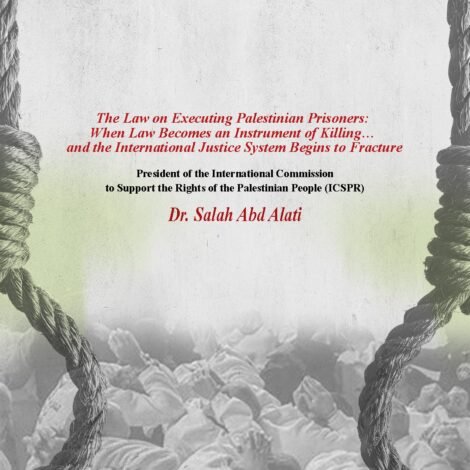
ICSPR Issues an Analytical Paper Titled: “The Law on Executing Palestinian Prisoners: When Law Becomes an Instrument of Killing… and the International Justice System Begins to Fracture”
The International Commission to Support Palestinian People’s Rights (ICSPR) issued an analytical paper prepared by Dr. Salah Abd Alati, President of the International Commission to Support Palestinian People’s Rights, titled: “The Law on Executing Palestinian Prisoners: When Law Becomes an Instrument of Killing… and the International Justice System Begins to Fracture.” The paper examines the legal, political, and humanitarian implications of what is known as the “law on executing Palestinian prisoners,” considering it a dangerous transformation in the structure and function of Israeli legislation, from a tool supposedly meant to regulate the use of force into a legal cover that legitimizes killing and grants it an institutional character.
At the outset, the paper stresses that this law cannot be isolated from the broader context unfolding in the occupied Palestinian territory, especially since October 7, 2023, when Israeli policies entered a more violent and organized phase in targeting the Palestinian person, their body, existence, and fundamental rights, including prisoners and detainees held in prisons and detention centers. The paper argues that the law reflects a qualitative shift in the nature of the conflict, as the matter is no longer confined to managing a system of repression and detention, but now extends to redefining the position of the Palestinian prisoner within the Israeli legal system as a legitimate target for liquidation.
The paper notes that the facts related to the prisoners’ movement up to April 2026 clearly reveal the depth of this transformation, as more than 9,600 Palestinian prisoners are being held in occupation prisons, including 86 female prisoners, around 350 children, and more than 3,532 administrative detainees held without charge or trial. It explains that these figures do not merely reflect the expansion of arrest policies, but also expose an integrated structure of repression that goes beyond conventional detention to the systematic use of tools of subjugation and abuse.
The paper further points out that the Israeli prison system no longer confines itself to depriving prisoners of their liberty, but is also practicing multiple forms of “slow execution” through torture, starvation, medical negligence, and prolonged solitary confinement, amid a dangerous rise in the number of martyrs of the prisoners’ movement. It states that the number of martyrs of the prisoners’ movement since 1967 has reached 326, including 112 prisoners since October 2023 alone, while the occupation authorities continue to withhold the bodies of 97 prisoners, in flagrant violation of the rules of international humanitarian law and the basic standards of human dignity.
The paper explains that the danger of this law lies not only in introducing a new punishment, but also in its structural nature, which reshapes the function of the judiciary, especially the military judiciary, turning it into a direct instrument for producing death rather than a body that guarantees justice. It emphasizes that the judicial environment in which this law may be applied lacks the minimum requirements of a fair trial, in light of confessions extracted under torture, the absence of real judicial independence, and conviction rates that approach totality.
In the legal framework, the paper underlines that the law constitutes a grave violation of international law, due to its direct contradiction with the right to life as a non-derogable right, and its clear breach of the Geneva Conventions, particularly Common Article 3, which prohibits the passing of sentences and the carrying out of penalties without a fair trial in which essential judicial guarantees are ensured. It affirms that any implementation of the death penalty in this context can only be regarded as an arbitrary execution amounting to a war crime, and even a crime against humanity if carried out within the framework of a systematic and continuous policy.
The paper also addresses the discriminatory nature of the law, explaining that it targets Palestinians and no one else, which makes it part of a broader legal and political system based on institutional discrimination and violence rooted in national identity. It considers that this discriminatory dimension places the law within the context of an apartheid system that uses legislation to entrench exclusion and provide legal legitimacy for collective punishment and legal liquidation.
On the political level, the paper explains that the law reflects profound transformations in the structure of the occupying state’s strategic thinking, shifting from a logic of “control” to one of “existential deterrence,” whereby the Palestinian prisoner is intended to be transformed from a person deprived of liberty into a deterrent instrument directed at Palestinian society as a whole. It also notes that this law serves internal agendas among far-right currents seeking to exploit it to reinforce their retaliatory discourse and mobilize popular support through competition in policies of killing and abuse.
The paper adds that this law contributes to undermining any prospect for a political solution, because it effectively eliminates one of the most important negotiation files, namely the prisoners’ file, and pushes toward deepening the conflict rather than resolving it. It argues that the enactment of the law does not pose a danger to Palestinians alone, but constitutes a real test of the international legal system’s ability to impose limits on power and prevent law from sliding into becoming merely a tool in the hands of the stronger party.
ICSPR considers that the significance of this law goes beyond its direct effects, as it reflects four major transformations: first, the legalization of genocide, whether in its slow or direct form; second, the dismantling of the legal protection system for prisoners; third, the re-engineering of the relationship with the Palestinian people on the basis of total subjugation; and fourth, the undermining of the foundations of the international legal order itself. It explains that the implementation of this law would open the door to mass executions, escalating Israeli crimes, intensified popular resistance, the collapse of trust in any political process, and the entrenchment of a culture of impunity.
In this context, the paper calls for building a comprehensive national strategy based on the internationalization of the conflict as a strategic rather than a tactical option, and for this strategy to proceed from the centrality of rights away from political bargaining, while activating all avenues of international accountability, beginning with the International Criminal Court, passing through the International Court of Justice, and extending to the activation of the principle of universal jurisdiction in states whose laws permit it.
The paper also stresses the need for intensive action within the United Nations system, whether through the Security Council, despite the political constraints imposed on it, or through the United Nations General Assembly by using the “Uniting for Peace” mechanism, in order to overcome the state of international paralysis. It further emphasizes the importance of working toward the establishment of special international judicial mechanisms to hold perpetrators of war crimes accountable, strengthening the role of the High Contracting Parties to the Geneva Conventions in fulfilling their legal obligations to prosecute perpetrators of grave breaches, and convening a conference of the High Contracting Parties to consider the crimes of the Israeli occupation and adopt the necessary measures to stop them and provide protection to Palestinian civilians.
At the internal Palestinian level, the paper affirms the importance of rebuilding the Palestinian political system and legal framework in a manner consistent with the requirements of international justice, including the adoption of the principle of universal jurisdiction, the incorporation of international crimes into domestic legislation, and freeing Palestinian jurisdiction from the constraints imposed by the Oslo Accords, on the basis that the legal battle cannot be fought with restricted and incapacitated tools.
In parallel, ICSPR calls for strengthening international alliances with states and human rights organizations, activating the role of civil society and the Palestinian diaspora, and escalating global popular pressure through boycott and advocacy campaigns, emphasizing that international experience has proven that law alone is not enough unless it is backed by political will and sustained popular pressure.
In conclusion, the International Commission to Support Palestinian People’s Rights (ICSPR) affirms that the battle against the “law on executing prisoners” is not merely a battle to defend the rights of a category of prisoners, but a broader battle connected to the future of international law itself and the ability of the international community to halt this dangerous decline. It also stresses that international silence regarding this law cannot be considered a neutral position, but rather constitutes, in essence, a form of complicity, and that freedom for prisoners is not a political slogan but a legal and humanitarian entitlement, and that rejecting this law is a defense of justice itself before it becomes a new victim.