

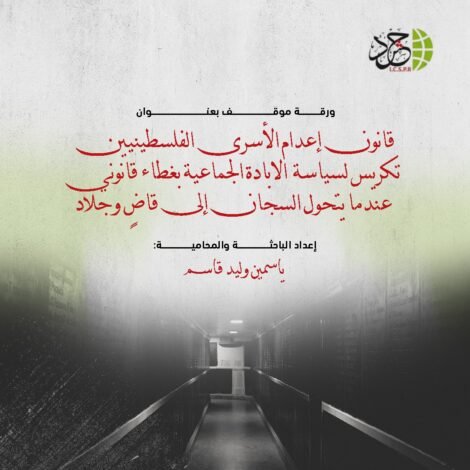
ICSPR Issues a Position Paper Titled “The Law on Executing Palestinian Prisoners Institutionalizing a Policy of Genocide Under Legal Cover”

Date: April 18, 2026
Press Release
ICSPR Issues a Position Paper Titled: “The Law on Executing Palestinian Prisoners: Institutionalizing a Policy of Genocide Under Legal Cover”
The International Commission to Support Palestinian Rights (ICSPR) has issued a position paper prepared by researcher Yasmin Walid Qassem, titled: “The Law on Executing Palestinian Prisoners: Institutionalizing a Policy of Genocide Under Legal Cover – When the Jailer Becomes Judge and Executioner.” The paper examines the legal and humanitarian dimensions of the proposed Israeli law on executing Palestinian prisoners within the Israeli context.
In its introduction, the paper affirms that Palestinian prisoners continue to be subjected to grave and ongoing violations, including arbitrary detention, systematic torture, and deprivation of basic rights. It notes that these violations have reached their peak during the war on the Gaza Strip since 2023, where harsh and exceptional detention conditions have been imposed, accompanied by physical and psychological abuse and deliberate medical neglect, leading to an unprecedented deterioration in prisoners’ health conditions.
The paper explains that the growing number of prisoners and detainees in Israeli prisons reflects a dangerous escalation in arrest policies, with their number exceeding 9,500, including women, children, administrative detainees, and those classified as “unlawful combatants,” amid the use of vague legal policies aimed at undermining the fundamental guarantees of a fair trial.
It further clarifies that the primary objective of the paper is to analyze the Israeli death penalty law as a discriminatory legal tool that contributes to the entrenchment of serious violations of international human rights law and international humanitarian law, while highlighting its direct threats to the right to life and fair trial guarantees.
The paper also reviews the international legal framework related to the death penalty, emphasizing that the global trend is moving toward restricting or abolishing this punishment due to its incompatibility with the right to life and the prohibition of torture and cruel treatment. It stresses that any application of the death penalty must be subject to strict judicial safeguards, which are absent in recent Israeli legislation.
Moreover, the paper sheds light on the concept of arbitrary execution and its connection to the crime of genocide, explaining that Israeli policies represent a systematic pattern of violations targeting a specific group on a national basis, which falls within the scope of serious international crimes.
The paper addresses the international legal framework governing the protection of prisoners, particularly the Geneva Conventions, affirming that the occupying power is legally obligated to ensure humane treatment of prisoners and provide full protection, including the right to healthcare, fair trial guarantees, and the prohibition of torture and inhumane treatment.
In this context, the paper reviews the legislative background of the death penalty in Israel, noting a gradual expansion in its scope, culminating in directly targeting Palestinian prisoners through recent legislative initiatives.
It states that the draft law on executing prisoners has gone through several legislative stages since 2015, until its final approval in March 2026, allowing the implementation of death sentences by judicial majority, without providing real opportunities for appeal or clemency, and within a limited timeframe constituting a blatant violation of international fair trial standards.
The paper emphasizes that the new law entails a range of serious violations, most notably its discriminatory nature in application, targeting Palestinians exclusively, restricting judicial safeguards, and imposing strict limitations on those sentenced, including complete isolation, denial of visits, and execution within a short period.
It also explains that this law clearly contradicts international instruments concerning the safeguards for the protection of persons facing the death penalty, which require strict standards, including the right to appeal and seek pardon, and limiting its application to the most exceptional cases conditions not met by the Israeli legislation.
Regarding legal responsibility, the paper stresses that the Israeli occupation bears full legal responsibility to protect prisoners and detainees as protected persons under international humanitarian law, affirming that any violation of these obligations, including arbitrary execution, constitutes an international crime requiring accountability.
The paper also addresses the positions of the international community and human rights organizations, which have widely rejected the death penalty law as a serious violation of international law, calling for urgent measures to halt its implementation and hold those responsible accountable.
In its conclusion, ICSPR affirms that the adoption of the law on executing Palestinian prisoners represents a dangerous escalation in the system of Israeli violations and reflects a trend toward legitimizing killing under legal cover, calling on the international community to take immediate action to stop this law and ensure the protection of Palestinian prisoners in accordance with international standards.