
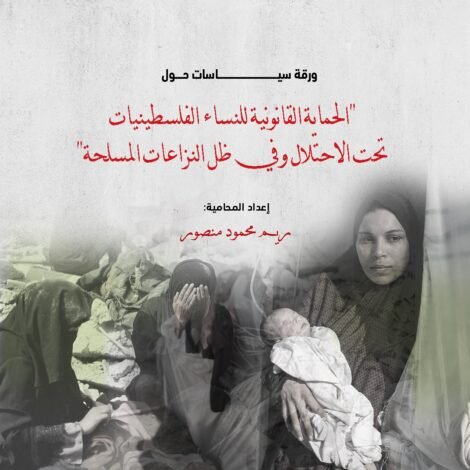
ICSPR Issues Policy Paper Titled “Legal Protection for Palestinian Women under Occupation and in Situations of Armed Conflict”
 wasem aa
Send an email
wasem aa
Send an email
Date: March 8, 2026
Press Release
ICSPR Issues Policy Paper Titled: “Legal Protection for Palestinian Women under Occupation and in Situations of Armed Conflict”
The International Commission to Support Palestinian Rights – ICSPR issued a policy paper titled “Legal Protection for Palestinian Women under Occupation and in Situations of Armed Conflict,” prepared by lawyer Reem Mansour. The paper examines the international legal framework governing the protection of women in situations of armed conflict, with a particular focus on the conditions faced by Palestinian women in the occupied Palestinian territories and the complex violations they endure as a result of the ongoing Israeli occupation and the escalation of military operations.
The paper explains that Palestinian women face a highly complex humanitarian and legal reality, where prolonged occupation intersects with armed conflict and gender-based discrimination, placing them in a dual sphere of vulnerability. This occurs despite the existence of a comprehensive international legal framework that includes the rules of international humanitarian law, international human rights law, and international conventions dedicated to the protection of women. Nevertheless, the gap between normative standards and practical implementation remains wide, particularly in light of persistent impunity and weak international accountability mechanisms.
The paper stresses that violations committed against Palestinian women are complex and overlapping in nature. Within the framework of the Israeli occupation, women are subjected to policies of movement restrictions, forced displacement, home demolitions, and denial of access to essential services, including healthcare and education. These policies undermine family stability and increase the social and economic burdens borne by women, particularly in cases where the family breadwinner has been killed, injured, or detained.
The paper also addresses what it describes as bureaucratic structural violence, such as the denial of medical permits for treatment or forcing women to give birth at checkpoints or in inhumane conditions inside tents and shelters. It argues that such practices do not merely constitute restrictions on movement but represent grave violations of the right to life and may amount to inhuman and degrading treatment.
In the context of armed conflict, the paper notes that women face direct risks including bombardment, indiscriminate targeting, injuries, and the loss of family members, in addition to indirect risks resulting from the destruction of civilian infrastructure, including healthcare facilities and shelters. The targeting of homes and the transformation of residential spaces into unsafe environments deprive women of the private sphere that constitutes a fundamental pillar of social and psychological protection.
The paper further addresses the consequences of large-scale displacement in the Gaza Strip, where hundreds of thousands of women have become displaced persons living in overcrowded tents or shelters that lack privacy, safety, and basic services. Such conditions constitute a clear violation of the rights to dignity and privacy as protected under the Fourth Geneva Convention.
The study also highlights what it describes as silent health-related violence, as thousands of women have been forced to give birth in extremely harsh conditions in tents or hospital corridors due to the collapse of the healthcare system and the targeting of medical facilities. According to the paper, such circumstances may amount to inhuman and degrading treatment under international law.
Data cited in the paper indicate that women and children constituted approximately 70% of the victims of the war in the Gaza Strip. The number of women killed reached 12,316 out of a total of 48,346 fatalities, while women and children represented around 69% of the total 111,759 injured persons. They also accounted for about 70% of the missing persons, whose number reached 14,222.
The war has also resulted in the displacement of nearly two million people from their homes in the Gaza Strip, half of them women. In addition, approximately 13,901 women have become widows and sole providers for families that lost their primary breadwinner, forcing them to shoulder enormous economic and social burdens amid the near-total collapse of the economy and infrastructure.
In the West Bank, the paper documented the killing of 26 women between October 7, 2023 and early 2025 as a result of attacks by Israeli forces and settlers. It also recorded the detention of approximately 53 Palestinian women prisoners in Israeli prisons, including two from the Gaza Strip, who are being held under harsh detention conditions.
The paper also examines the rise of gender-based violence during times of conflict, noting that economic and social pressures, the erosion of the rule of law, and the weakening of institutional protection mechanisms often contribute to increased violence. At the same time, fear of social stigma or cultural constraints may limit women’s ability to report violations or seek remedies.
It further stresses that, as an occupying power, Israel bears legal responsibility for protecting the civilian population and ensuring public order under international humanitarian law. The persistence of such violations therefore reflects a serious failure of effective international accountability.
In its conclusion, the paper emphasizes that the protection of Palestinian women cannot be achieved solely through theoretical legal frameworks. Rather, it requires activating international accountability mechanisms, pursuing perpetrators through both criminal and civil cross-border litigation, and ensuring women’s access to justice and effective remedies, in order to end impunity and strengthen legal protection for women in contexts of occupation and armed conflict.