
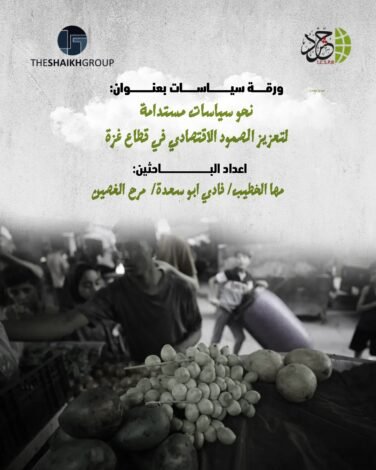
(ICSPR) Issues a Policy Paper Titled “Towards Sustainable Economic Policies to Enhance Economic Resilience in the Gaza Strip”

Date: 29 August 2026
Press Release
In partnership with The Shaikh Group (TSG) and as part of the Youth Civil Society Activists Diploma Training Programme
(ICSPR) Issues a Policy Paper Titled: “Towards Sustainable Economic Policies to Enhance Economic Resilience in the Gaza Strip”
The International Commission to Support Palestinians’ Rights (ICSPR), in partnership with The Shaikh Group (TSG) and as part of the Youth Civil Society Activists Diploma Training Programme, has issued a new policy paper titled: “Towards Sustainable Economic Policies to Enhance Economic Resilience in the Gaza Strip.” The paper examines the reality of Gaza’s economy under the prolonged blockade and the war of genocide, and explores the policies required to move beyond the growing dependence on relief aid and emergency assistance towards building a local economy capable of resilience, recovery, and restoring its productive capacity.
The paper proceeds from the reality that the Gaza Strip has faced a structural economic deterioration accumulated over nearly two decades of blockade, which has been exacerbated to an unprecedented degree by the war and the extensive destruction it has caused to infrastructure, economic facilities, productive sectors, and sources of income. It stresses that, as a result of the war and the restrictions imposed on the Strip, the local economy has shifted from a limited productive economy that was nevertheless capable of generating a minimum level of employment and income, to one increasingly dependent on humanitarian aid and emergency interventions.
The paper explains that the problem is not limited to the scale of material destruction or job losses. It is also linked to the absence of sustainable economic policies capable of addressing the roots of economic vulnerability, protecting livelihoods, and rebuilding local capacities in agriculture, industry, services, and small enterprises. It argues that continuing to confine the response to emergency assistance and temporary employment programmes, without linking them to a long-term economic plan, entrenches dependency and delays genuine recovery.
The policy paper notes that, prior to the war of genocide in October 2023, economic resilience in the Gaza Strip rested on a set of productive, service, and institutional pillars. These included agriculture, services and individual enterprises, industry, fishing, development-support programmes, employment inside the occupied territories, the public sector, and the financial and banking sector. However, the war inflicted extensive damage on these pillars, leading to the breakdown of the economic and social safety net on which Palestinian families had relied for years.
The paper highlights that the agricultural sector represented one of the most important foundations of resilience and food security in Gaza, given its role in providing food, income, and employment opportunities. Before the war, the sector contributed approximately 11% of Gaza’s gross domestic product and covered an important share of the population’s food needs, while agricultural exports accounted for more than half of the Strip’s merchandise exports. However, the war resulted in the destruction of approximately 86% of agricultural land, rising to 94% in North Gaza Governorate, in addition to the destruction of crops, greenhouses, wells, and farms, as well as a sharp decline in cultivated vegetable areas and agricultural production.
The paper stresses that the destruction of agriculture affects not only farmers, but also threatens food security for the wider population and increases dependence on imports and humanitarian assistance. The suspension of local production has also contributed to rising food prices, disrupted food-processing industries linked to agriculture, and caused the loss of tens of thousands of direct and indirect jobs, particularly in areas that previously accounted for the largest share of agricultural land and local production.
Regarding the services sector and individual enterprises, the paper shows that this sector was the backbone of Gaza’s economy in terms of output and employment. Before the war, it contributed approximately 54.9% of gross domestic product and absorbed 51.6% of the labour force. The sector suffered a major collapse as a result of the destruction of commercial areas, infrastructure, shops, and workshops, leading to a sharp decline in activity and the loss of income sources for large numbers of workers.
The paper also sheds light on the collapse of the industrial sector, which included food processing, textiles, plastics, handicrafts, and other productive activities. It notes that a large proportion of industrial facilities were destroyed or put out of service, depriving the local economy of a productive base essential for providing goods and employment opportunities, and weakening the sector’s ability to recover in the post-war period.
The paper further explains that the fishing sector had traditionally constituted a source of food and income for tens of thousands of people living in coastal areas. However, the war, the maritime blockade, and the destruction of boats, ports, storage facilities, and repair infrastructure caused fishing activity to fall to extremely low levels. It stresses that the loss of the fishing sector compounds the food-security crisis and increases the vulnerability of households that depended on it as a direct source of both income and food.
The paper notes that support programmes and development projects had helped, before the war, to provide temporary employment opportunities and support small businesses and women-led initiatives, particularly in food processing and livelihood-related fields. However, it stresses that such programmes, despite their importance during the response phase, cannot replace the restoration of essential productive sectors or serve as a permanent alternative to an integrated national economic policy.
The paper also points out that the revocation of work permits for Gaza workers inside the occupied territories deprived thousands of households of one of their relatively more stable sources of cash income before the war. It stresses that the loss of these jobs deepened the income gap and increased the burdens that economic recovery programmes must address, particularly because these households lost income that had constituted a primary source of livelihood.
With regard to the public sector, the paper stresses that the declining ability to pay salaries regularly or in full, amid the financial crisis faced by the Palestinian Authority, the withholding of clearance revenues, and Israeli deductions, threatens one of the last remaining income sources for a large number of families in the Gaza Strip. It argues that the continuing public-sector financial crisis directly affects purchasing power, local markets, and households’ capacity to withstand the collapse of other sources of income.
The paper calls for a shift from a short-term crisis-management approach to an economic and rights-based approach focused on building sustainable economic resilience. This includes rehabilitating productive sectors, supporting small and medium-sized enterprises, strengthening local production, securing supply chains, protecting livelihoods, and linking humanitarian assistance to genuine and sustainable economic recovery programmes.
It stresses the need to give the agricultural sector central priority within recovery and reconstruction programmes by rehabilitating agricultural land, repairing wells and irrigation networks, supporting farmers with agricultural inputs, seeds, and equipment, rebuilding greenhouses and agricultural facilities, and protecting farmers’ access to their land. The paper also calls for programmes aimed at restoring local production, strengthening food security, and reducing dependence on imports and external aid.
The paper recommends supporting the services sector and individual enterprises as among the sectors most capable of absorbing labour and revitalising local markets. This should include small and concessional grants, financing programmes for micro and small enterprises, and support for craft workshops, commercial shops, self-employed professionals, and women-led initiatives. It also stresses the importance of adopting fair and transparent employment policies that ensure that the most affected groups—including young people, women, displaced persons, and persons with disabilities—can access employment, training, and economic-support opportunities.
The paper calls for the launch of programmes to rehabilitate industrial facilities and support priority local industries, particularly food processing, pharmaceuticals, plastics, textiles, and construction materials. It argues that rebuilding the industrial sector must be linked to policies that facilitate the entry of raw materials and equipment, support local products, provide vocational and technical training for workers, and connect reconstruction efforts with the creation of productive and sustainable employment opportunities.
Within the framework of its procedural recommendations, the paper calls on government bodies, local institutions, the private sector, international organisations, and donor agencies to develop an integrated national strategy for economic resilience and recovery in the Gaza Strip. Such a strategy should include specific objectives, clear budgets, time-bound programmes, coordination and accountability mechanisms, and indicators to measure the impact of interventions on employment, income, production, and food security.
It further recommends establishing or supporting national and community-based financing mechanisms for small and medium-sized enterprises and productive initiatives, with priority given to sectors that rebuild livelihoods and create sustainable jobs, such as agriculture, food processing, recycling, renewable energy, digital services, and women- and youth-led enterprises.
The paper stresses that the responsibility of the international community should not be limited to financing emergency relief. It must also include supporting the reconstruction of the local economy and protecting the rights to work, food, and development. It further calls for linking reconstruction funding to respect for Palestinians’ economic and social rights, and for ensuring the removal of restrictions that obstruct the movement of people, goods, raw materials, and equipment and prevent economic sectors from restoring their capacity to operate and produce.
The paper concludes that building economic resilience in the Gaza Strip is not a temporary humanitarian matter, but rather a national, human-rights, and developmental necessity. Genuine recovery requires restoring people’s ability to produce, work, and meet their needs with dignity, while ending policies that have transformed Gaza’s economy into one dependent on aid. It affirms that any reconstruction process that does not place the restoration of productive sectors, the protection of livelihoods, and the empowerment of families and local enterprises at the centre of planning and implementation will remain incomplete and incapable of establishing a more just and resilient Palestinian economy.